A custom 3D e-commerce platform combining real-time configuration, vehicle compatibility logic, and business automation for the UK’s commercial van equipment market


United Kingdom
Automotive • Industrial equipment
Interactive 3D Configurator
Bundle and pricing logic
CAD-to-web asset pipeline
Compatibility rules engine
Web-based 3D visualization

Petra Palusova
CSO, Digital Tails Group
15 min read
Yoke is a UK manufacturer of trade-specific van equipment, known for specialized, hand-crafted interiors built for electricians, plumbers, and engineering professionals. Their products depend on exact fit and customization, yet their previous digital setup could not manage the complexity of real configurations. Customers struggled to understand options, and the workshop faced constant risk of inaccurate orders.
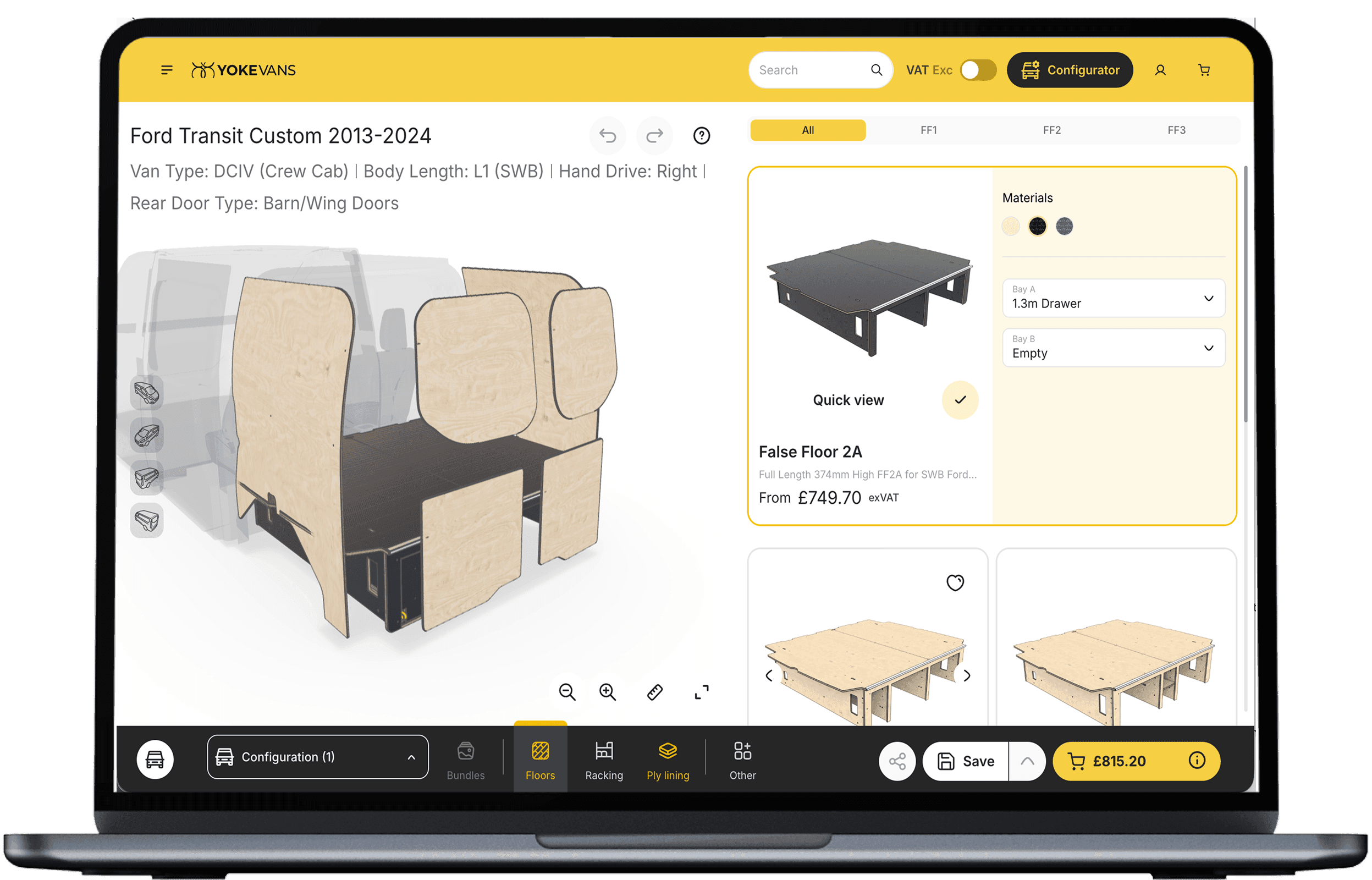
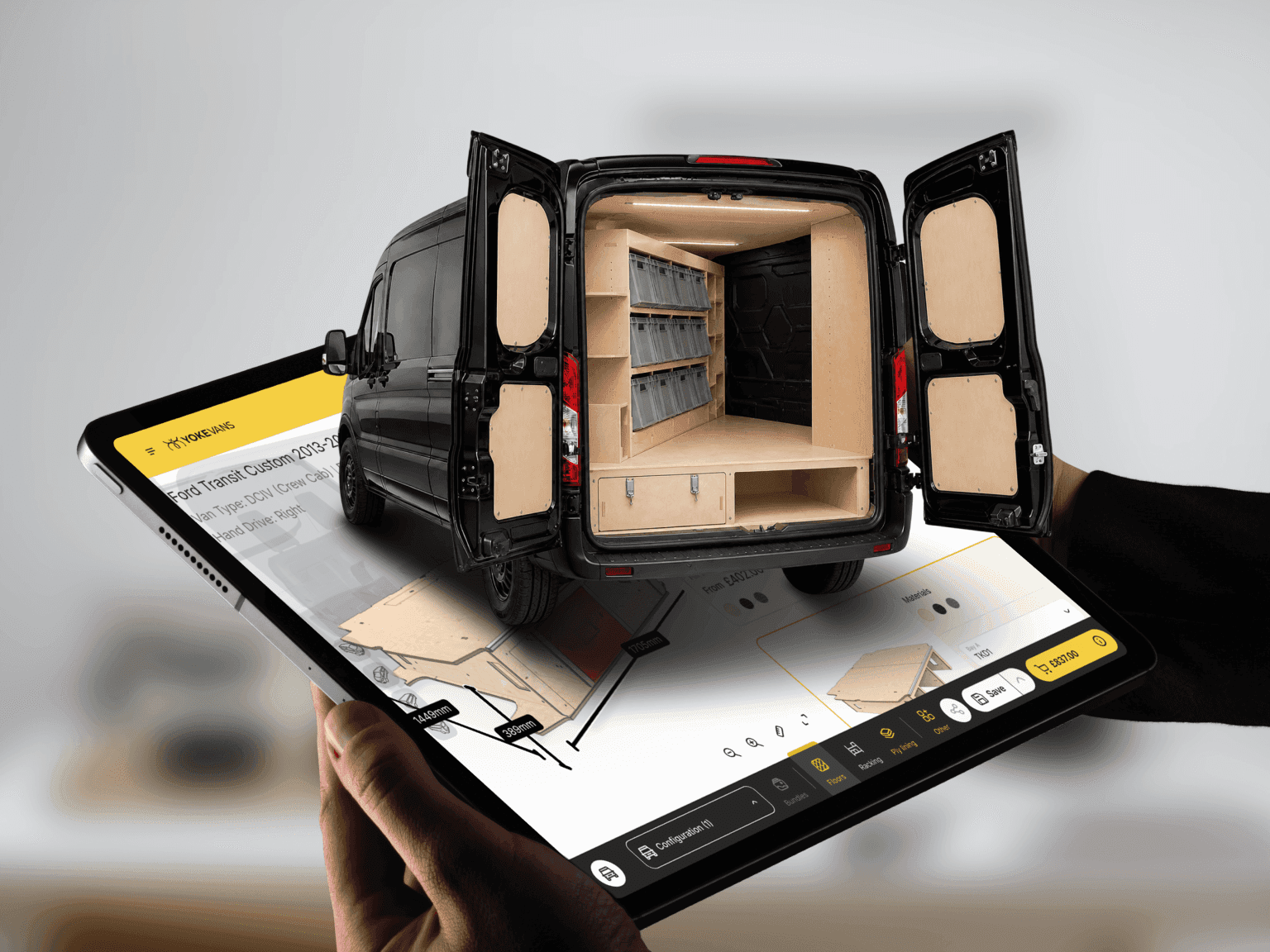
Digital Tails Group was asked to rethink the entire digital layer. The new platform brings together an advanced 3D configurator for 60+ van models, intelligent compatibility rules using our proprietary Smart Logic Engine technology, “My Garage” feature for fleet management, trade-oriented bundles, and dynamic pricing tied to real manufacturing steps. A custom CAD-to-web pipeline allows heavy Fusion360 models to load in the browser for an easy visual and functional experience aligned with Yoke’s workflows.
As a final result, we built a unified 3D e-commerce system that mirrors the workshop’s logic, guides customers toward valid configurations, and supports higher-value purchases with fewer mistakes. With our platform, Yoke will be provided with a scalable foundation for future growth.
Problem and business context
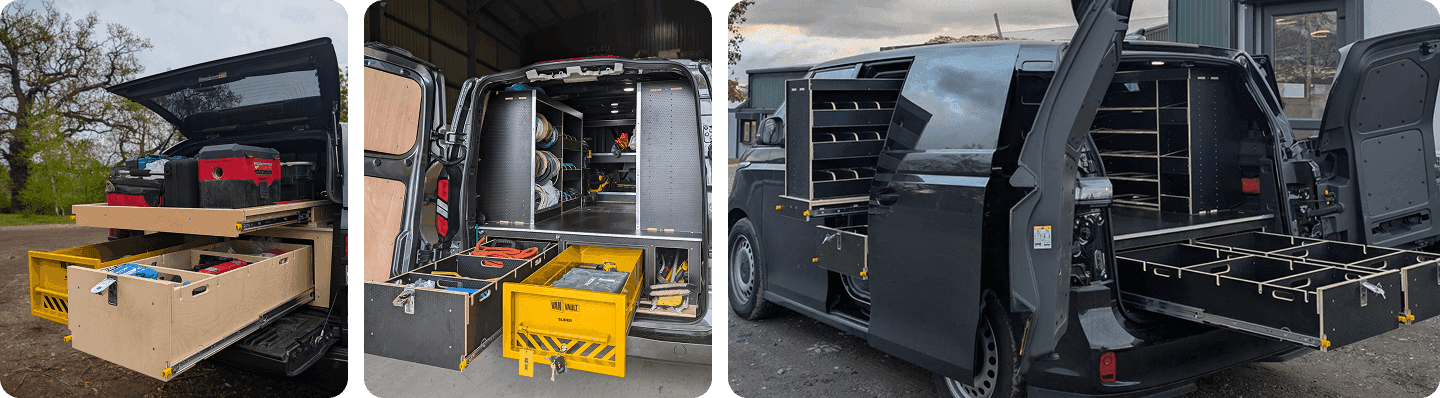
In the professional van equipment market, every layout must match both the vehicle’s interior and the workflow of a specific trade. Unlike generic storage providers, Yoke builds configurations specifically matching the workflows of electricians, plumbers, and engineers. The trade variations are refined and produced in the workshop north of London. It’s a demanding environment: van interiors differ by model and year, trades impose certain functional requirements, and each component must align with real production constraints.
Any mismatch leads to inefficiencies, waste, or a poor end-user experience, which warrants a need to build a rule-driven system with high precision.
The starting point: limitations of the previous digital setup
Previous setup
Before the redesign, Yoke’s online presence operated on a WordPress shop supported by third-party plugins. The “configurator” was essentially a static gallery of 2D product renders stitched together to approximate different setups. Most of the meaningful logic such as vehicle dimensions, product relationships, material variations, and trade-specific needs remained outside the website. It lived in spreadsheets, CAD files, and the team’s internal expertise, which meant the digital layer could never fully represent how the business actually worked.
Pain points
Flat imagery made it difficult for customers to understand how components interacted inside a vehicle, since it must account for space, alignment and loadout. WordPress plugins could not process the complexity behind van platforms, compatibility rules, or the many variations of ply and racking systems. And once Yoke’s catalogue expanded, the limitations became structural:
Trade-specific combinations and bundles could not be expressed reliably
Material choices could not be previewed or priced dynamically
The system could not prevent invalid configurations or guide customers toward correct ones
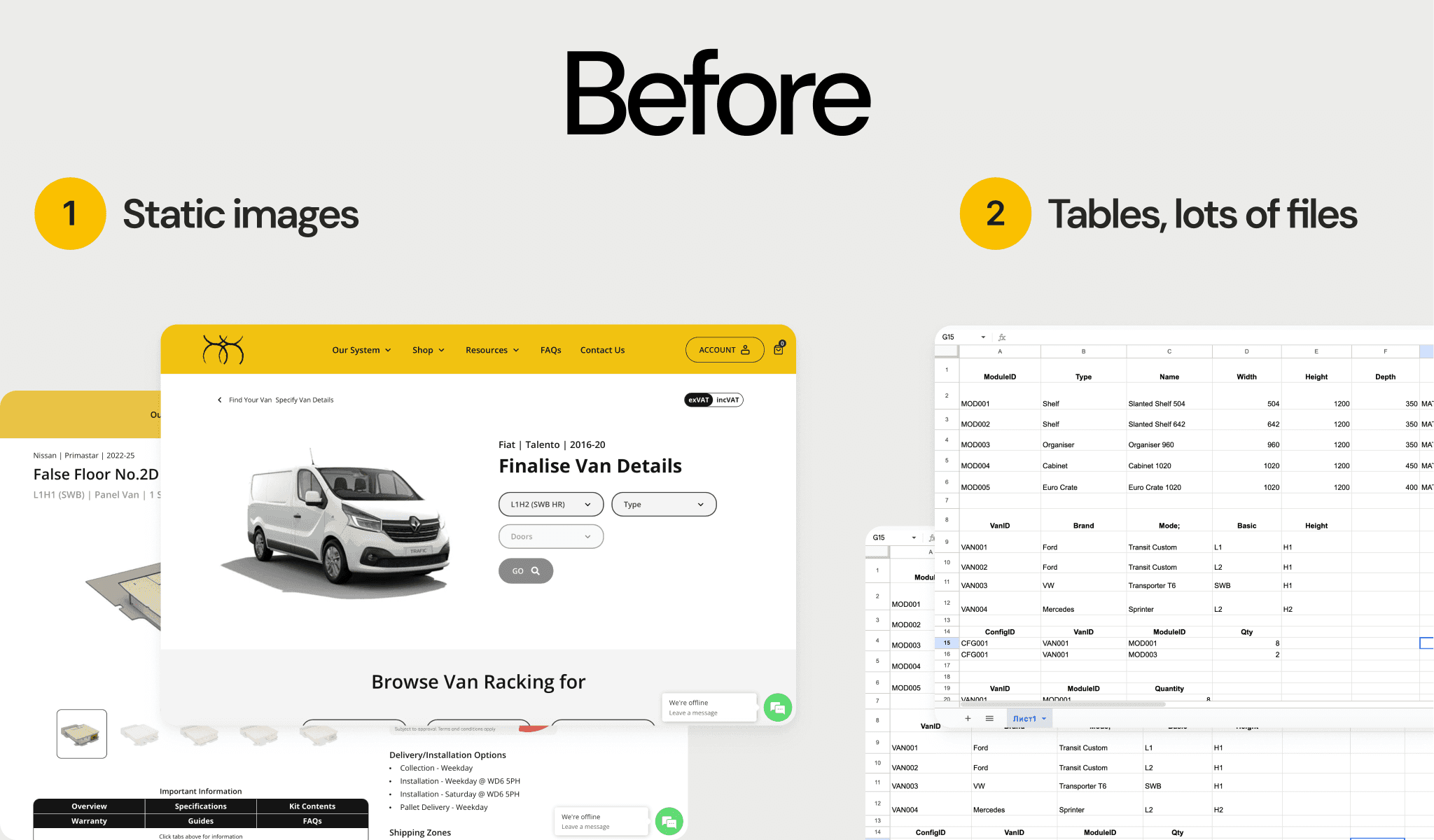
For the internal team, the site functioned more as a catalogue than as a sales or configuration tool. All critical knowledge remained offline, and the digital experience didn’t support the level of precision the workshop actually required.
Defining the objectives for a production-grade digital system
As the scope of Yoke’s product logic became fully visible, the objective shifted from improving the website to building a digital system capable of representing the business end-to-end. During this process, several priorities emerged.
Accurate 3D Visualization
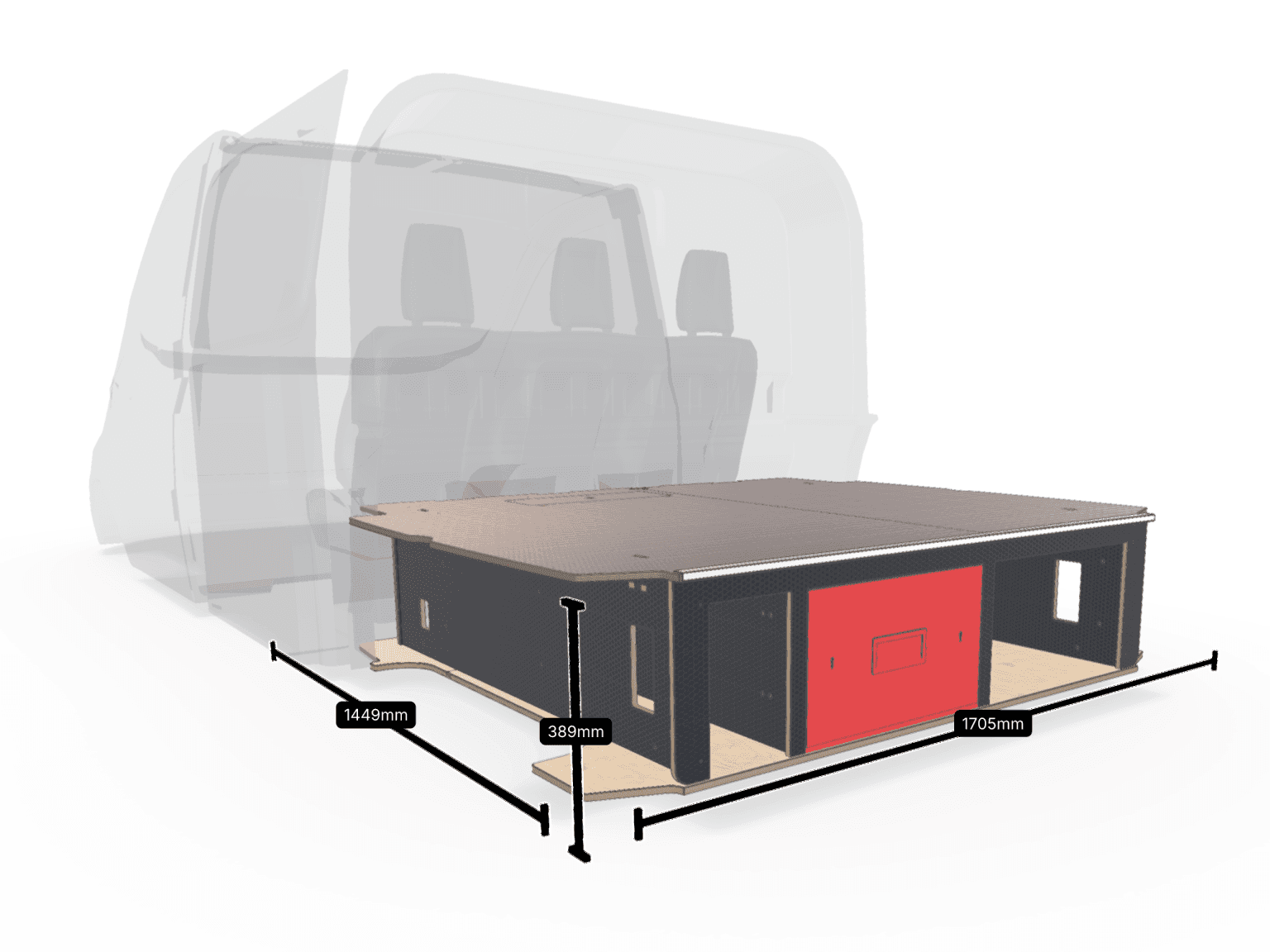
First, customers needed the ability to see their vehicle accurately in 3D, with components placed exactly where they belong. The visual layer had to reflect real geometry and real workshop outcomes, not just approximations.
Rules-Driven Configuration
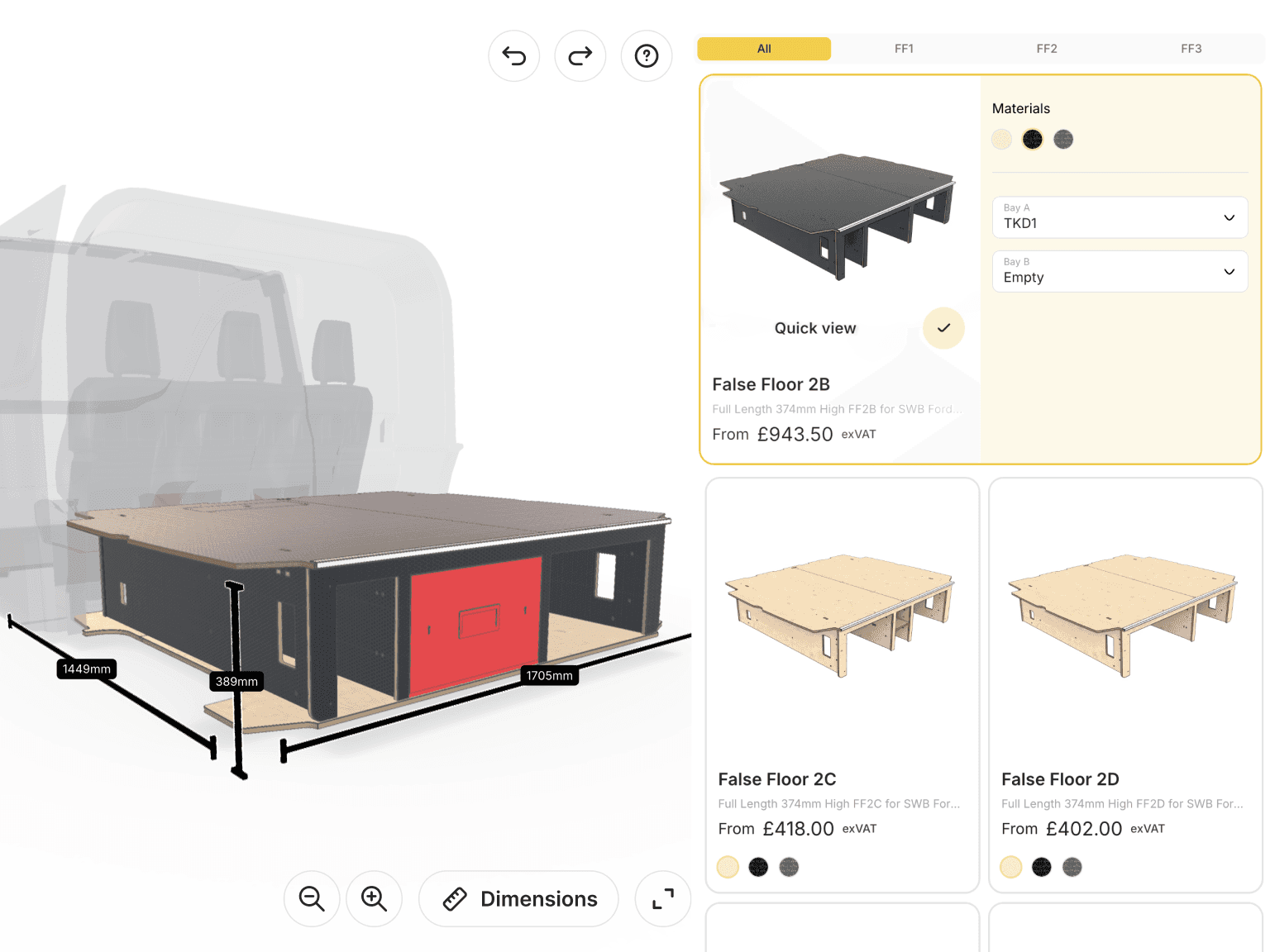
Second, the configuration process had to be driven by rules. Compatibility logic, previously held in spreadsheets and internal knowledge, needed to guide users through valid choices and prevent combinations that could not be manufactured.
Scale, Variation, and Bundles
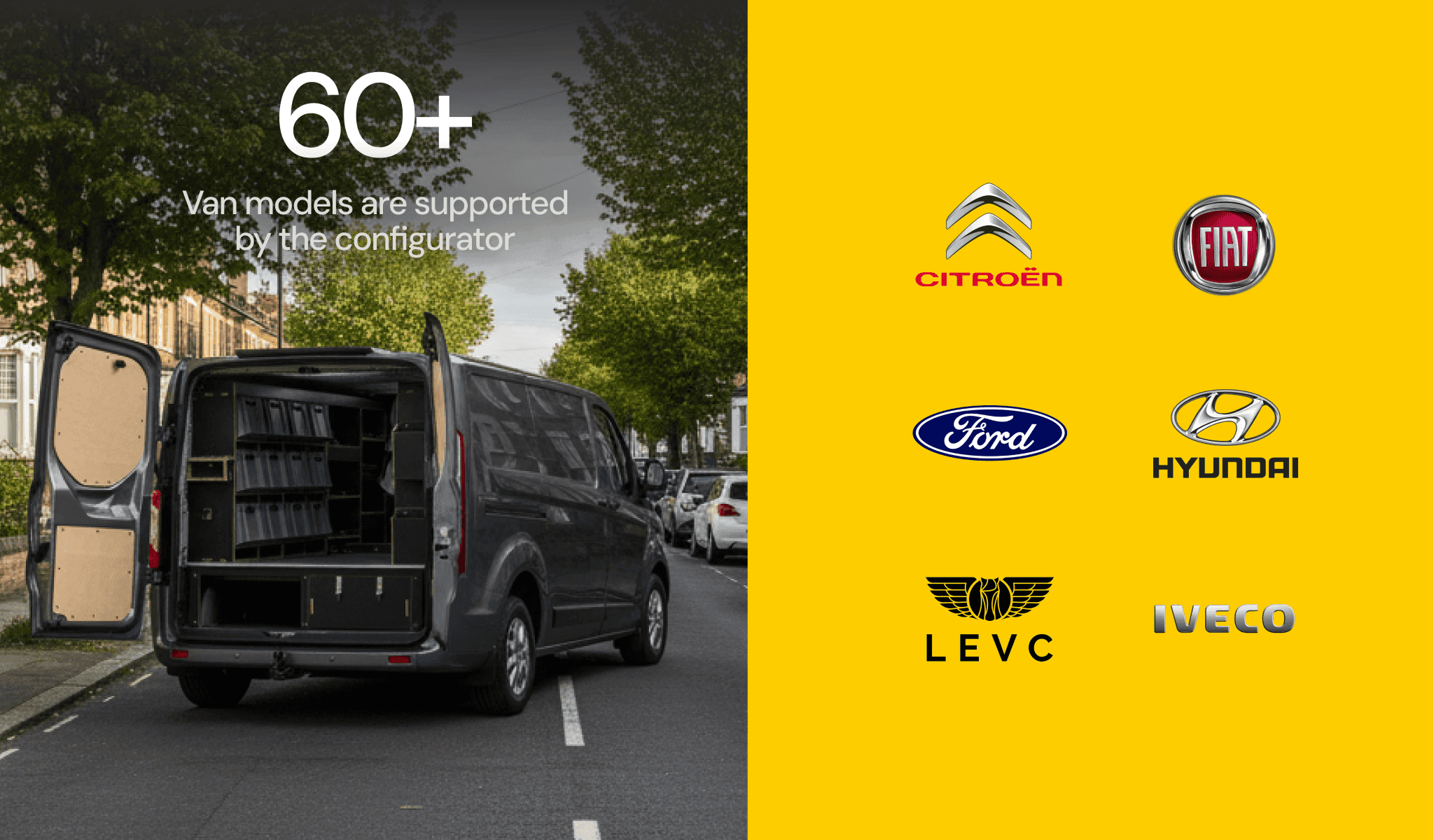
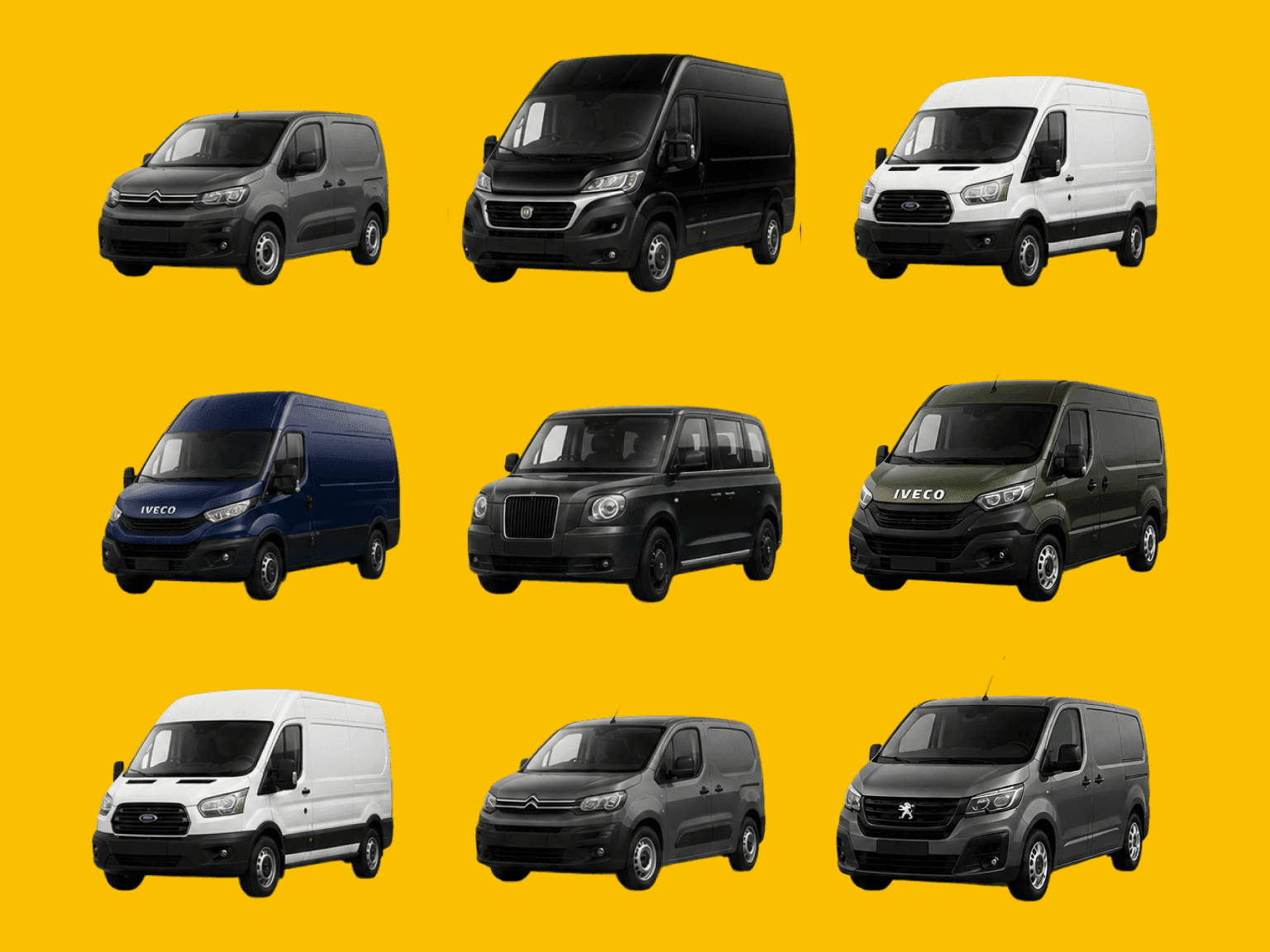
The system also had to accommodate extensive variation. More than 60 van models and their derivatives needed to be supported, with the flexibility to expand as Yoke broadened its range. Bundles played an important role here: they had to mirror the workshop’s actual production patterns while making larger, trade-relevant configurations easier for customers to select.
Beyond the configurator itself, we had to make sure that the platform had space to grow. Our concept enabled dedicated flows for different trades, richer bundle pathways, and a structure that could support fleet management for business clients. Underneath it all, Yoke wanted to move away from a patchwork of plugins toward a single, coherent 3D e-commerce system built around the realities of their business.
Delivery scope
DTG rebuilt Yoke’s digital ecosystem from the ground up, turning an offline configuration process into a structured, rule-driven 3D platform. The work spanned the full chain of technical, visual, and business logic requirements
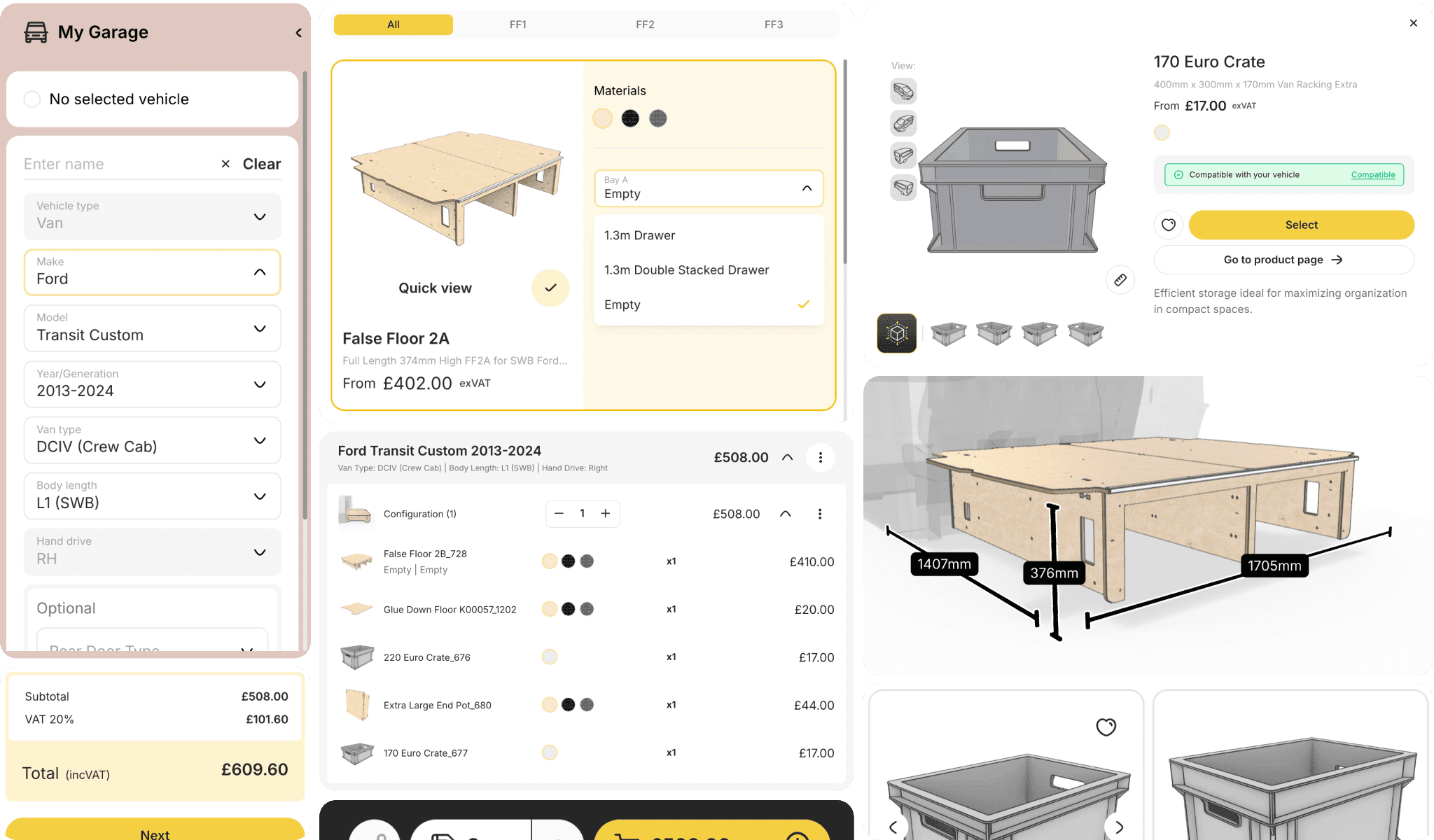
The solution architecture in practice
Implementation journey
Phase 1 – defining the model
The project began with a technical and operational analysis of Yoke’s product architecture and van compatibility landscape. In this phase, we mainly focused on understanding how components relate to specific van models, how the workshop actually produces and assembles each element, and where constraints emerge in real manufacturing conditions.
It became clear that a fixed specification approach was unworkable, given the client’s simultaneous restructuring of its product catalog, manufacturing logic, and sales model. Much of the early work involved translating loosely defined, experience-based operational knowledge into a coherent system model that could support automation without oversimplifying reality.

Phase 2 – joint discovery and catalog restructuring
With a shared model in place, in the second phase we shifted toward restructuring the catalog in close collaboration with Yoke’s team. A foundational van-base system was developed to support shared interior geometries across multiple vehicle brands, creating a stable reference layer for all configurations. Product categories, variants, and naming conventions were reorganised to reflect how solutions are built and sold in practice rather than how they had evolved historically. Bundles were defined around real workshop patterns, and designers translated the new catalog logic into clear UX flows for both the configurator and the shop environment.
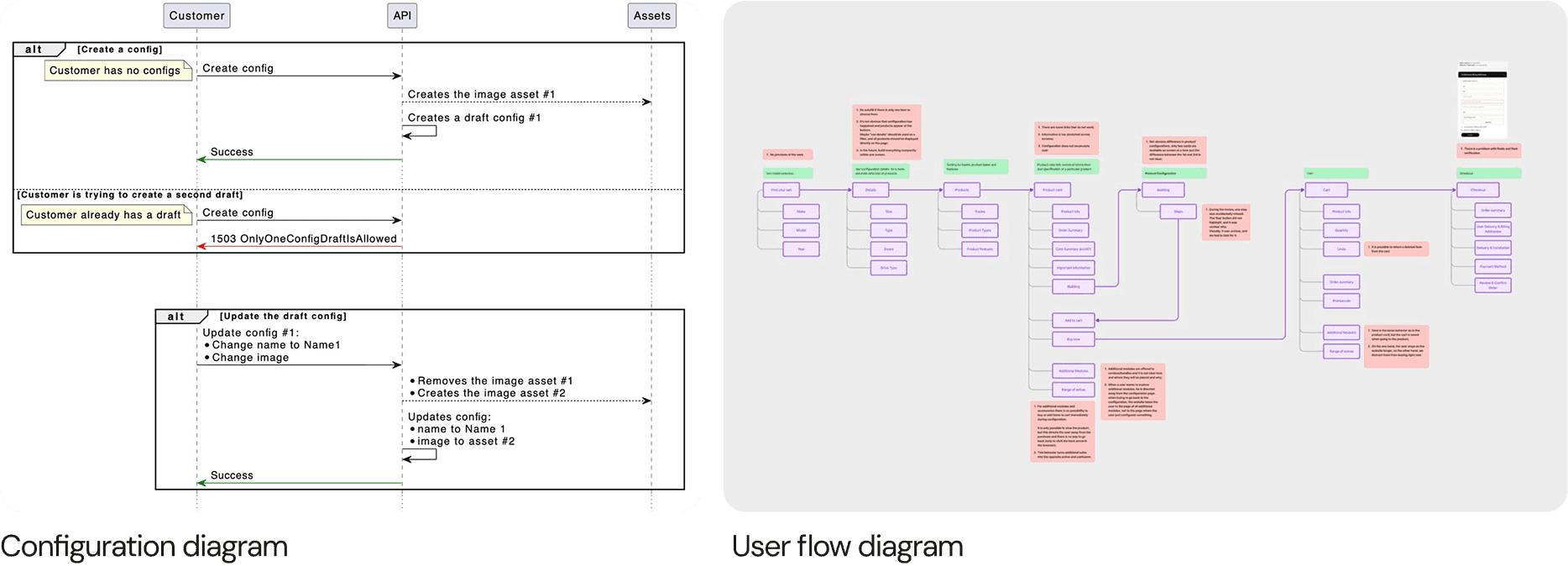
Phase 3 – development and phased rollout
Core development centred on the 3D configurator, the catalog framework, and the underlying rules engine, with features released incrementally to maintain momentum and flexibility. Additional capabilities such as My Garage, trade-specific filters, and predefined trade-solution patterns were layered in over time, alongside scope-increasing feature additions. The project targeted an MVP with approximately 70–80 percent of planned functionality by mid to late October, followed by a structured three-month post-launch cycle dedicated to completing remaining features, optimising performance, and refining the overall user experience.
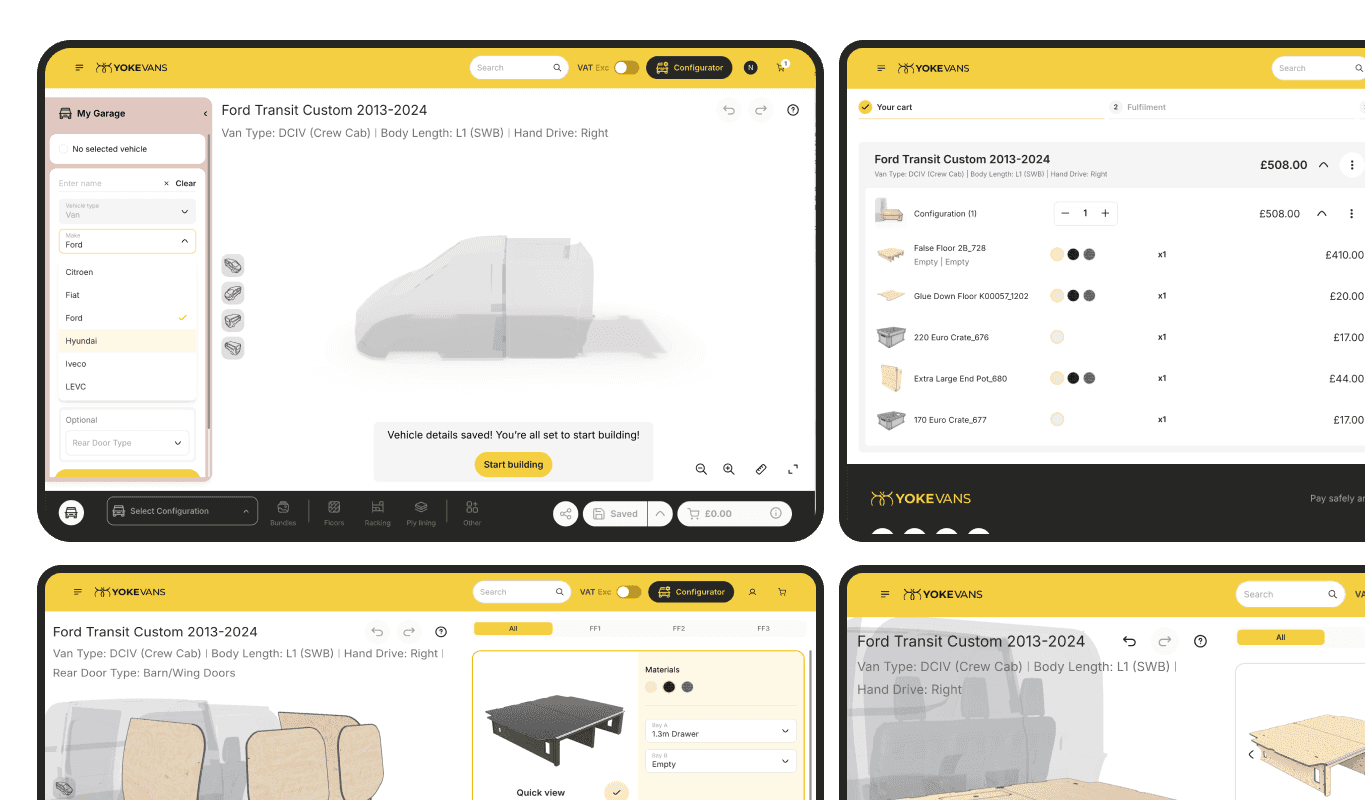
Projected business impact and long-term value
While the platform launches with a robust technical and structural foundation, its full business impact will emerge progressively as customers adopt the new configuration experience and internal workflows settle around it. Over the first year, Yoke is expected to benefit from clearer customer understanding of product options, as interactive 3D replaces the 2D representations and allows buyers to better assess space, fit, and component choices. By restricting configurations to valid combinations and anchoring all variants to a consistent van-base model, the system is also designed to reduce mis-orders and production errors, an effect that should become visible as order volumes grow.
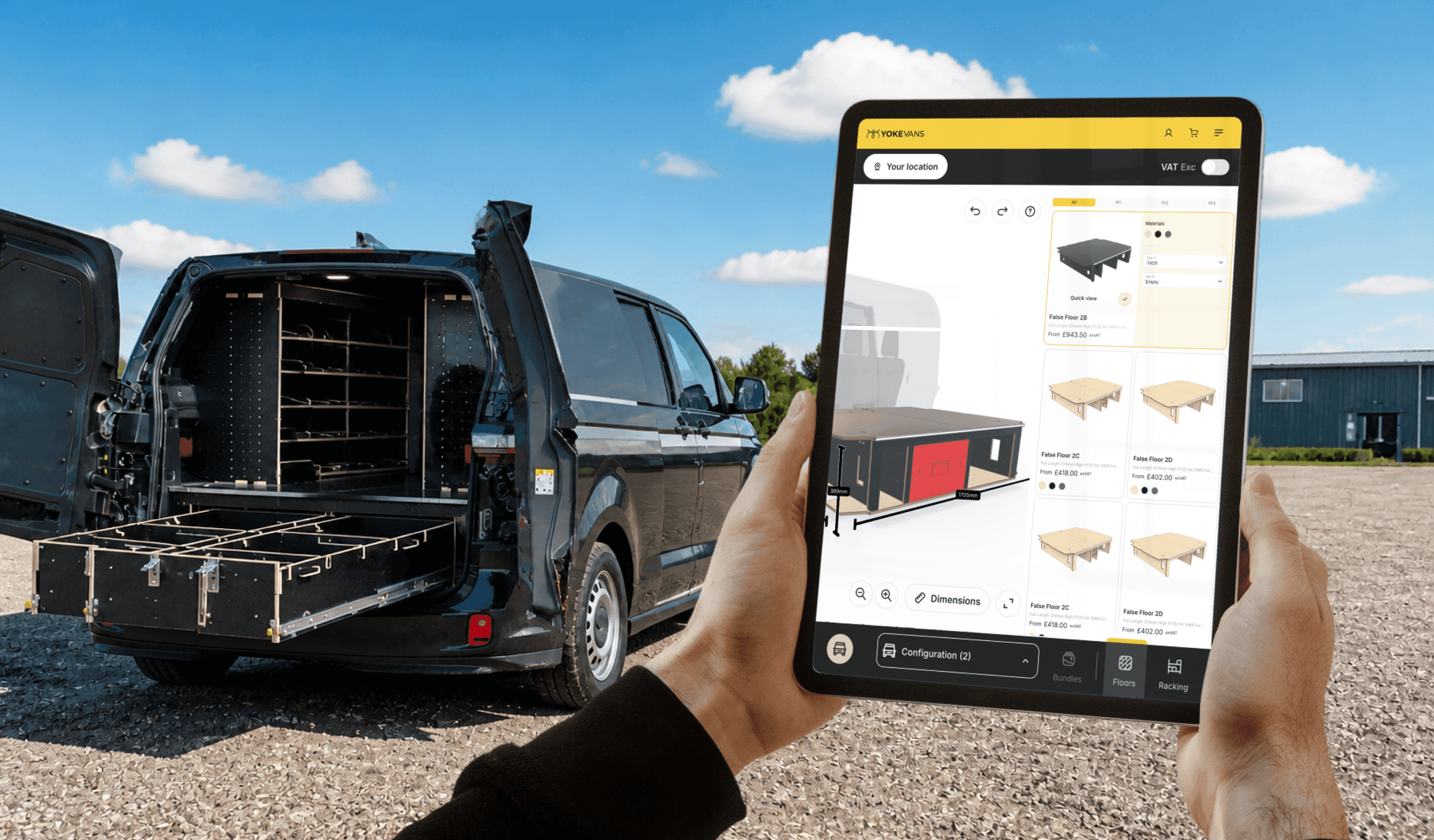
Commercially, the introduction of bundle-led configuration is expected to support higher average order values by encouraging complete and workshop-aligned solutions. At the same time, the closer alignment between the digital layer and workshop reality should reduce operational friction, improve predictability in materials and workload planning, and strengthen the feedback loop between sales and production. Beyond immediate gains, the platform establishes a scalable strategic foundation for future offerings, including trade-specific configuration paths, fleet-oriented solutions, and deeper professional workflows as Yoke expands its product range.
Looking ahead, the system’s modular architecture positions Yoke for future internal integrations and capabilities that extend the platform beyond a sales interface into a core operational asset. Taken together, the project marks a shift toward a resilient, data-driven configuration model to support current and any future growth of Yoke’s business.
Contact us
We are here to help
Interested in using this technology in your campers business?