The Smart Logic Engine by Digital Tails Group: The Technical Architecture of High-Performance Configuration
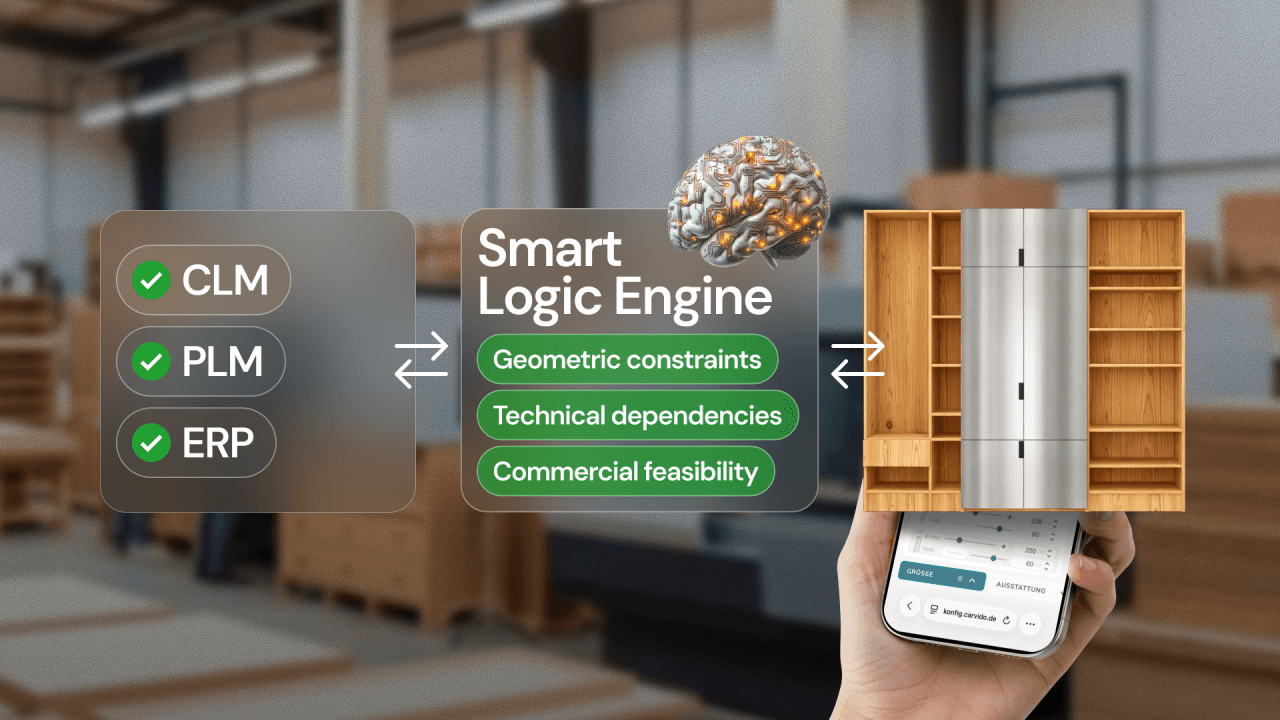
Industrial sales operate in a high-stakes environment, and the 3D configurator has become a part of this digital experience. A truly effective 3D interface requires visual fluidity and a deep, mechanical intelligence that understands the physical reality of the product. It’s the validation paradox: maintaining a light and fast user experience while enforcing thousands of engineering constraints. We solve this challenge by anchoring the 3D interfaces to the Smart Logic Engine – a proprietary architecture that acts as the "coded brain" behind the curtain. The Smart Logic Engine is the high-performance validation layer that powers our 3D configurator, treats every action as a dynamic data point and instantly reconciles it against complex engineering DNA.
In this article, we present the mechanical soul of the modern digital sales experience. We explain how a backend service hosts the intensive logic to achieve a sleek, user-friendly interface backed by absolute technical authority. Our solution facilitates the transition from high-fidelity 3D exploration to 100% buildable, commercially viable, and production-ready orders; let’s look at how the computational logic works.
For whom is the Smart Logic Engine engineered?
We developed the Smart Logic Engine specifically for manufacturers of high-variance, technically complex products. The majority of our clients are enterprises where the standard sales process is currently bottlenecked by manual engineering reviews. Our technology acts as a bridge for organizations that have moved their catalog to the web but still struggle with the validation gap.
Technical sales force: For teams selling industrial products and machinery, modular construction and design, or bespoke systems, the Smart Logic Engine acts as a "digital engineer" sitting on the salesperson's shoulder. It empowers non-technical staff to configure complex systems in a web browser with the absolute certainty that the resulting output is physically buildable.
Engineering and production: The next group benefits from the "gatekeeper" effect. When the configuration logic is rooted in the Smart Logic Engine, engineering teams no longer carry the burden of vetting "impossible" web orders. The engine filters out noise and ensures that only 100% validated data packets reach the PLM environment for final execution.
The global distributor network: For manufacturers with diverse dealer networks, the Smart Logic Engine provides a centralized “source of truth”. It guarantees that, for example, a dealer in Munich and a distributor in Chicago are bound by the same engineering constraints and regional SKU availability, that is managed through a unified web-based interface.
The B2B customer: In procurement environments, professional buyers expect speed, accuracy, and technical certainty. The Smart Logic Engine enables them to configure solutions within clearly defined engineering and commercial constraints, aligned with regional availability, pricing logic, and compliance requirements. Instead of long back-and-forth cycles with sales and engineering, the buyer receives immediate validation and reliable specifications.
The real-time sync: 3D visualization, CPQ, and logic enforcement
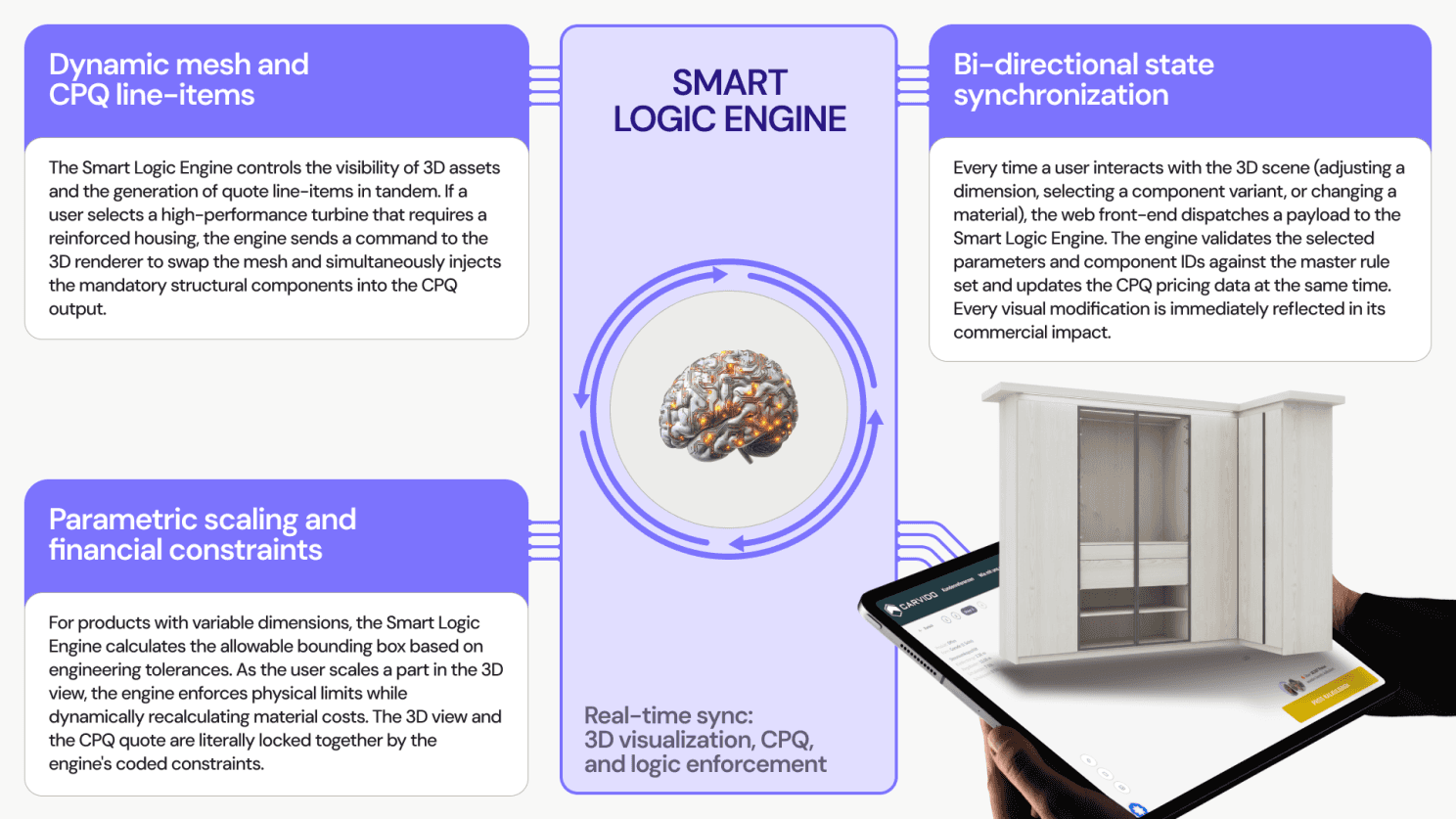
In our ecosystem, the Smart Logic Engine acts as the authoritative source of truth, simultaneously governing both the 3D Configurator and the CPQ logic. We treat the 3D model as the visual manifestation of the engine’s current computational state rather than as a static image. The integration operates through a high-frequency, bi-directional communication loop.
Managing high-variance configuration combinatorics
The primary technical challenge the Smart Logic Engine addresses is the combinatorics problem. When the product ecosystem is too complex, adding a single variable increases the number of potential conflicts across the 3D model and the CPQ pricing structure. Each option interacts with multiple rules, dependencies, and constraints, creating a network that must remain consistent for both design and production.
While a standard web-form would struggle to process the dependencies, our Smart Logic Engine utilizes a Constraint-Based Solving (CBS) architecture to establish a robust CLM framework. Instead of a linear list of "if-then" rules, the engine treats the configuration as a multi-dimensional web of requirements:
Non-linear dependency mapping
The Smart Logic Engine understands that a change in part A might affect part G, which in turn requires a change in the 3D placement of part M. The engine doesn't check these one-by-one; it evaluates the entire state graph simultaneously.
Conflict-free pathfinding
As the 3D configurator encourages free-form exploration, users frequently navigate into invalid states, prompting the Smart Logic Engine to maintain constant state-awareness. By pre-calculating the valid neighbor states of a configuration, the engine avoids a system crash when a user attempts a physically or commercially impossible move; instead, it preserves the last valid state and calculates the precise "delta" required to reconcile the new selection with engineering reality.
The 3D anchor logic
Within the 3D environment, the Smart Logic Engine assigns logic anchors to every mesh and converts simple coordinates into smart points that carry metadata regarding attachment rules, angles, and costs. When a user attempts to snap a component to an anchor that violates engineering criteria, the engine’s CPQ layer instantly suppresses that part from the available catalog to maintain configuration integrity.
The validation hierarchy: the three-layer logic architecture
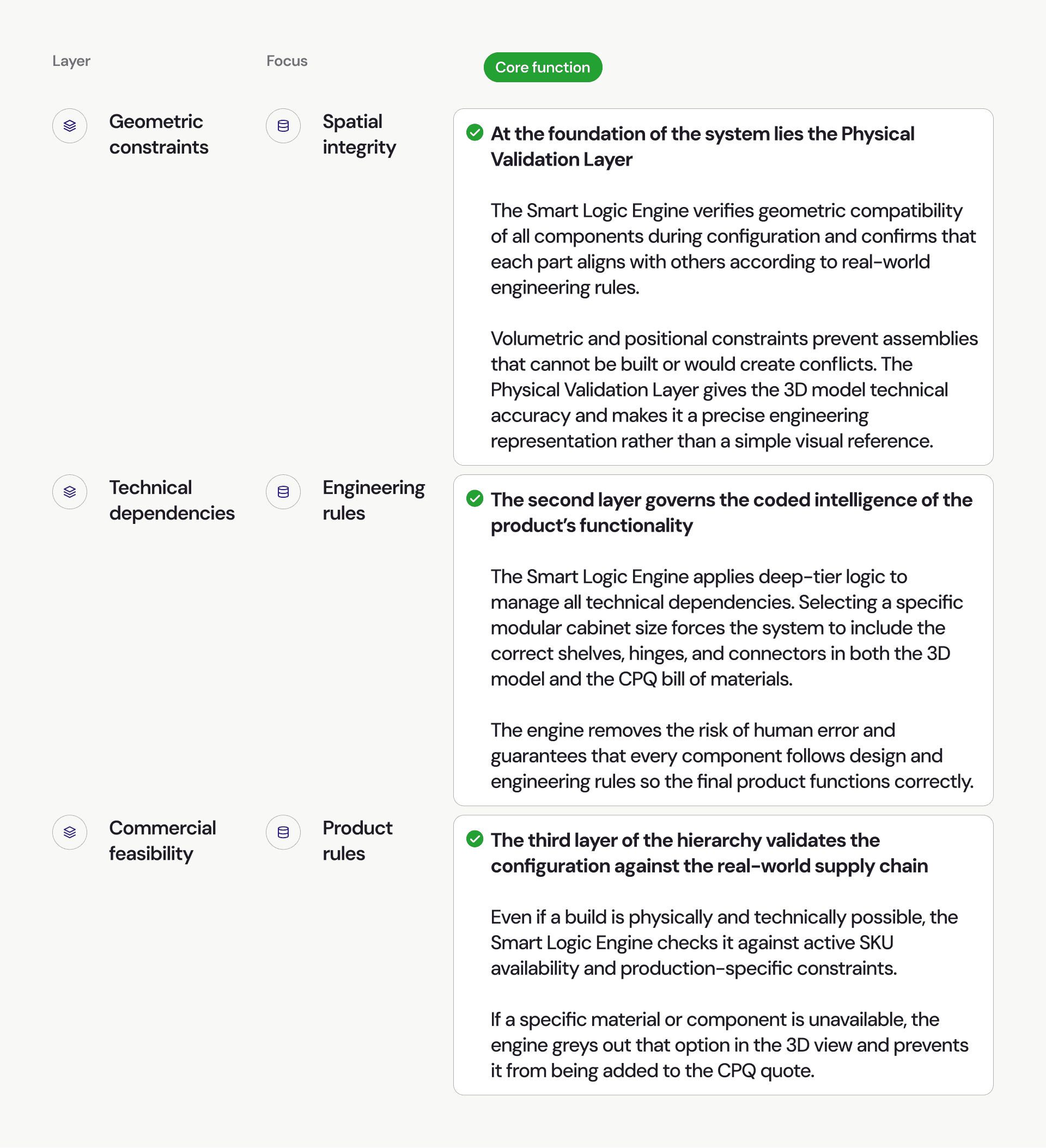
The technical core of Digital Tails Group’s Smart Logic Engine rests on a hierarchical validation stack. Instead of treating configuration as a linear list of options, the engine runs a multi-layered audit across all relevant rules simultaneously. Every change in the 3D configurator passes through three distinct layers of verification before the CPQ layer can finalize a quote.
Optimized product lifecycle equals business results
The Smart Logic Engine connects product configuration directly to the CLM and PLM infrastructure that governs the product lifecycle. Every configuration is validated against engineering rules before the system generates a production-ready data payload that includes the exact SKUs, materials, dimensions, and component relationships required for manufacturing.
Because this data aligns with established engineering standards, it moves directly into ERP, CLM, and PLM systems without manual re-entry. Orders travel from the customer’s configuration session into planning, procurement, and production with full technical accuracy.
For the business, this connection turns configuration into a reliable operational pipeline. Sales can support complex, high-variance products without slowing the organization. Engineering rules remain protected, operations receive production-ready specifications, and the product lifecycle stays synchronized from the first selection to final assembly. The result is measurable business value: fewer errors, faster order processing, and a structure that supports growth as product portfolios expand.
The Smart Logic Engine standard
The Smart Logic Engine turns complex orders into growth opportunities. It manages the entire CLM process—handling every variable, constraint, and product rule to allow operations to scale efficiently. Configurations stay accurate, orders move straight into production, and businesses can launch new products faster.
High-variance manufacturing does not have to produce costly mistakes or repeated manual checks. Companies can bring their most sophisticated product lines online, enter new markets, and grow revenue without expanding headcount. For manufacturers who want to move faster, scale smarter, and maintain accuracy across every order, the Smart Logic Engine provides the intelligence and control to make it happen.