Why You Need Dynamic Configuration Logic to Manage Complex Product Catalogs Online

Managing a high-variance part catalog is one of the toughest challenges in custom manufacturing. When your products feature hundreds of configurations, sizes, material dependencies, and optional add-ons, a standard e-commerce system collapses under the weight of the data.
If you try to map every possible custom combination to a separate stock keeping unit (SKU), your database quickly balloons into millions of dead SKUs. Navigating this structural complexity on a website leads to a broken user experience, ordering errors, and a heavily burdened back-office team.
Traditional SKU-based setup ➔ 10 sizes × 5 materials × 8 accessories = 400 unique SKUs to create and manage
Rules-based configuration ➔ 1 base product + 3 parametric rules matrix = 1 dynamic dynamic model
The fix is a complete architectural shift. Instead of building static SKU tables, specialized manufacturers use attribute-based configuration logic. By moving your product constraints into an online rules engine, you can cleanly display complex options in a web browser without breaking your catalog structure.
The real dangers of an unmanaged part catalog
When high-variance manufacturers try to force custom products into traditional flat e-commerce frameworks, it creates three major structural bottlenecks:
The SKU explosion bottleneck: Every time an engineer designs a minor variation or a new accessory size, IT must generate a new parent-child SKU chain across your CRM and web platform. This database bloat makes regular inventory audits and price updates almost impossible.
The invalid option matrix: Without interactive guardrails, a customer can easily select a specialty voltage motor from one dropdown menu and a standard housing enclosure from another that are physically incompatible. The order goes through, only to be rejected later by a shop lead.
Slow website search functionality: Traditional site search tools are designed for simple consumer goods. When forced to index thousands of multi-layered industrial parts, filtering scripts slow down significantly, frustrating B2B buyers who want a fast quoting experience.
Comparison: SKU explosion vs. rules-based product structure
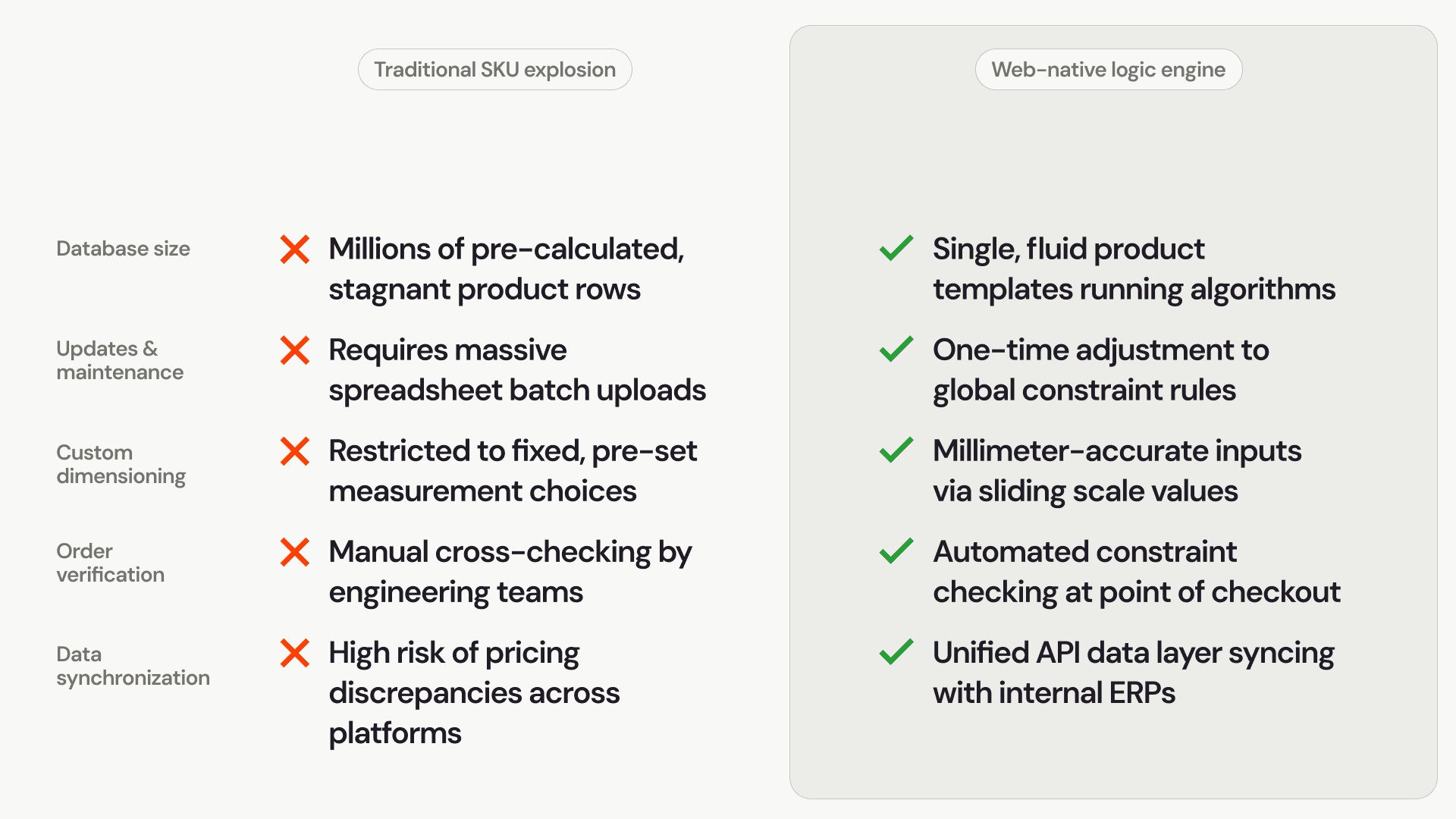
How to organize complex manufacturing logic on the web
Cleaning up a high-variance catalog requires decoupling your front-end web choices from your backend inventory database. Here is how to structure your data for optimal performance:
User interface: Dynamic options
▼
Matrix logic engine: Resolves dependencies
▼
ERP output: Compiles build specifications
1. Implement a parametric matrix instead of rigid SKUs
Instead of creating a dedicated SKU for a 1200mm beam, a 1300mm beam, and a 1400mm beam, you define a single structural part code with a parametric dimension field. When the buyer adjusts the length slider in their browser, the configuration engine dynamically passes the exact value directly to your cutting lists, leaving your database perfectly clean.
2. Establish strict logic dependencies
Your configuration rules should operate as active filters. When a buyer selects an initial option (such as Stainless Steel Construction), the logic engine immediately updates all secondary attributes in real time. It hides or deactivates incompatible choices, ensuring that the buyer only sees options that can physically be manufactured together.
3. Separate the checkout SKU from the build specifications
A web configuration engine does not need to look up a pre-existing manufacturing SKU to process a sale. At checkout, the system can generate a clean, dynamic string that communicates the entire build to your ERP system. This single token passes the exact recipe to production without requiring manual part creation.
The operational payoff for your organization
Legacy setup: Complex catalog ➔ Web bloat ➔ Order errors ➔ Engineering review (days lost)
Modern engine: Clean logic layer ➔ Smart filter ➔ 100% accurate data ➔ Direct production (instant)
Seamless B2B buying experiences
Industrial purchasing agents do not want to hunt through a 500-page PDF table to find the exact component modification they need. An attribute-driven configurator presents clear, visual options that make sense to a non-technical user, dramatically accelerating the quoting and buying journey.
Drastically reduced administrative overhead
When your catalog relies on global rules rather than millions of independent line items, product maintenance drops from a full-time job to a routine check. When material costs or engineering constraints change, your team updates a single base matrix rule, and the change instantly applies across your entire web sales pipeline.
Error-proof data streaming
By establishing visual validation rules directly at the point of choice, you stop order errors before they can happen. Your shop floor stops receiving messy, experimental orders and instead processes clean, structured data packages that match your live inventory and machinery specs every single time.