Why Per-Seat Software Costs Punish Growing Manufacturing Teams

When shopping for industrial enterprise applications, the traditional user-license model seems harmless at first glance. Software vendors present a tidy, affordable monthly rate per user. But as an agile manufacturer scales up production, this pricing structure quickly transforms from a predictable operating cost into an active tax on business growth.
The per-seat pricing model forces an artificial barrier between different parts of a manufacturing business. By restricting software access to a privileged group of users, companies unintentionally isolate data within specific departments, leading to communication errors, manual workarounds, and slower production cycles.
The pricing trap: Linear costs vs. exponential growth
The core problem with user-license software is that its cost scales directly with your headcount, rather than the true value you get from the application.
[ Headcount growth ] ───> Multiplies total user license fees
▼
[ Resulting impact ] ───> Financial penalty for hiring assembly tech, sales reps, or support staff
For a growing production facility, this linear cost progression creates three clear operational bottlenecks:
[ THE PER-SEAT REPERCUSSIONS ]
[ The license rationing ] [ The shared account risk ] [ The communication silo ]
Back-office leads hold back Staff share single passwords Shop floor relies on paper
logins to save budget. to bypass costs, breaking printouts, losing access
Data entries get delayed. accurate audit trails. to live operational updates.
Comparison: Per-seat restrictions vs. usage-based operations
The way an enterprise licenses its core engineering and sales software completely dictates how information flows through the plant floor:
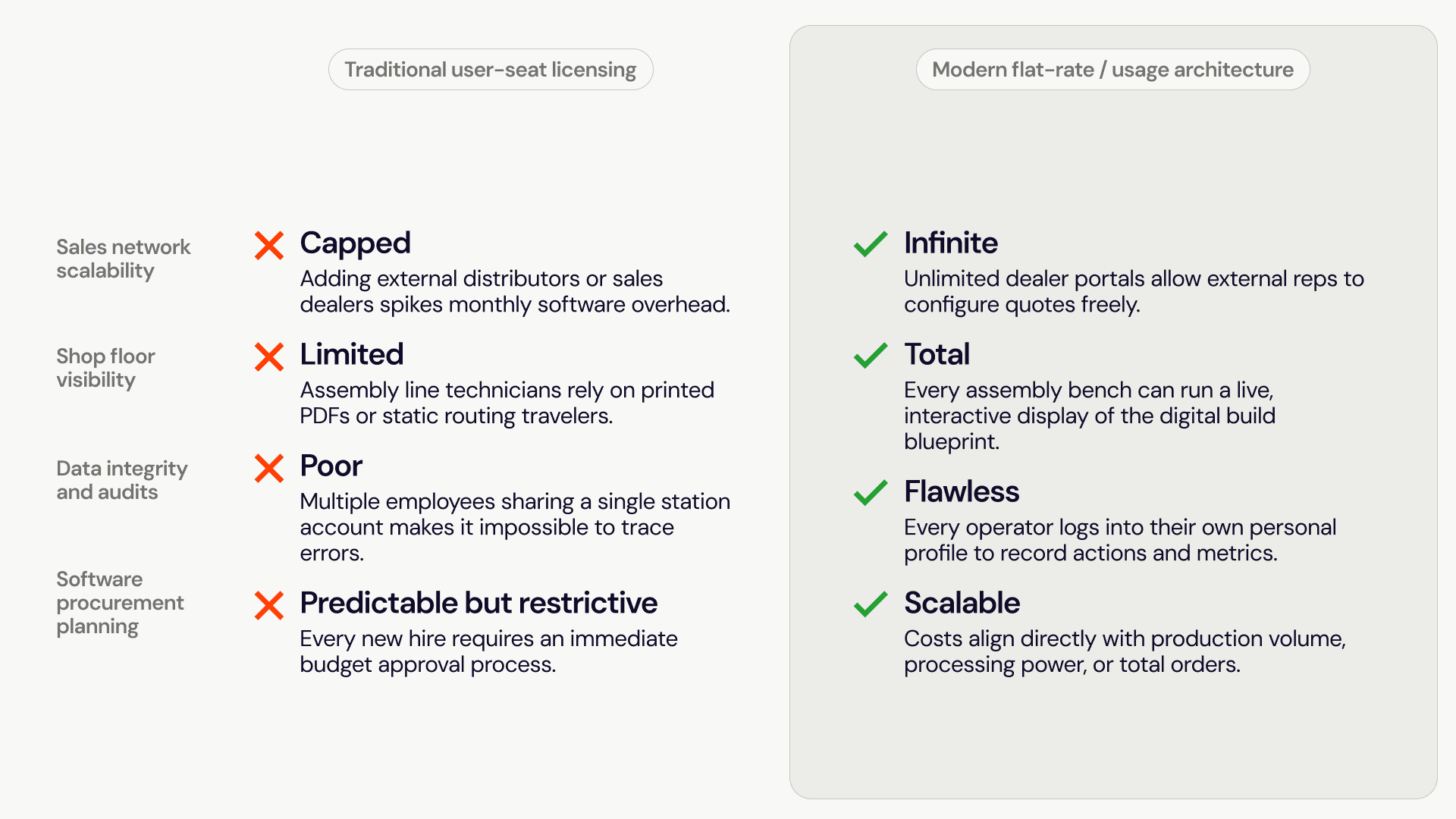
Removing the barriers to manufacturing data
Eliminating per-seat software constraints is about building a connected business environment where information moves effortlessly between your front office, your customers, and your machinery.
[Sales configurator UI] ➔ [Direct ERP system ingestion] ➔ [Automated shop floor machine codes]
▲ ▲
│ (Unrestricted, free-flowing data thread)
└───────────────────────────────┘
1. Democratizing your digital configuration tools
When your quoting application is unburdened by seat costs, you can safely put your custom logic engines directly into the hands of your independent dealer network, third-party field reps, and end-customers. This maximizes your true sales reach without creating an exponential software bill.
2. Providing direct data visibility on the line
An open-access software model allows you to mount interactive screens at every major workstation on your production floor. Assembly technicians can pull up real-time 3D assemblies, toggle individual layer visibilities, and check exact tolerances directly on screen, dramatically reducing build errors and material scrap.
3. Unifying the sales-to-production pipeline
True operational efficiency happens when your product configurator, your CRM, your ERP software, and your factory machinery form a single, uninterrupted communication loop. Removing user boundaries allows data to pass from an online customer selection right into your manufacturing execution system without manual human manipulation or data entry.
The long-term bottom line
Seat-based architecture: Headcount rises ➔ Software costs spike ➔ Restricted logins ➔ Operational bottlenecks
Custom software: Headcount rises ➔ Cost stays stable ➔ Universal access ➔ Seamless workflows
Rationing your company's software access to minimize user-licensing fees is a counterproductive way to protect your operating budget. It cuts off your technical teams from the very data they need to keep production running smoothly.
Transitioning your enterprise platform to a modern, value-driven architecture or a flat-rate infrastructure ensures that your software acts as a true engine for growth. By giving your entire ecosystem—from remote distributors to your frontline assembly staff—unlimited access to unified product logic, you remove operational friction, shorten lead times, and set your manufacturing team up to scale efficiently.