Why Advanced Digital Experiences Need a Technology Platform, Not Just a Technology Stack

Companies have always adopted new technologies to solve specific challenges and improve the way they operate. Over time, this has created technology environments built from many specialized solutions, each designed for a particular purpose. Individual solutions can deliver significant value, but modern digital experiences require a level of coordination that goes beyond the capabilities of isolated systems. The ability to connect different technologies – especially newer technologies – workflows, and processes within a unified environment has become an important factor in how organizations build and scale digital experiences.
Platforms provide a foundation where multiple technologies can work together within one ecosystem. They allow companies to combine different capabilities together, reduce unnecessary output, and create an environment that can easily support future development. A connected platform is a result of a broader change in how businesses approach technology. Now we clearly see that the focus moves from paying for individual tools toward building a flexible foundation where technologies work together and create greater value as a whole.
The limitations of disconnected solutions
Most technology environments do not appear overnight. They develop gradually, with companies adopting different solutions at different stages of their growth. One system helps solve a specific challenge, another supports a new business requirement, and over time, these individual decisions shape the wider technology landscape. Each solution can deliver value within its own area, but the relationships between these systems often create additional complexity. Information is distributed across different platforms, processes follow different structures, and teams must find ways to connect technologies that were created for separate purposes.
The impact of disconnected solutions is most visible when organizations need to adapt, expand, or create new experiences. Changes within one system may require additional work across connected solutions. New initiatives may depend on multiple integrations before they can move forward. Teams spend valuable resources managing connections between platforms, maintaining consistency, and ensuring that different systems continue to support each other. A collection of separate technologies can provide powerful individual capabilities, but without a shared foundation, organizations face greater complexity when they scale innovation and respond to new opportunities.
Disconnected solutions create challenges that extend beyond the technology itself. The impact can be seen across several areas:
Complex integrations: Connecting separate systems requires additional development, maintenance, and coordination. Each connection introduces dependencies that need ongoing attention.
Fragmented workflows: When technologies operate in separate environments, teams need additional processes to move information between systems and maintain consistency across different activities.
Limited flexibility: Independent solutions can make it more difficult to introduce new capabilities, adapt existing processes, or scale digital experiences without additional complexity.
Higher operational effort: Managing multiple platforms requires more resources for maintenance, updates, and alignment between different systems.

The shift from tools to platforms
Individual technologies have always played an important role in helping organizations solve specific challenges and introduce new capabilities. Over time, technology environments have expanded to include many different solutions, each built for a particular purpose. The growing number of connected systems has created a need for a more unified approach to technology architecture.
Platforms bring multiple capabilities together within a shared environment. Different technologies can work together, exchange information, and support connected workflows without relying on a collection of separate solutions. A platform creates a structure where organizations can build on existing capabilities and introduce new ones within the same ecosystem.
The value of a platform comes from the connections between its components. When technologies work together within a unified environment, organizations can reduce complexity, improve efficiency, and create digital experiences that support changing requirements over time.
Having everything under one roof
A unified technology platform creates value through the connections between different capabilities. When multiple technologies exist within the same ecosystem, organizations can reduce the effort required to manage separate systems and create more consistent processes across their operations.
A connected environment helps teams work with greater efficiency. Information can move between different parts of the ecosystem with fewer barriers, reducing the need for manual coordination and additional integration work. Development teams can focus more on creating new experiences instead of maintaining complex relationships between disconnected solutions.
A platform approach also provides greater flexibility for future growth. New requirements can be addressed within an existing structure, allowing organizations to expand their capabilities without creating additional layers of complexity. The ability to build on a common foundation supports faster adaptation and more sustainable development over time.
The advantage of a unified platform comes from the combined value of its components. Individual technologies contribute their own capabilities, while their connection creates a broader environment where organizations can develop more complete and scalable digital experiences.
The advantages of a connected platform can be seen across several areas:
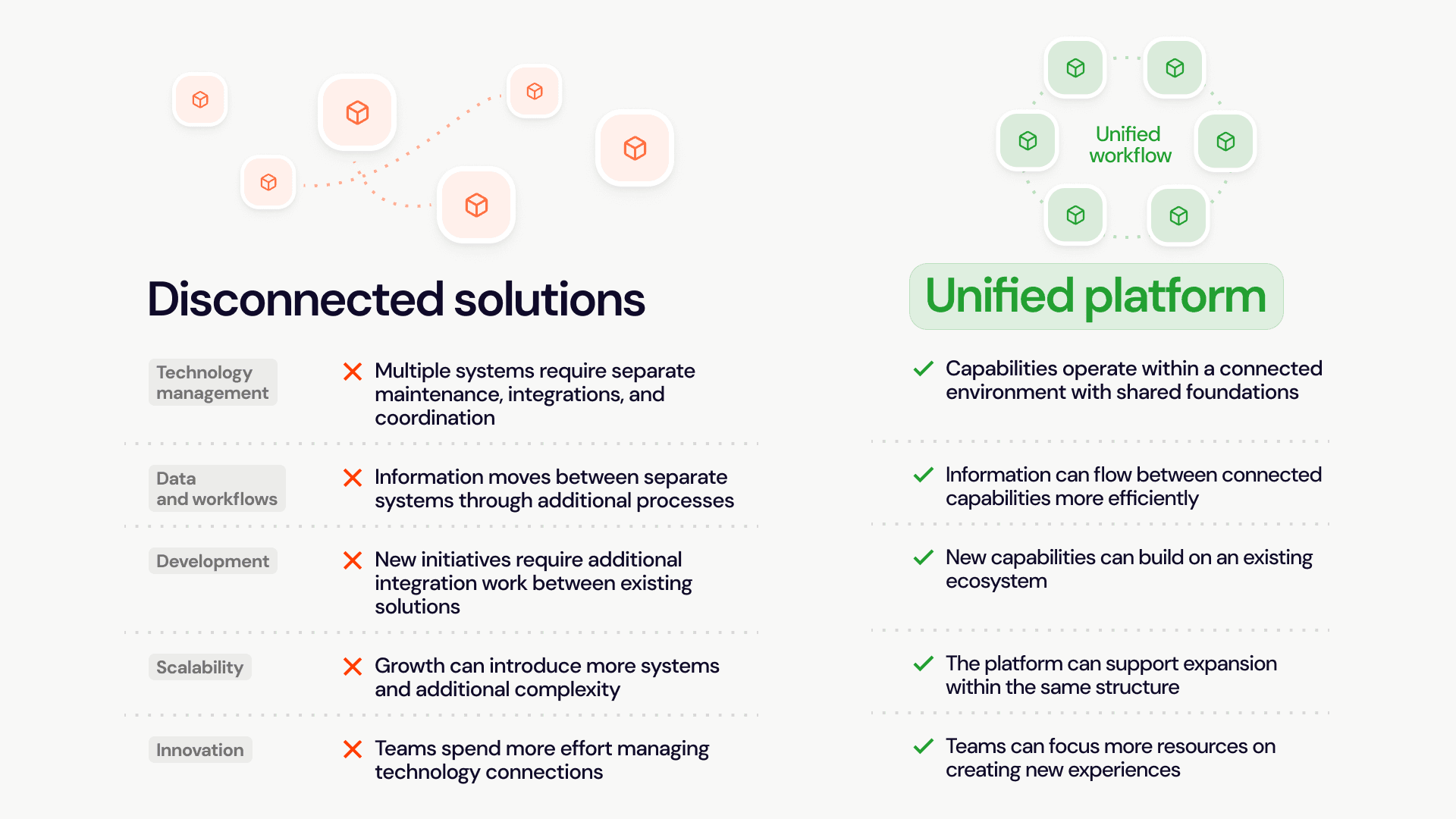
A platform approach creates value beyond individual capabilities because each component contributes to a larger ecosystem. The connection between technologies allows organizations to create more coordinated experiences, improve operational efficiency, and build a foundation that supports future development.
Why integration becomes a competitive advantage
The value of a platform is created through the relationship between its different components. Individual technologies can provide powerful capabilities on their own, yet their impact grows when they are connected within a larger ecosystem. The ability for different systems to share information, support common processes, and work together creates opportunities that separate solutions cannot provide.
Integration also influences how organizations respond to new requirements. A connected platform allows different capabilities to contribute to the same workflow, reducing the need for isolated solutions and repeated development efforts. Teams can build on existing structures, while maintaining consistency across the experiences they create. The competitive advantage comes from creating connections between technologies rather than simply collecting individual tools. A platform with strong integration provides a foundation where capabilities can complement each other, enabling organizations to develop more complete experiences and respond to future needs with greater flexibility.
A unified technology platform creates value through the connection between different capabilities. When multiple technologies operate within the same ecosystem, organizations can reduce complexity, create more consistent workflows, and build experiences with greater efficiency.
A platform approach creates value beyond individual capabilities because each component contributes to a larger ecosystem. The connection between technologies allows organizations to create more coordinated experiences, improve operational efficiency, and build a foundation that supports future development.
Building for the future
Technology environments rarely remain still. Business requirements change, customer expectations evolve, and new capabilities emerge. Organizations need a foundation that can accommodate these changes without rebuilding their entire technology landscape each time a new requirement appears.
A platform approach provides room for growth because new capabilities can be introduced within an existing ecosystem. Instead of creating separate solutions for every new opportunity, organizations can extend a foundation that already connects technologies, processes, and workflows. The long-term value of a platform comes from its ability to evolve. A well-designed ecosystem can support new technologies, new experiences, and new business models while maintaining consistency across the environment.
The future belongs to connected platforms
The next generation of digital experiences will rely on ecosystems where multiple technologies work together within a unified environment. The value comes from creating connections between capabilities and building a foundation that supports continuous development.
One platform. Multiple technologies. A foundation built for what comes next.