The Bespoke Breakthrough: Reclaiming Proprietary Logic and the Myth of Custom Risk
Your business is unique – reclaim your proprietary logic
If the "SaaS ceiling" we discussed in our previous article is the point where a business begins to outgrow its rented skin, then the transition to bespoke software is an act of reclamation of the real core of the business.
Maturing organizations must eventually shift from "How do we fit in?" to "How do we stand out?" Your business is not a generic entity; it is a specific set of relationships, a unique sequence of operations, and a proprietary way of solving problems. When you rely on off-the-shelf software, you are essentially renting someone else’s opinion on how your industry should run. You are adopting a "middle-of-the-road" logic designed to satisfy the average, while your competitive advantage almost always lives in the exceptions.
Bespoke software, when done well, represents the ultimate alignment between intent and execution.
It is the end of the era of workarounds. Instead of your team acting as the manual bridge between rigid modules, the software is designed to breathe with your team. It supports real-world dependencies rather than forcing you to click through a dozen tabs to simulate a process that should take a single second.
Debunking the “high-risk” myth of custom software
For many leaders, the word "custom" triggers a visceral financial flinch. It conjures images of black hole projects: two-year development cycles, spiraling budgets, and a finished product that is obsolete by the time it launches. However, this reputation is a ghost of the past – a relic of Waterfall development where every line of code was written from scratch and in a vacuum.
The perceived risk of custom software is often a product of outdated methods, not the software itself. In the past, building bespoke was like hand-forging every nail for a house. Today, the process is closer to high-end modular architecture. We are no longer debating whether custom software works. We are debating whether you can afford to keep paying the "inefficiency tax" of tools that don't. Strong technical partners no longer need to reinvent the wheel, because modern bespoke development utilizes modular design and proven frameworks.
Proven components: Authentication, cloud infrastructure, and data encryption are now standard building blocks
Phased delivery: Instead of a "Big Bang" launch, systems are built in focused sprints. You don't build the whole cathedral at once, you build the chapel that solves your biggest bottleneck first.
The 80/20 rule: We use industry-standard libraries for the common 80% of functionality and reserve the intensive, custom engineering for the 20% that actually drives your revenue and differentiation.
Total cost of ownership (TCO): The hidden math
When businesses compare SaaS to Bespoke, they often compare a monthly subscription fee (visible) against a capital investment (daunting). This is a flawed comparison. To find the true TCO, you must look at the "License Bloat" vs. "Asset Value."
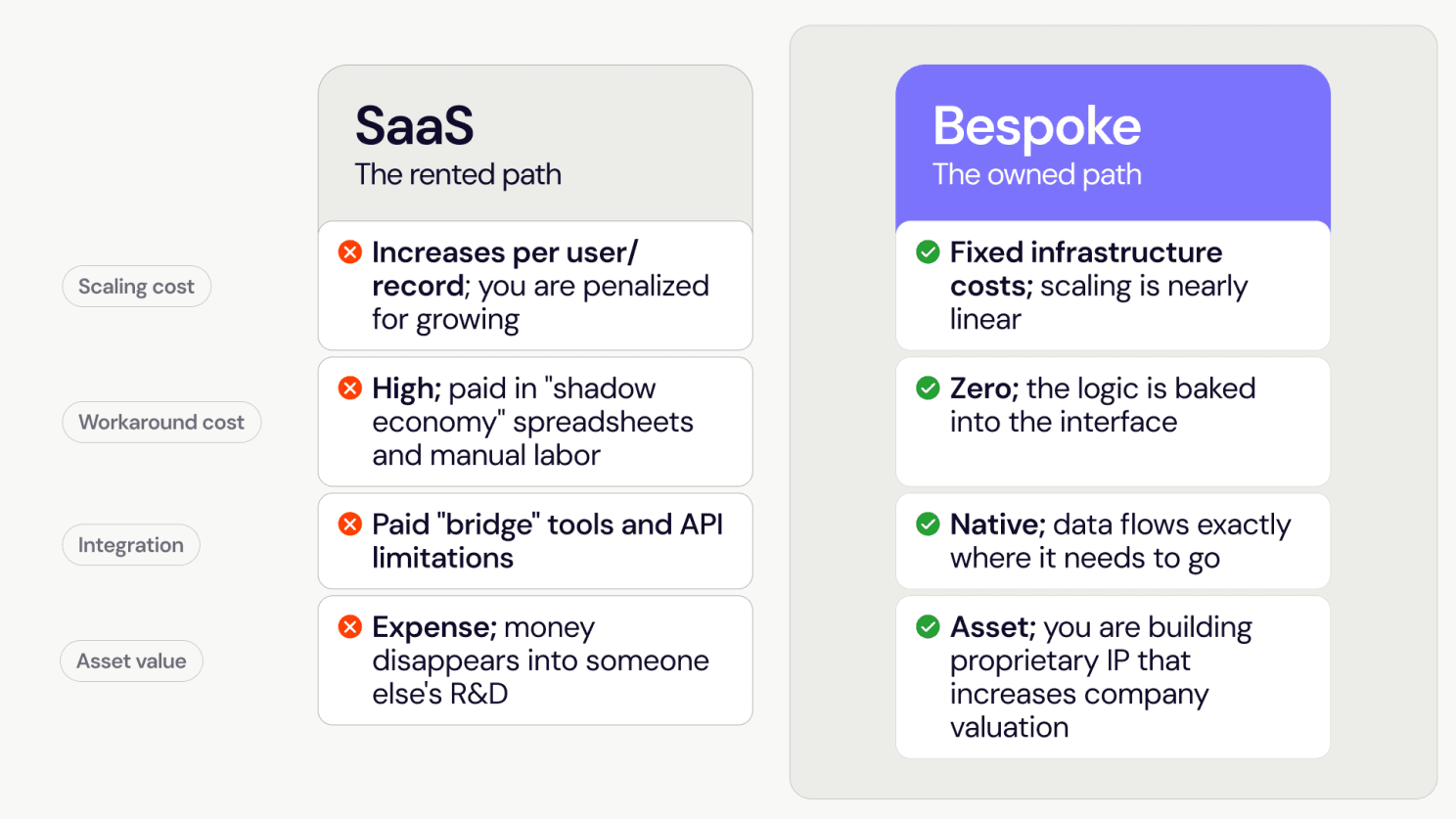
As we can see, the "safe" choice of staying with a generic SaaS often becomes the high-risk move over a five-year horizon. You are essentially paying to limit your own agility. Once you decide to shift to a bespoke model, you will trade a recurring, unpredictable expense for a controlled and strategic investment.
The strategic advantages of custom software ownership
When you rent your core infrastructure, you are a tenant in your own house. You live at the mercy of a landlord who can raise the rent, change the floor plan, or decide to stop maintaining the roof at any moment. Transitioning to bespoke software is therefore an act of sovereignty, moving you from a position of dependency to one of total strategic autonomy.
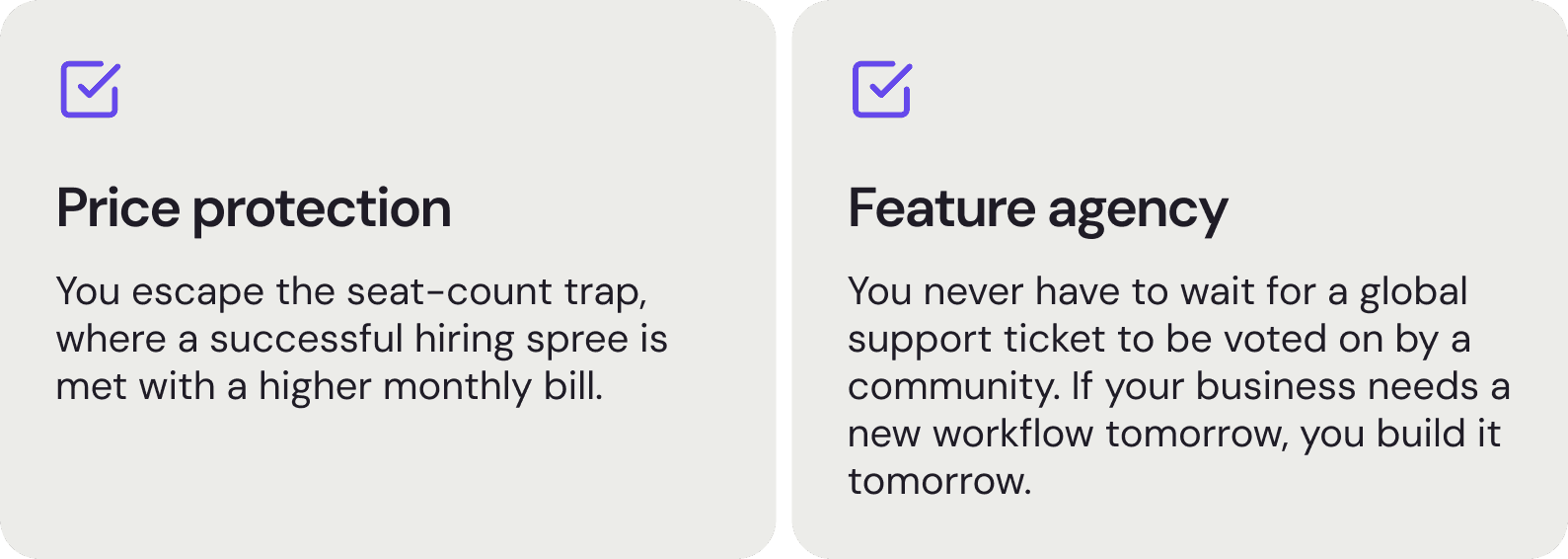
Independence: Killing the "surprise" expense
In the SaaS world, you are tethered to a roadmap you didn't write. If a provider decides to pivot their product toward a different market, or "sunset" a feature your team relies on daily, you have no recourse.
Data and integration sovereignty
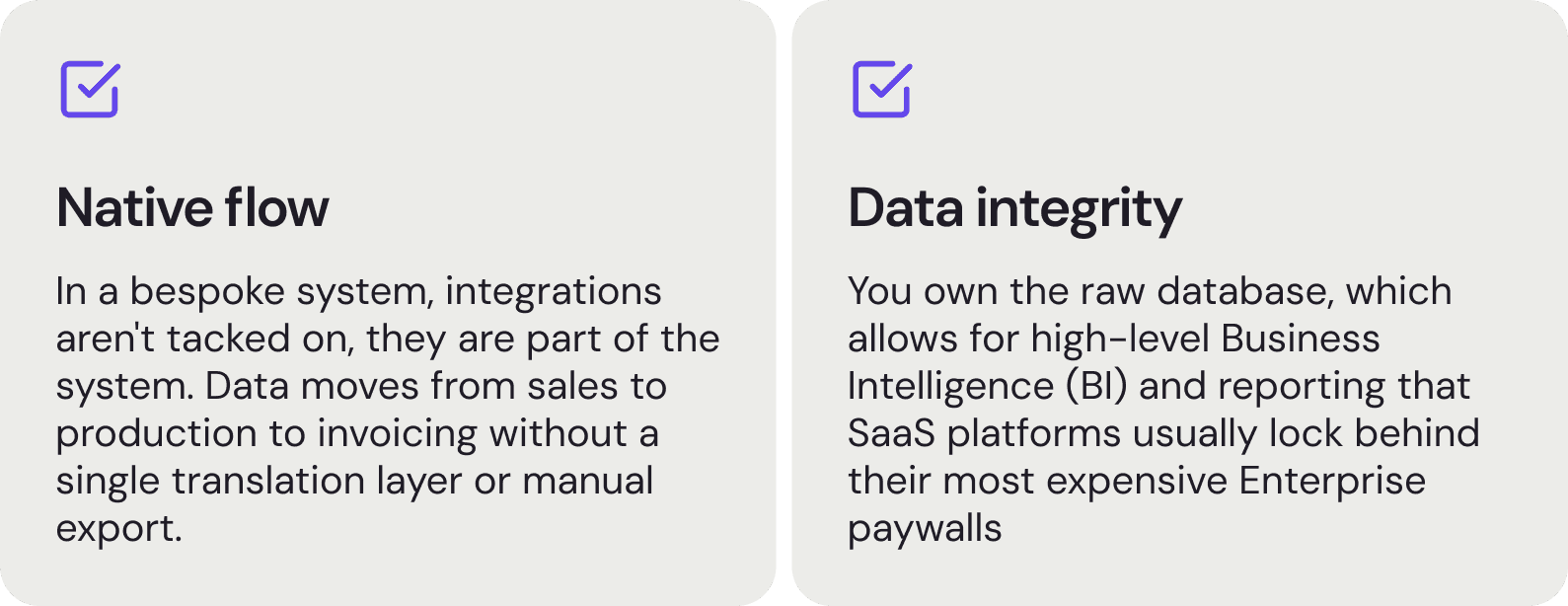
Generic tools are built like silos. To make them talk to one another, businesses often rely on "bridge tools" or fragile, third-party API connectors. This creates a "spaghetti architecture" where a single update in one app can break your entire data chain.
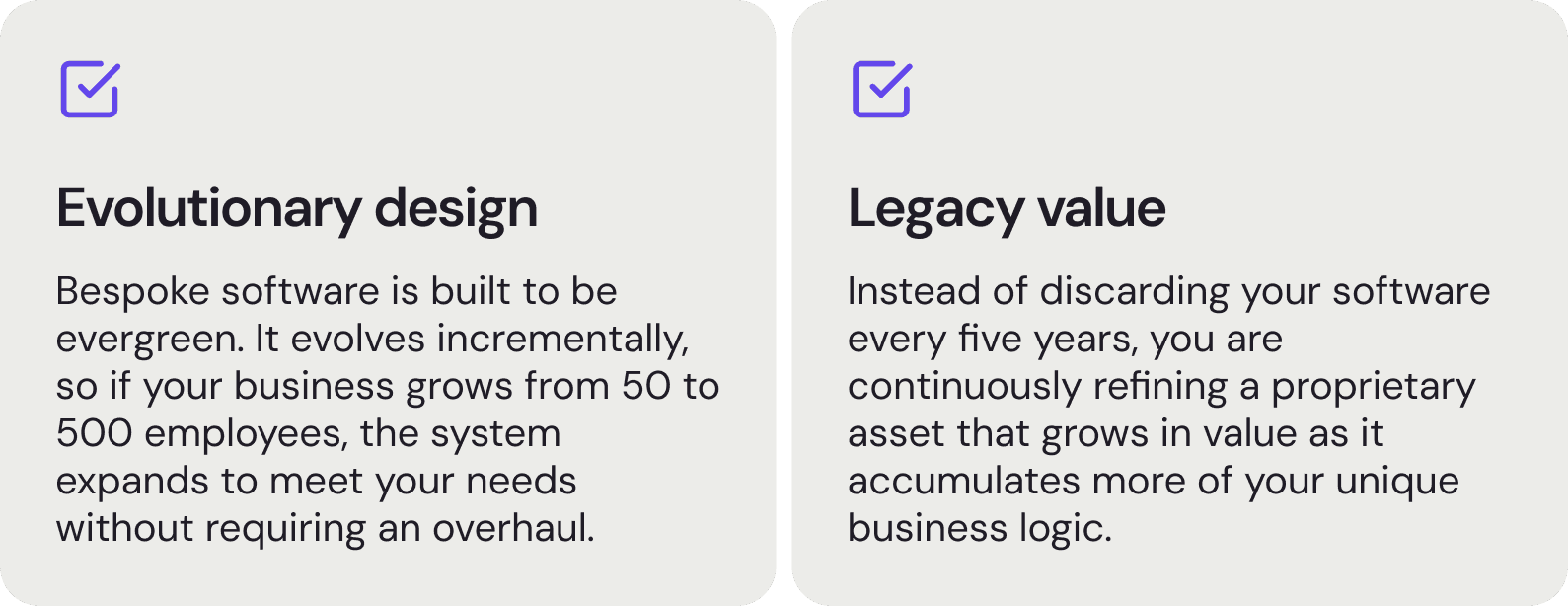
Future-proofing: Growth without migration
The most painful event in an SMB’s lifecycle is the forced migration – the moment a system becomes so inadequate that the company must stop everything to move to a new platform. This process is lengthy, expensive and carries high data-loss risks.
The lean implementation strategy
The biggest threat to a bespoke project is ambition. Most business owners wait too long to go custom because they envision a "Big Bang” launch where every department migrates to a new system on a single Monday morning. This is the "all at once" trap, and it is the primary reason custom projects fail. But the modern path to bespoke is a strategic evolution.
Avoiding the "all at once" trap
The real risk isn't actually building custom software itself, but trying to build it as a monolith. When you attempt to replace every SaaS tool in your stack simultaneously, you create a project so large that it loses momentum before the first line of code is even tested.
The solution is to identify the critical friction points. You don't need to build a custom email client or a custom calendar – SaaS handles those "utility" functions perfectly. You build custom logic only where the "SaaS ceiling" is currently costing you the most money. And by taking the first step, you reduce technical debt and allow your team to adapt to the new system in digestible increments.
Focusing on the MVP: ROI that funds itself
In the bespoke world, the Minimum Viable Product (MVP) is your most powerful financial tool. Instead of waiting eighteen months for a complete system, we focus on a high-value module that solves a single, expensive problem.
The benefits of starting with an MVP:
Early ROI: A focused module launches within 12–16 weeks, and efficiency gains follow immediately
The self-funding cycle: Phase 1 removes manual workarounds and frees capital for Phase 2, and the software pays for its own evolution
User feedback loops: Real-world usage by your staff in Phase 1 informs the design of Phase 2, and your team defines its needs through the tools they already use.
Closing thoughts
The transition from a "rented" infrastructure to a "bespoke" one is ultimately a transition from defense to offense. When you stop fighting your tools, you start leveraging them. The most immediate impact is the sudden disappearance of the "spreadsheet shadow economy" we discussed here. When the software actually understands your business rules, the need for manual "translation" evaporates.
There is a persistent myth that custom software complicates business, but in reality, the opposite is true. The complexity already exists, and it’s currently living in your messy spreadsheets, long email chains, and the exhausted minds of your employees who have to remember a dozen "if-this-then-that" workarounds.
Bespoke software captures the complexity you’re dealing with, and takes the chaos of your daily operations and formalizes it into a clean, automated, and invisible engine. When done correctly, it is the only way to truly remove the difficulties in your operations.