The SaaS Ceiling: The Lifecycle of Standardized Software and How Generic Tools Limit Business Growth

For the modern small and mid-size business, software choices have long ceased to be just technical decisions. They are, in every practical sense, decisions about time, capital, and most importantly – the psychological overhead of growth. They sit on the edge between an organization that scales with grace and one that buckles under the weight of its own expansion.
In the early chapters of a company’s story, the "Software as a Service" (SaaS) model is the undisputed hero. It offers the ultimate promise: world-class infrastructure for a monthly fee. By adopting off-the-shelf tools, a lean team can inherit industry-standard workflows overnight, bypassing the need to manage servers, security patches, or complex updates. For many, this is convenient and realistic.
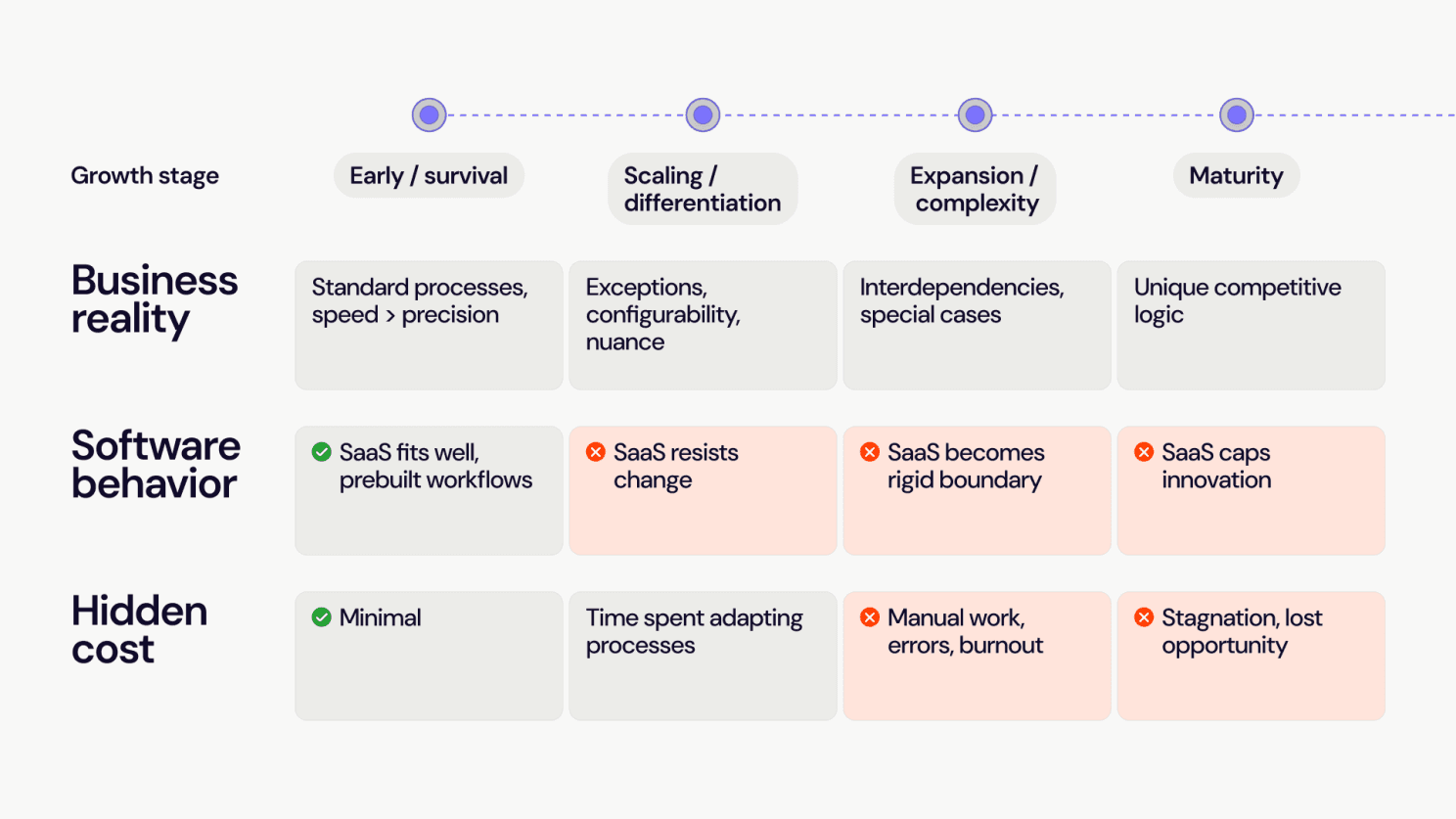
But as a business matures, a shift occurs. The tools that initially felt like a tailwind begin to feel like a headwind. Your team is no longer using the software to speed up their work, but rather spending more and more time adjusting your business processes to fit the rigid templates the software demands. This we call the SaaS ceiling – the point where "good enough" begins to hinder the very growth it was meant to support. At this crossroad, every growing company faces the same fundamental question: Do we continue to force-fit our unique business into a generic box, or do we start building something that actually reflects the way we work?
Why off-the-shelf software is only a temporary solution
The first move toward a rental mindset is pragmatic and understandable. In the "survival and surge" phase of a young company, speed is the only currency that matters. SaaS tools offer an immediate operational foundation. They allow a founder to deploy a functional department, whether it’s for sales, production or anything else – in the time it takes to enter a credit card number. This is the path of least resistance, and because these tools are built on the "middle of the bell curve," they provide a pre-packaged version of best practices. For a team still defining its internal culture, inheriting these standardized workflows is a relief. It offers a sense of order and sanity that prevents the chaos of rapid growth from becoming overwhelming. You don't have to design a process from scratch when the software provides a template that is, for the time being, good enough.
Furthermore, there is a budgetary comfort of this model that cannot be overstated. By converting what used to be a massive upfront capital expenditure into a manageable, recurring operational expense, companies can preserve their cash for, let’s say, product development. There is a deep peace of mind in knowing that the burden of technical management (security patches, server uptime, feature updates) belongs to someone else. In this honeymoon period, the software is a utility: reliable, invisible, and perfectly adequate for a business that is still finding its shape.
When standardized software starts to limit operations
In the early days, being standard is an advantage, but as a business matures, its value is derived from its uniqueness. Growth doesn't just mean quantitatively more customers; it means nuanced relationships, specialized service tiers, and exceptional operational logic. You are getting more specific in what you offer. And this is when the "good enough" features of a generic platform start to crack under the pressure of real-world complexity. Customers begin to ask for exceptions that the system wasn't programmed to handle. Products evolve from simple line items into highly configurable offerings with interdependent parts. Pricing models, once linear, gain layers of volume triggers, seasonal bundles, and regional variables that the standard template cannot hold.
The result is a compromise, at least temporary. Rather than the software evolving to meet these new demands, the burden shifts to the staff. You start seeing teams adjust the company’s business logic to satisfy the software limitations. Critical decisions are made based not on what is best for the customer, but on "what the system will allow us to do." At this stage, the software stops being a business enabler, and becomes a rigid boundary that you must navigate around daily.
The spreadsheet shadow economy — how manual workarounds drain you
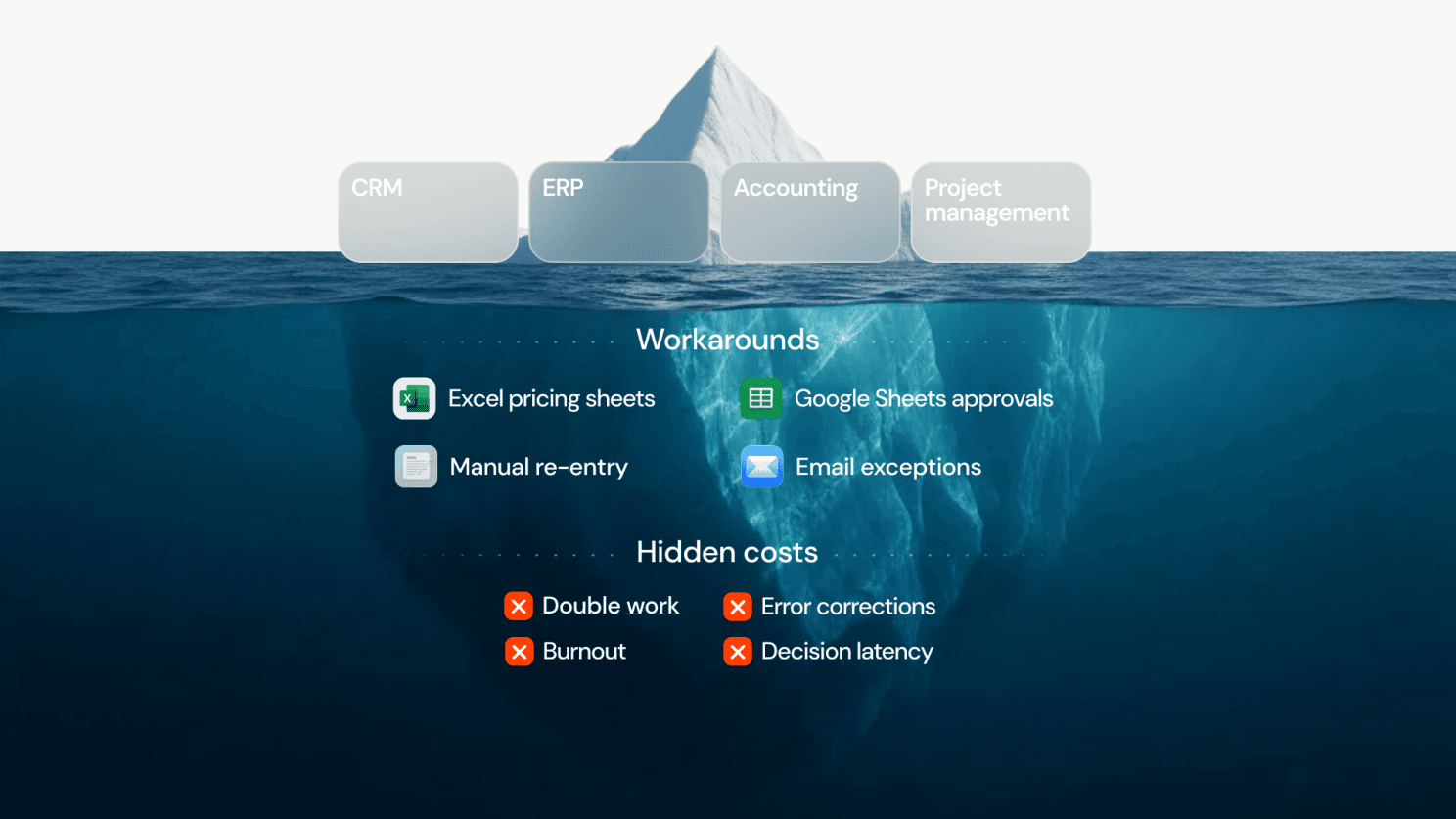
This is when the "official" system stops reflecting reality. The work doesn't stop, you still need to do it, but it migrates somewhere else. It's the birth of the spreadsheet shadow economy. Because the core software cannot accommodate a new pricing tier or a multi-step approval chain, the team retreats to the one tool that offers total freedom: the spreadsheet. And oftentimes, many of them. These are viewed as temporary fixes. However, as the business continues to scale, the disconnected files become the actual engine of the company. They house the mission-critical data that the primary software is too rigid to track. Staff must manually bridge the gap between real-world operations and what the system records, creating a massive, invisible workload.
As a result, we see a significant operational drag tax. You find yourself paying for high-level talent to perform low-level data entry, double-checking automated reports that are perpetually out of sync, and fixing "manual errors" that are actually just symptoms of a broken workflow. The human cost is equally high. The "translation layer" or the mental effort required for an employee to act as the bridge between two disconnected apps, leads to inevitable burnout. When your best people spend more time fighting the system than using their expertise to move the business forward, the software has officially transitioned from an asset to a liability.
“Low cost” software becoming expensive
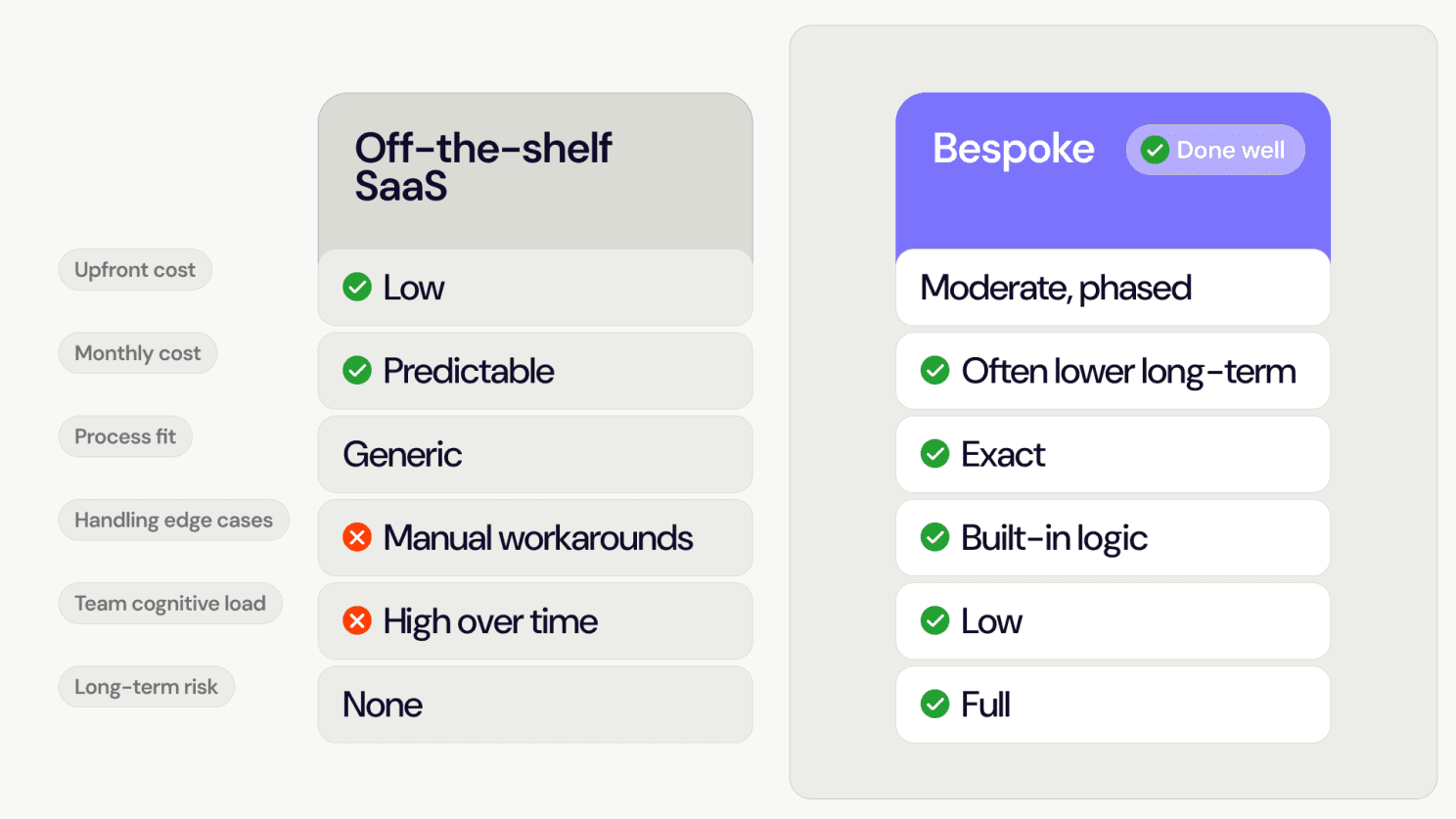
The decision to stay with a standard solution may feel like the fiscally responsible choice, but this is usually a result of skewed accounting. When we weigh rental vs. reality, the "lower cost" of a monthly subscription is a visible line item, while the cost of inefficiency is hidden in the margins. Avoidable mistakes, lost leads, and the "payroll leakage" of employees performing manual workarounds are real expenses. Over time, the money saved on licensing is slowly drained by the friction of a tool that no longer fits the job, and eventually solidifies into a growth barrier. It is a subtle but firm realization: the software wasn't built for your version of the business. It was built for an idealized, simplified and foremost generalized version of your industry. When your systems cannot adapt to your specific operational nuances, you stop asking "How can we do this better?" and start asking "Does the software allow us to do this at all?"
The most significant danger, however, is the stagnation risk. By staying within the "generic box," a company inadvertently caps its own potential. Real optimization happens at the edges – the 10% or 20% of your process that is truly unique. If your software prevents you from automating those specific, high-value workflows, you are essentially formalizing mediocrity. You aren't just outgrowing the off-the-shelf software, you are actually allowing it to dictate the limits of your innovation.
Breaking free when you outgrow standardized systems
For many business owners, the hesitation to move beyond standard software is rooted in a traditional view of risk. We tend to perceive "new software" as a volatile variable or an unpredictable investment of time and capital. However, at the turning point of mid-market growth, this logic flips. The real risk is not the change itself, but the mounting friction of the status quo. The longer a company relies on a system that it has outgrown, the more it cements inefficiency into its very culture. This leads us to a final question that every executive must eventually answer: Is your business being supported by its tools, or are your tools merely formalizing a series of expensive manual workarounds? If your most talented people are spending their days acting as the "glue" between disconnected apps, your software doesn’t have a bottleneck – it is a giant bottleneck as a whole.
Recognizing the SaaS ceiling isn't a failure of your initial tech strategy, and you should understand it as a milestone of your success. It serves as the signal that your business logic is now too valuable to be rented. At this point, companies can take a new approach — using a bespoke solution.
In the next article, we will explore the bespoke breakthrough and how to reclaim ownership of your core systems, stop fighting your tools and start scaling your competitive edge.