Smart Guided Selling: Using AI Assistant Rules to Help New Hires Quote Technical Equipment Easily

Industrial manufacturing onboarding is notoriously slow. When a company sells highly customized equipment—such as complex hydraulic manifolds, custom electrical switchgear, or modular conveyor assemblies—a new sales representative often requires months of technical training before they can generate an accurate, buildable quote independently.
The reason for this long learning curve is the sheer volume of tribal knowledge, engineering constraints, and application logic required to configure a product correctly. A minor oversight by an unseasoned rep, like pairing an incompatible valve with a high-pressure pump, leads to immediate margin erosion or a rejected order.
Overcoming this onboarding bottleneck requires smart guided selling. By embedding private, ai-driven rule assistants directly into your sales portal, you turn your complex engineering playbook into a proactive, conversational co-pilot. New hires can fearlessly navigate intricate product catalogs, select compatible sub-assemblies, and generate error-free quotes on their very first week.
The business impact of the technical sales training gap
Forcing new sales reps to rely on physical binders, static spreadsheets, and senior engineers for quote validation introduces significant drag into an industrial commercial operation.
Extended time-to-productivity: When new hires must memorize thousands of technical part dependencies, they remain dependent on senior staff for months, stalling territory growth and delaying return on hiring investments.
The hidden margin drain: Inexperienced reps frequently miscalculate installation labor hours, select incorrect raw material grades, or leave off necessary ancillary components, resulting in under-quoted projects that eat away at business profitability.
Quote-turnaround stagnation: When an unseasoned rep has to wait in an internal engineering queue to double-check a specialized equipment layout, the customer waits days for a price, often driving them straight into the arms of a faster competitor.
Operational case studies: Traditional onboarding vs. AI-guided sales enablement
Case 1: Training and deployment speed
Traditional manual onboarding: Multi-week classroom and shadowing cycles are required before a rep handles live client requests.
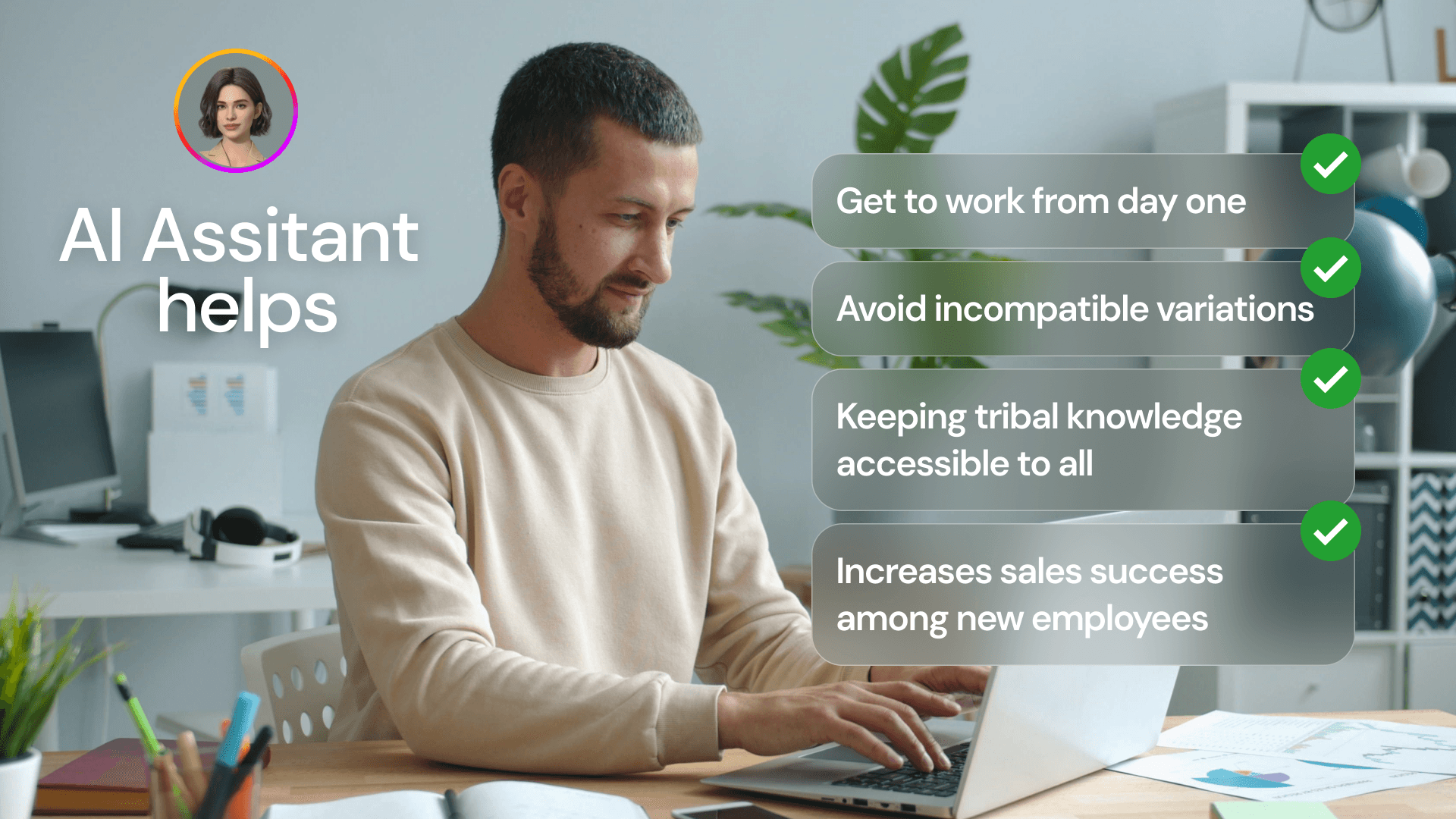
Ai-guided sales assistance: Reps can quote accurately on day one because the software acts as a continuous operational guardrail.
Case 2: Component dependency verification
Traditional manual onboarding: Sales staff must perform a manual lookup of paper compatibility charts and cross-reference multiple spreadsheets.
Ai-guided sales assistance: The system runs automated compatibility validation and blocks incompatible options instantly.
Case 3: Retaining tribal knowledge
Traditional manual onboarding: Crucial product context is trapped inside the heads of senior engineers, creating constant review loops.
Ai-guided sales assistance: Historical data and engineering rules are codified directly into conversational prompting logic.
Case 4: Cross-selling and upselling efficiency
Traditional manual onboarding: Low performance metrics because new hires frequently overlook complex add-on parts.
Ai-guided sales assistance: High performance metrics because the ai contextually prompts correct auxiliary options based on user selections.
Case 5: Sales rep confidence and autonomy
Traditional manual onboarding: Reps display hesitant, slower interactions with complex buyers due to a fear of making configuration errors.
Ai-guided sales assistance: Reps engage in bold, accurate, and self-sufficient client consulting from their first week.
Three ways ai rules transform new hires into application experts
A practical guided-selling system functions like an expert engineer sitting next to a new sales rep, actively analyzing configuration data and offering real-time course corrections.
1. Contextual constraint prompting during configuration
Instead of presenting a new hire with an overwhelming list of thousands of part numbers, the ai-driven sales portal restricts visible choices based on the customer’s application environment. If a rep selects an outdoor, high-corrosion environment setting, the assistant automatically filters out standard carbon steel options and prompts the rep to choose from pre-approved marine-grade stainless alloys.
2. Natural language querying for legacy engineering rules
When an abstract customer requirement lands in a new rep's inbox, they don't have to dig through old server folders to find historical precedents. They can type the request directly into their private sales assistant—for example, "What clearance do we need for a 50hp motor in a nema 4x box?"—and the system securely retrieves the exact engineering tolerance rule instantly from your technical database.
3. Proactive configuration auditing and upsell mapping
Before a quote is finalized, the assistant runs a silent background audit on the entire bill of materials. If it notices a specialized configuration that typically requires a specific mounting bracket or an extended warranty package, it highlights the missing opportunity on screen, detailing exactly why the addition is required for the customer's specific industry use case.
Real-world configuration outcomes across representative scenarios
Scenario A: Rep pairs wrong voltage motor with an inverter
Legacy training outcome: The order hits the factory floor, causes a physical mismatch, and breaks the assembly line.
Smart guided selling outcome: The assistant flags the voltage mismatch immediately and blocks checkout until corrected.
Scenario B: Customer asks for extreme environment specs
Legacy training outcome: The rep pauses the live customer call to email applications engineering, delaying the deal cycle.
Smart guided selling outcome: The ai assistant instantly surfaces approved material limits on screen during the call.
Scenario B: Rep forgets a critical structural brace
Legacy training outcome: The project is severely under-priced, causing direct margin loss on the shop floor.
Smart guided selling outcome: The system adds the required brace automatically based on the total calculated weight of the unit.
Scaling your sales footprint with bulletproof accuracy
Relying on human memory and lengthy training cycles to protect your manufacturing margins creates a permanent ceiling on your company's growth.
Implementing a smart guided-selling environment allows you to decouple your sales velocity from the complexity of your engineering specs. By transforming your technical rules, margins, and component dependencies into an active, ai-assisted interface, you empower any salesperson to quote technical machinery flawlessly, protect your bottom-line profitability, and deliver rapid, reliable quotes that win more business.