Pragmatic AI for Manufacturers: Practical Ways to Automate the Quoting Process Securely

For custom manufacturers, the quoting process is a notorious operational bottleneck. When a B2B buyer submits an engineering document, a complex spreadsheet of requirements, or a non-standard Request for Quote (RFQ), your internal workflow often grinds to a halt. Estimates require technical sales reps to cross-reference legacy pricing tables, check material availability inside an ERP, and loop in application engineers to verify structural tolerances.
This manual approach introduces severe delays, with custom quotes routinely taking days or weeks to return to a prospective client. In a fast-moving commerce environment, the fastest quote often wins the business.
Implementing pragmatic AI automation offers an alternative to these manual workflows without the risk or expense of unproven technology. By introducing secure, domain-specific artificial intelligence models directly into your estimation layer, you can parse unstructured RFQs instantly, generate highly accurate quotes automatically, and feed clean structural data straight into your backend systems—all while keeping your proprietary engineering secrets locked down and safe from public leaks.
Understanding the architectural divide in manufacturing automation
Many manufacturing executives hesitate to adopt automated intelligence tools because they confuse enterprise-grade automation with consumer-facing, public AI programs.
[ Public AI engines ] ─── Private training data ───> Public domain leak
(High IP risk)
[ Pragmatic enterprise AI ] ─── Isolated cloud layer ───> Secure factory automation
(Zero data leakage)
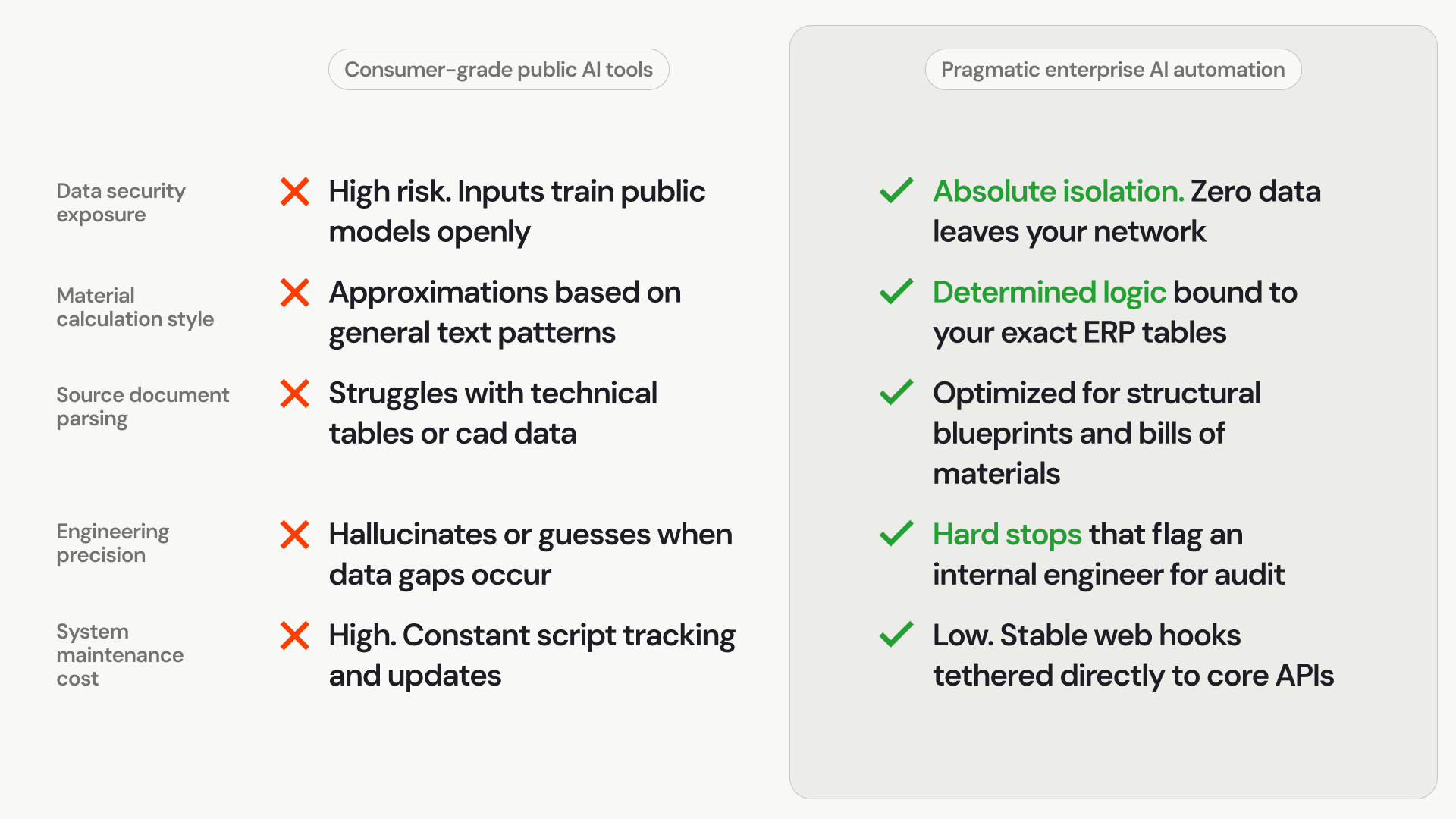
The difference between these approaches impacts everything from daily system maintenance to the long-term security of your company's core intellectual property:
Three secure pillars of pragmatic AI quoting
Deploying automated quoting securely requires setting up precise, isolated software boundaries that handle raw customer data safely and accurately.
1. Isolated document extraction via private LLMs
The initial hurdle of quoting is organizing the unstructured data inside customer emails, PDFs, and spreadsheets. Pragmatic automation routes these files through a sandboxed, privately hosted Large Language Model (LLM) operating within a secure cloud environment. The model reads the technical text, identifies critical variables—like raw material types, dimensions, and quantities—and formats them into clean, machine-readable data arrays without ever exposing your private data to the public internet.
2. Deterministic pricing calculations via ERP anchoring
To eliminate AI "hallucinations"—where an algorithm generates plausible-sounding but completely incorrect numbers—the software never allows the artificial intelligence to calculate pricing directly. Instead, the AI functions strictly as a data translator. It extracts the raw specs from the RFQ and feeds that structured data into your existing, rules-bound ERP system or pricing matrix, ensuring that every quote rests on your actual labor rates and real-time material costs.
3. Automated engineering guardrails and anomaly detection
A practical automated quoting tool includes built-in safety boundaries based on your past factory output. If a customer's requested dimensions or material tolerances deviate sharply from your standard manufacturing limits, the software detects the outlier immediately. Instead of generating an invalid automatic price, the system pauses the transaction, drafts a preliminary cost profile, and alerts an applications engineer for a manual review.
Real-world outcomes of secure automation
Securing your quoting pipeline directly impacts processing speed, technical accuracy, and engineering workloads across your entire product line:

Accelerating commerce without sacrificing security
Relying on manual data entry and human cross-referencing to calculate custom manufacturing quotes limits your operational throughput and slows down your sales engine.
Deploying pragmatic, enterprise-grade AI automation lets you eliminate estimating backlogs securely and efficiently. By binding isolated data-extraction tools directly to your internal database rules, you can respond to complex customer requests in seconds, protect your proprietary engineering data, and ensure your factory floor operates with complete structural accuracy.