How Upgrading to True Modular 3D Configuration Transforms Custom Manufacturing

Many industrial manufacturers begin their digital sales journey by adding simple product visualization plugins to their websites. These basic add-ons allow users to change colors, toggle between a few preset options, or swap out static images in a standard web browser. While this works well for simple consumer goods, it quickly falls apart when applied to complex, engineered-to-order industrial products.
Heavy equipment, modular structures, and complex assemblies require more than simple visual tweaks. They rely on strict structural rules, precise spatial constraints, and complex engineering logic.
Upgrading from basic visual add-ons to a true modular 3D configuration engine completely transforms how your sales and production teams operate. Instead of just changing how a product looks on a screen, true modular configuration alters the underlying engineering framework of the product in real time, making it an incredibly powerful B2B sales tool.
Where simple web plugins fall short
Using basic visual plugins for complex manufacturing lines creates a frustrating divide between what your customer sees online and what your factory floor can actually build. These basic tools present three major challenges for growing companies:
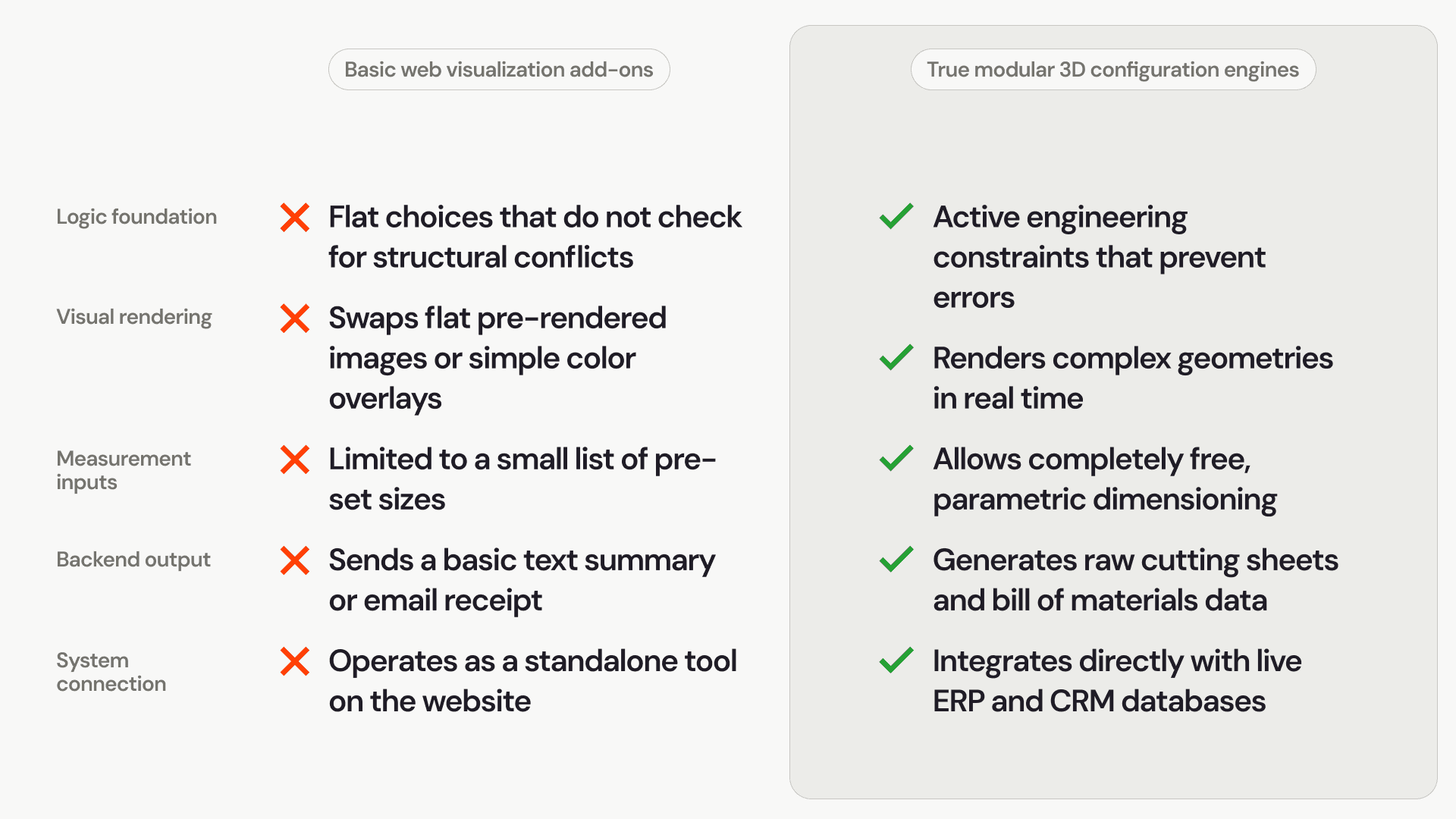
The structural disconnect: Simple web add-ons do not understand engineering rules. A customer can easily use a basic dropdown menu to pair a massive industrial frame with weak support brackets. The website accepts the order, but your production team has to stop everything to fix the engineering error.
The dimensional dead end: Basic visualization tools rely on a fixed gallery of pre-rendered images. If your product line allows customers to input millimeter-accurate measurements, static plugins cannot display those changes dynamically, forcing your sales team back to manual drafting and sketches.
The isolated data silo: Simple plugins operate as completely separate tools on your website. They cannot communicate with your core business systems, forcing back-office workers to manually type customer selections into your ERP or inventory software.
Comparison: Basic visual plugins vs. modular 3D configuration engines
The structural difference between a basic visual add-on and a true 3D configuration engine completely changes how your business handles quotes, data, and production:
The power of rules-based modular configuration
Upgrading to a modular 3D configuration engine means your web application handles custom changes using real engineering logic rather than simple visual tricks.
Real-time constraint validation
A true modular engine acts as an automated engineering advisor. As a buyer builds their custom product on screen, the system constantly checks their choices against your factory rules. If a selected component requires an extra brace or a specific power supply, the software automatically adds those supporting parts behind the scenes, ensuring every order is 100% buildable.
Fluid parametric scaling
Instead of forcing buyers to choose from a few standard sizes, a modular 3D engine handles unique length, width, and height inputs effortlessly. When a user changes a physical dimension on screen, the software recalculates the entire model geometry instantly, automatically adjusting part counts, weight distributions, and pricing in real time.
Seamless manufacturing data generation
A true configuration engine bridges the gap between sales and production. At checkout, the system instantly translates the customer's visual choices into highly accurate technical data, sending structured part numbers, exact cutting lengths, and material allocations directly to your factory floor.
Streamlining your operational workflow
Relying on simple visual plugins keeps your engineering team trapped in a continuous loop of checking quotes and correcting manual entry errors. It slows down your sales cycle and limits your production capacity.
Upgrading to a true modular 3D configuration engine allows you to fully automate your sales-to-production pipeline. By embedding your exact engineering rules directly into an interactive web interface, you eliminate order mistakes, free up your technical staff, and provide your B2B customers with a fast, error-free buying experience.