How to Deploy a Visual Configurator Without Completely Overhauling Your Current ERP

Many manufacturing executives stall their digital transformation plans because they fear a massive IT nightmare. They know an online 3D product configurator would accelerate sales, but they assume that launching one requires ripping out and replacing their core Enterprise Resource Planning (ERP) system.
An ERP overhaul is incredibly expensive, highly disruptive, and can take months or even years to complete. Forcing your business to wait for a total database migration just to launch a modern sales tool can cost you significant market share.
The good news is that you do not need to replace your existing ERP to launch a modern sales interface. By utilizing an intelligent middleware layer and modern API connections, you can deploy a highly advanced visual configurator directly on top of your legacy database, gaining all the commercial benefits of automated ordering without the risk of an infrastructure overhaul.
The mistake of the monolithic ERP migration
Traditional software implementations treat the ERP as a single, massive monolith that must handle everything from factory accounting to front-end 3D graphics. Attempting to force an older ERP to handle fluid web visuals and complex customer choices creates three severe operational risks:
The customization trap: Legacy ERP platforms are built for rigid data rows, not real-time visual logic. Forcing an old database to process parametric 3D models requires extensive, brittle custom coding that can easily break during future software updates.
Severe project delay: Waiting for a total ERP modernization before launching a digital sales tool can paralyze your sales growth. Competitors using agile web software will capture your market while your teams are trapped in multi-year IT implementation meetings.
Operational disruption: Ripping out your primary database threatens your daily factory output. If a major data migration encounters an unexpected bug, your order tracking, inventory management, and shipping departments can freeze completely.
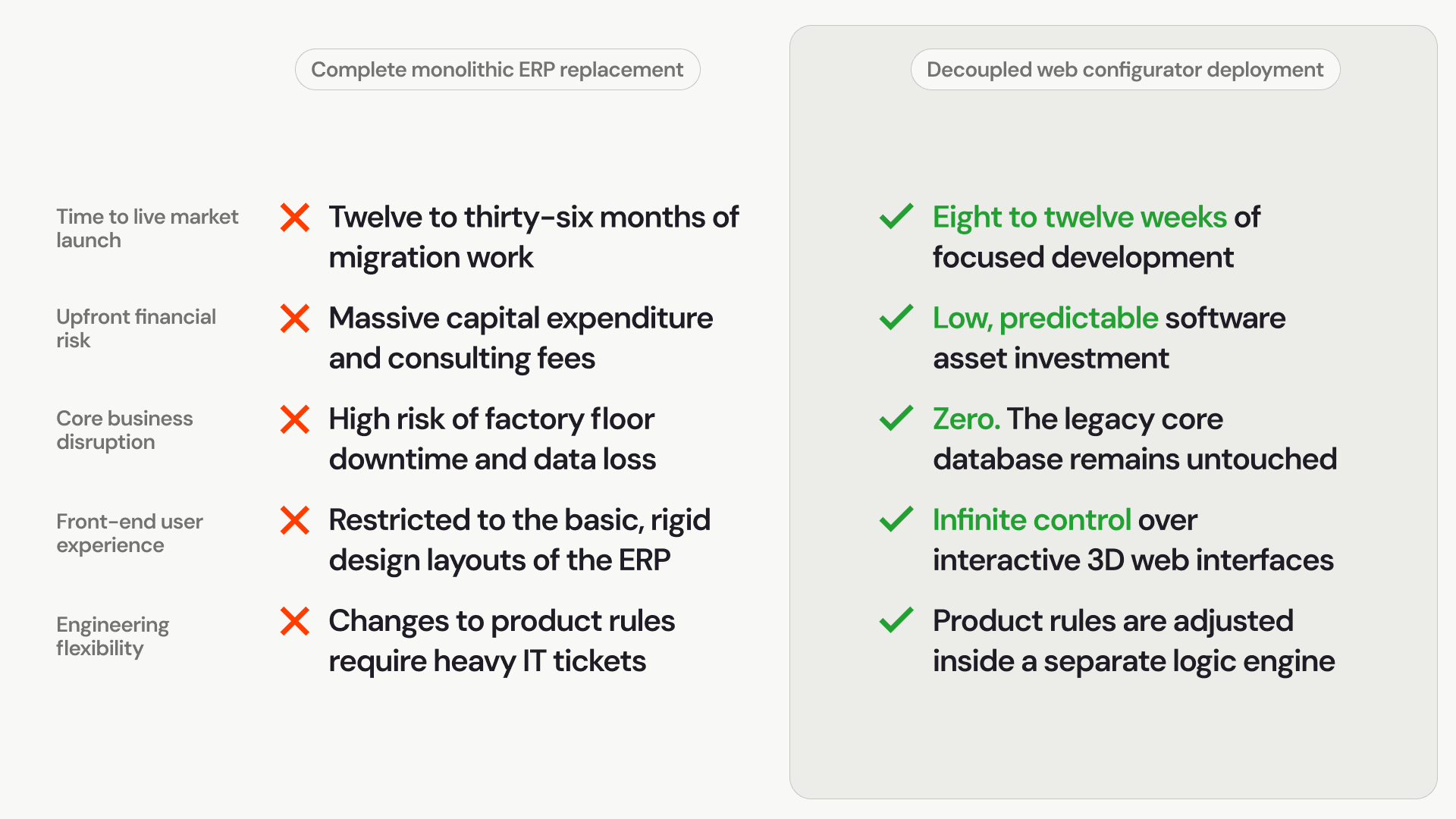
Comparison: ERP replacement vs. decoupled API deployment
Deploying a decoupled visual sales tool on top of your current database protects your stable operations while instantly modernizing your front-end customer experience:
How to connect a web 3D configurator to legacy databases
Building a bridge between a visual configuration engine and an older ERP relies on a modern software architecture pattern known as decoupling. Instead of forcing the two systems to become one, they communicate using lightweight data translations.
1. Establish an asynchronous API bridge
Your web configurator does not need to constantly strain your legacy ERP database with heavy visual requests. Instead, a modern configuration engine uses standard Application Programming Interfaces (APIs) to sync data quietly in the background. The web application pulls inventory statuses and base pricing tiers at set intervals, keeping the user interface lightning-fast without slowing down your internal company servers.
2. Utilize a standalone product rules engine
To protect your legacy infrastructure, you keep your complex engineering formulas out of the ERP entirely. You build and maintain your configuration constraints—like geometric limitations, material combinations, and dimensional dependencies—inside a dedicated custom software layer. This separate system does the heavy lifting, validating choices in the user's browser before any data is sent back to your office systems.
3. Streamline checkout with structured data injections
When a customer clicks checkout on your website, your legacy ERP does not need to process the 3D graphics. The configuration engine strips away the visual components and compresses the order into a clean, highly structured text token, such as a standardized JSON payload or a flat database string. The software injects this clean string directly into your existing ERP order queue, appearing exactly like a manual entry but without the human delay or typos.
Protecting your infrastructure while scaling your sales
Tying your commercial growth to a massive database overhaul is an unnecessary operational risk. It strains your technical staff, drains your budget, and keeps your sales network stuck using legacy tools.
Deploying an independent, decoupled visual configurator allows you to upgrade your sales pipeline immediately while keeping your core business data safe and secure. By connecting a modern 3D interface to your existing ERP through a smart API layer, you give your customers a fast, interactive buying journey while keeping your daily manufacturing operations completely stable.