How to Connect Manufacturing Sales Directly to the Shop Floor Without Manual Data Entry

For custom manufacturers, the hand-off between the initial sales meeting and the physical assembly line is a major source of friction.
Sales teams speak in commercial language: sizes, colors, and user functions. The factory floor needs technical instructions: part numbers, raw material lengths, and exact cutting steps.
Sales quote ➔ Manual data re-entry ➔ ERP planning ➔ Drafting ➔ Shop floor
❌ Error risk: High
Traditionally, companies bridge this gap with manual data entry, paper files, and constant phone calls. Every time an employee manually copies data from a CRM into an ERP system or a physical shop traveler, your business loses time and risks introducing severe data corruption.
Eliminating manual data re-entry is the fastest way to accelerate production, stop administrative waste, and guarantee that what your customer designs on screen is exactly what your factory builds.
The hidden costs of manual order translation
When your manufacturing workflow relies on manual data re-entry, it acts as an invisible tax on every order, causing three major structural problems:
The translation gap: When a sales rep manually types a custom request into a text note (e.g., "Customer needs extra structural support on the rear corner"), the production planner and the shop technician will interpret that sentence differently, frequently resulting in an incorrect build.
The version control nightmare: B2B buyers change their minds. If a customer modifies a dimension mid-cycle, that change must be manually updated across your quote, your ERP inventory, and your CAD drawings. If even one system is missed, the factory floor builds a discarded version of the product.
Administrative workflow drag: Your plant capacity becomes bottlenecked by data processors instead of your actual machinery. If your engineers spend hours every week typing part numbers from one screen into another, your lead times stretch out before production even begins.
Comparison: Manual paperwork vs. automated data flowsHow an automated sales-to-shop pipeline works
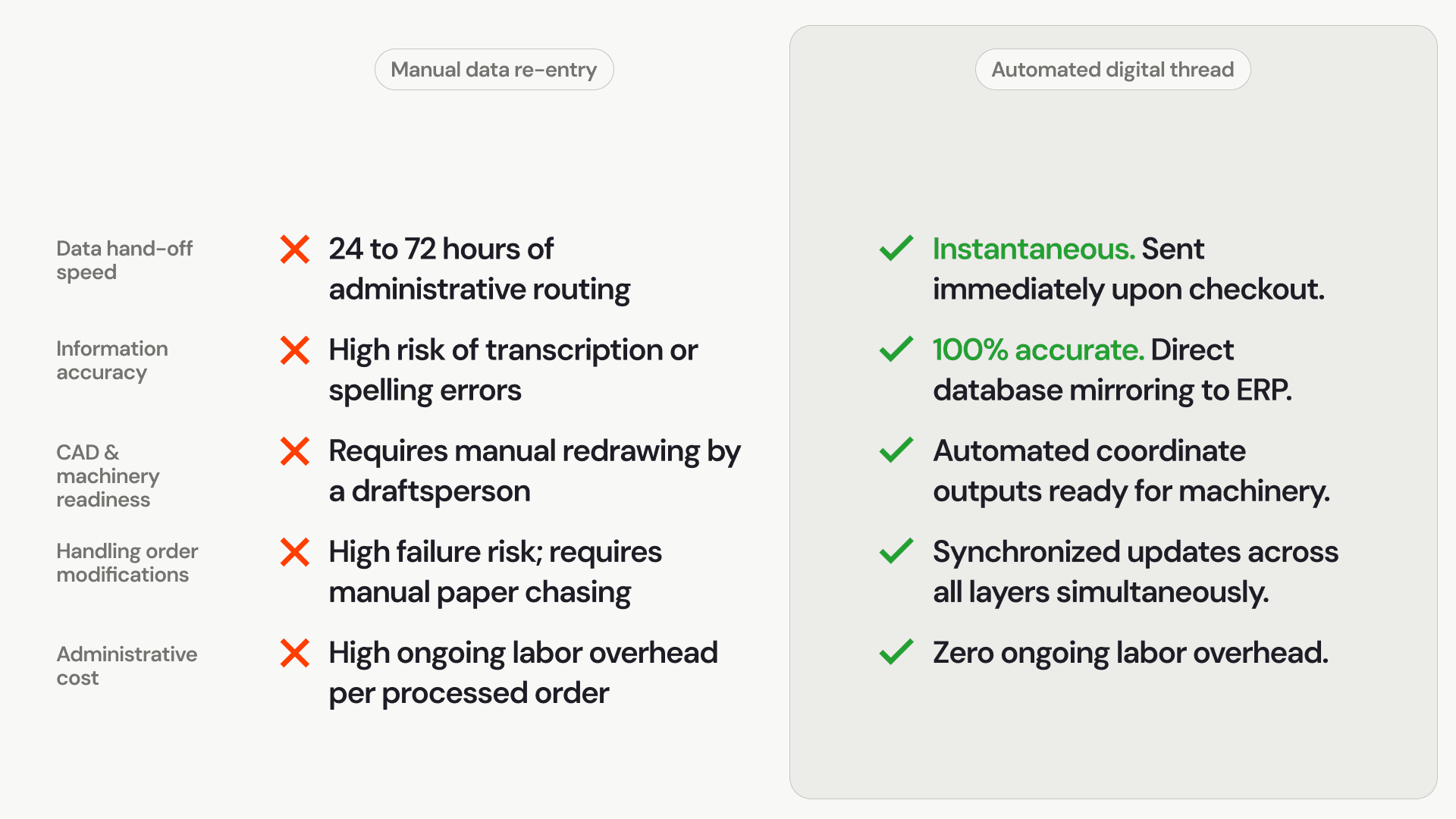
How an automated sales-to-shop pipeline works
To remove human data entry entirely, your front-end sales tool or 3D configurator must act as the primary data capturer for your entire business. Instead of generating text summaries, the logic engine maps the user's choices directly to your factory's operational data models.
Customer customizes 3D product online
▼
Logic engine processes parametric dimensions
▼ ▼
Direct ERP allocation Instant shop traveler packet
Direct database token mapping
A modern configuration engine does not treat user choices as isolated text options. Every slider, button, and material choice on the front-end user interface is mapped directly to specific database tokens that your ERP system understands. If a user increases an assembly's width, the software automatically translates that physical movement into exact, hard part numbers, length specifications, and weld sequences.
Instant shop traveler generation
Instead of a production planner sitting down to compile a physical build packet, the smart logic engine structures the shop traveler instantly. The system takes the verified model designed on screen and auto-populates a clean digital template containing the precise cutting lists, hardware counts, and quality control check-boxes.
Parametric CAD file extraction
For custom items that require automated machining, CNC routing, or precision laser cutting, the logic engine bypasses manual drafting entirely. Because the web application captures exact, validated dimensions, it can output structured file packets (like clean JSON coordinate sets or vector paths) directly to your downstream nesting or automated cutting software.
The operational benefits for your factory
Legacy way: Sales quote ➔ Admin review ➔ Manual ERP entry ➔ CAD drafting ➔ Shop floor (days lost)
Automated way: Sales quote ➔ Instant rules validation ➔ Direct ERP & shop feed (minutes lost)
Reclaiming expensive engineering hours
Your engineers did not go to school to act as data entry clerks. When you automate the data flow from the sales interface directly to the shop traveler, your technical team is completely freed from routine quoting chores. They can step out of the daily transactional firefighting loop and focus on high-value tasks like product R&D and refining factory floor flow.
Wiping out scrap costs at the root
The most expensive errors are the ones you make yourself through poor internal communication. If a customer receives an industrial build that is missing a critical bracket simply because a sales rep forgot to write it down on a spreadsheet, your company absorbs the entire cost of the remake. Removing manual data entry ensures that the exact engineering math validated during the sales session is what guides the technician's hands on the floor.
Infinite scaling without administrative overhead
In a traditional manufacturing model, doubling your weekly order volume requires you to double your administrative staff just to handle the crushing volume of quotes, drawings, and order entries. An automated data thread breaks this linear dependency. Your sales volume can scale infinitely, and your order data will flow smoothly to the production floor without adding a single dollar of administrative overhead to your operational sheet.