How Specialized Manufacturers Use Web 3D Configurators to Win Major Contracts

When competing for lucrative commercial contracts, smaller and highly specialized manufacturers frequently find themselves at a disadvantage against industry giants. Large conglomerates win bids not necessarily because their products are superior, but because they possess armies of sales engineers capable of rapidly churning out polished presentations, structural layouts, and formal quotes. For a leaner manufacturing team, dedicating dozens of engineering hours to a speculative bid is a massive operational risk.
To compete and win, specialized manufacturers are deploying web-native 3D product configurators. By embedding engineering logic and hyper-realistic, interactive 3D rendering directly into the web browser, these tools allow small sales teams to deliver immediate, flawless, and visually stunning project proposals. This effectively neutralizes the resource advantage of larger competitors on speed, precision, and customer experience.
The asymmetry of the bidding process
In major procurement cycles, B2B buyers — ranging from general contractors to industrial project managers — face a major point of friction: visualization risk. They are hesitant to award contracts for custom equipment, modular structures, or complex assemblies based on flat 2D blueprints, confusing part numbers, and dense text spreadsheets.
Company ➔ Has 20 sales engineers ➔ 24-hour 3D proposal turn around
Specialized shop ➔ Has 2 core engineers ➔ 7-day drawing delay (misses deadline)
Larger operations absorb this friction by flooding the bid with drafting resources. Leaner manufacturers get trapped in a damaging cycle:
The speculative drafting trap: Spending thousands of dollars in unbilled engineering time drafting custom CAD layouts for a bid that might fall through.
The "good enough" proposal penalty: Submitting a basic text quote with a standard product catalog photo, hoping the buyer has the imagination to understand why your custom solution is better. (Spoiler: They usually choose the competitor with the clear 3D render).
The speed gap: Taking days or weeks to return a revised technical drawing when a project manager requests a minor modification, stalling the buyer's momentum.
Technical comparison: Traditional RFP responses vs. Web 3D configurator enablement
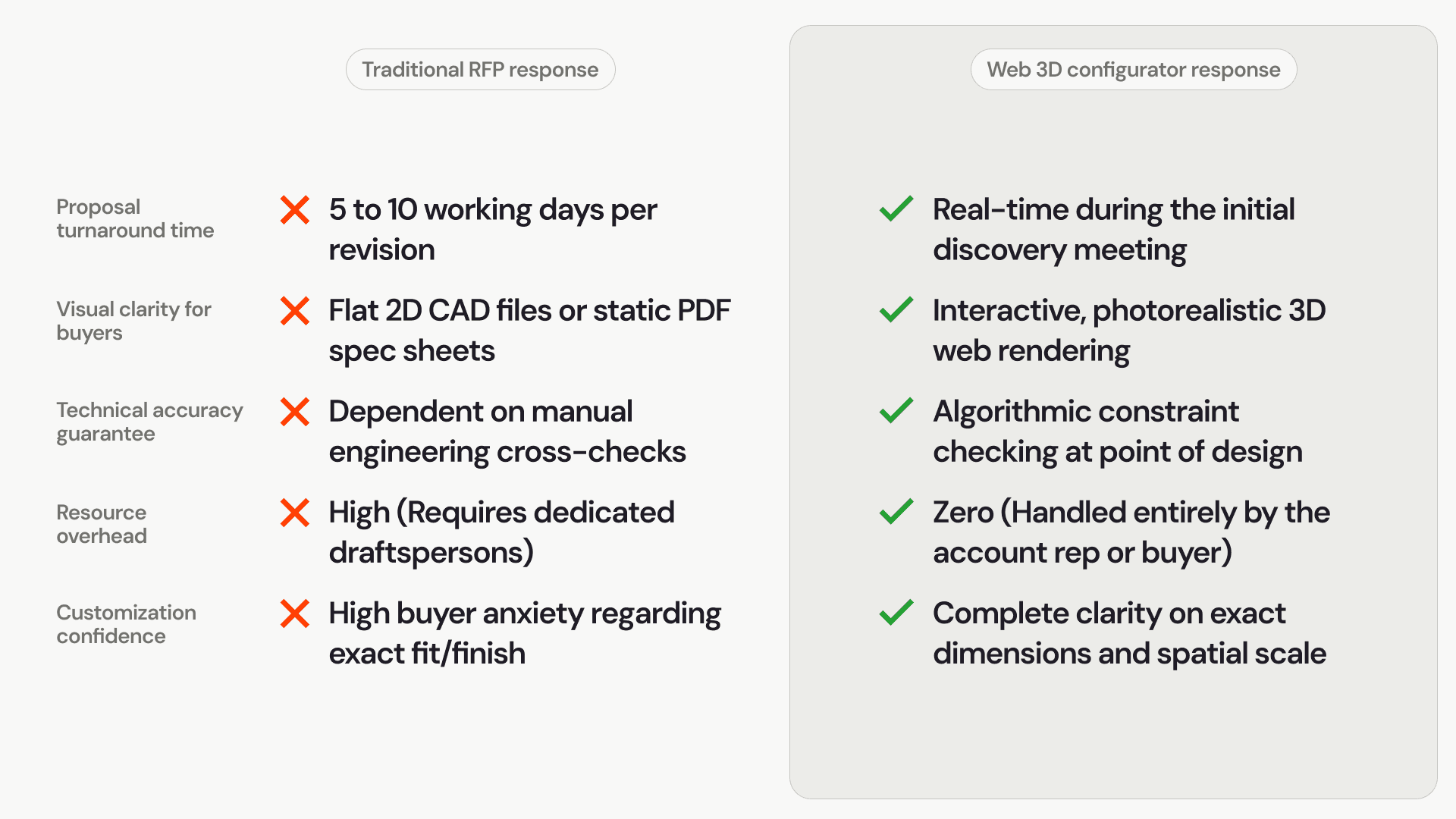
How Web 3D tools equalize the sales cycle
Deploying an interactive 3D configuration engine completely alters the dynamics of commercial bidding by shifting the engineering burden onto automated, web-native logic layers.
1. Instant photorealistic Proof-of-concepts
Instead of sending a buyer a dry, text-based estimate, your sales team can open a laptop or tablet and build the exact project solution live. Modern web-based graphics layers load complex, heavy physical structures instantly in any standard browser without requiring software installations. Buyers can spin, zoom, and inspect custom finishes, sub-assemblies, and physical profiles, instantly eliminating any ambiguity about what is being purchased.
2. Live technical and regulatory guardrails
A custom 3D configurator does not just render images; it enforces real-world physics and engineering rules. If a project manager requests a modification during a presentation (e.g., "What if we expand this structural rack by four feet?"), the sales rep can make the adjustment on the spot. The logic engine automatically handles component spacing, weight tolerances, and part dependencies instantly, providing a fully validated revision on screen alongside updated pricing.
3. Transparent, frictionless bid collaboration
Commercial contracts rarely have a single decision-maker. Procurement, operations, and executives all need to sign off. A web-native configurator allows your sales team to generate a unique, shareable URL for a specific configuration. The buyer can send that link directly to internal stakeholders, who can open the exact 3D model on their own screens, adjust options, and visualize the solution without miscommunication.
Live client meeting ➔ Interactive 3D adjustments ➔ Instant visual & price approval ➔ Shared project link
Winning on agility, not headcount
By automating the presentation and validation layers of your custom product line, you eliminate the resource barrier that keeps specialized shops from winning premium contracts.
You no longer need an enterprise-sized sales engineering department to impress enterprise-level buyers. With a high-performance web 3D configurator, your sales reps can deliver faster turnarounds, more accurate specs, and a vastly superior interactive buying experience than the sluggish legacy players. In the modern bidding landscape, speed and visual certainty beat brute corporate size every single time.