How 3D Validation Eliminates Manufacturing Order Errors and Costly Redos

Every manufacturing executive and plant manager knows the sudden drop in the stomach that occurs when a custom assembly hits the shop floor, only for a technician to discover that a critical mounting flange is offset by two inches.
At that exact moment, the machinery grinds to a halt. The order is flagged, material is scrapped, and a frantic email chain flies back to engineering and sales to figure out who messed up the specifications. In custom manufacturing, order errors are structural profit killers. They don't just cost money in wasted aluminum, steel, or timber; they steal your plant’s capacity, throw off production schedules, trigger expensive expedite fees, and damage customer relationships.
The traditional way of catching these errors — relying on manual cross-checks, checklist audits, and back-office review teams — is failing because human eyes cannot keep up with high-variance product logic. The solution to stopping this operational bleeding is embedding real-time 3D validation directly into the initial sales process. By locking engineering logic into a visual rules engine at the point of sale, you make it mathematically impossible to submit an unbuildable order.
Where the leakage happens
Order errors rarely happen because a customer or sales rep wants to make a mistake. They happen because traditional text-based ordering systems completely separate the commercial choice from the physical reality of the product.
Text dropdown: Bracket type A + Manual input: width 450mm ➔ No Visual check ➔ Order placed
Shop floor reality ➔ Bracket type A physically interferes with a structural weld at 450mm
❌ RESULT: Screeching halt, scrapped parts, 48-hour delay
When your sales pipeline relies on static PDFs, manual spreadsheets, or basic online text forms, you introduce three distinct points of failure:
The spatial blindspot: A customer or independent distributor can easily select two perfectly valid options from a dropdown menu that cannot physically exist in the same space. For instance, selecting an extra-large access hatch and a specific structural reinforcement beam that overlap.
The manual hand-off translation gap: A sales rep sketches a custom modification on a notepad during a client meeting. They type it up as a text note in the CRM. The production scheduler reads the note and interprets it differently. The CNC programmer codes it a third way. By the time it hits the shop floor, the original intent is completely lost.
The tolerances disconnect: A buyer custom-configures a modular enclosure and stretches the dimensions to a custom length. Without an active rules engine, the system accepts the input, completely missing the fact that at that specific length, the material will sag without an automated addition of a middle support pillar.
2D forms vs. real-time 3D geometric validation
To understand why 3D validation is a massive upgrade for operational efficiency, we have to look at how data is treated the moment a user interacts with a web interface:
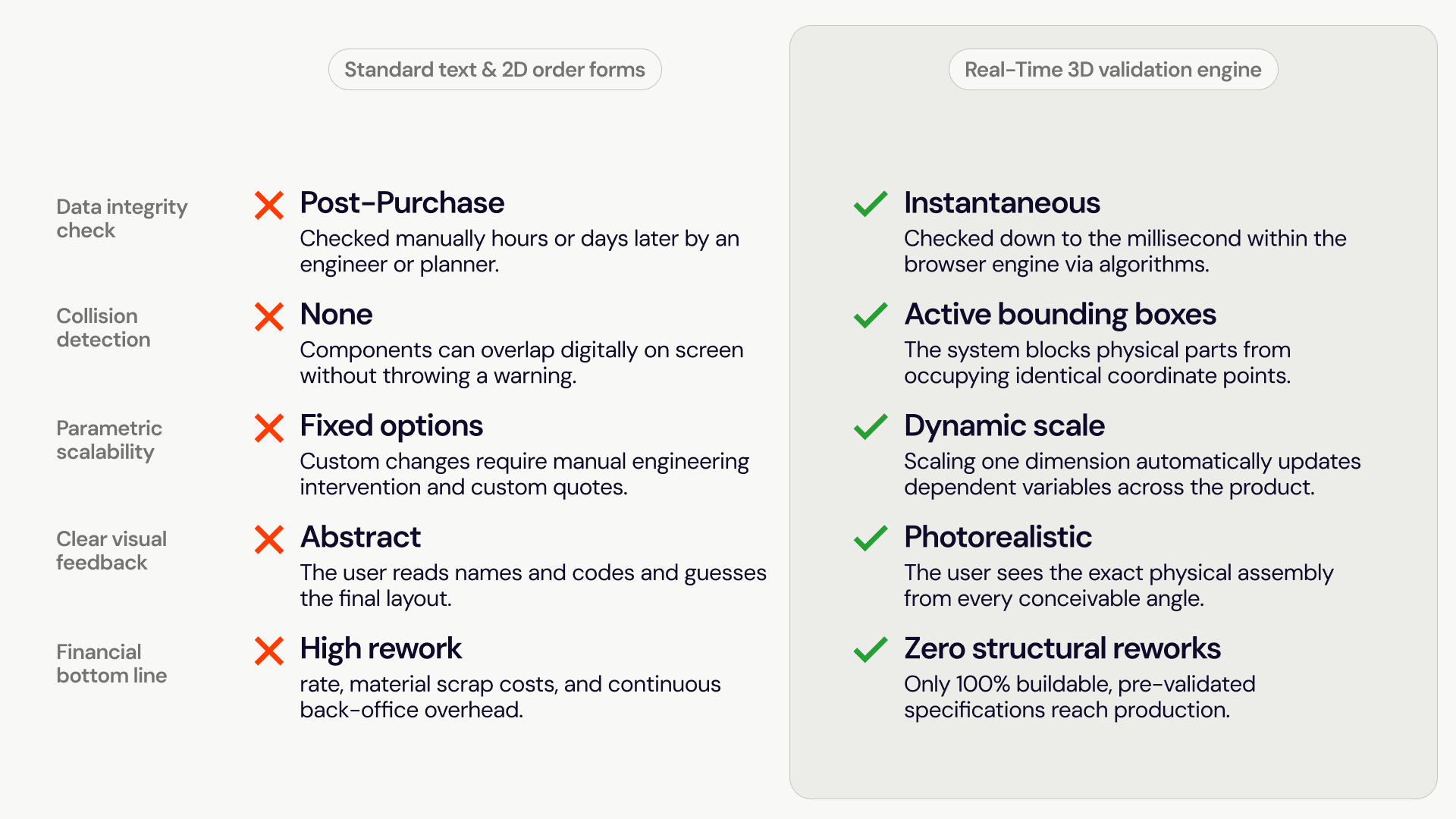
The mechanics of 3D validation: How it works behind the scenes
True 3D validation is not a simple graphics layer draped over a website. It is an engineering-first logic framework running right inside a web browser via WebGL or high-performance rendering engines. Here is the step-by-step architecture that keeps errors off your factory floor:
1. Explicit parametric constraint enforcement
Every part in your digital catalog is assigned explicit mathematical rules and dependencies. When a user changes the height of a custom shelving matrix, a heavy machinery frame, or an electronic enclosure, the engine runs continuous geometric calculations. If the height passes a specific threshold, the system automatically inserts necessary support structures, changes fastener types, or expands wall thicknesses without requiring a human to remember to do so.
User increases frame height ➔ Engine calculates structural span ➔ System auto-inserts middle support bracket
2. Matrix interferences & collision detection
A premium 3D configuration engine assigns invisible physical boundaries—known as collision meshes or bounding boxes—to every single component. If a sales rep tries to mount an instrument panel too close to a mechanical hinge, the engine actively stops the part from snapping into place. The application visualizes the collision in bright red, freezes the checkout button, and explains exactly what must be moved to resolve the physical conflict.
3. Real-time dimensional tolerance checks
Many custom products feature sliding scales for length, width, and depth rather than fixed increments. The logic engine enforces absolute maximum and minimum boundaries based on structural material physics and machine limitations. If a buyer tries to type in a custom length that exceeds what your factory floor press-brake or cutting machine can physically accommodate, the input field automatically snaps back to the maximum allowable limit with an inline explanation.
🚫 CANNOT SUBMIT ORDER: INVALID CONFIGURATION
[!] Collision detected: Access valve B overlaps support beam C
[!] Resolution Required: Please shift access valve B at least
50mm to the left, or select a smaller valve profile
The ultimate benefit: transforming the factory floor
When you eliminate order entry errors via automated 3D validation, the operational ripple effect completely transforms the economics of your manufacturing facility.
Wiping out the hidden costs of scrap material
When an unbuildable order slips through to the shop floor, the financial loss is compounded. You lose the raw raw material, the electricity used during initial processing, and the highly specialized labor time spent cutting, welding, or preparing a part that will ultimately end up in the dumpster. 3D validation ensures that you only cut raw materials for orders that are mathematically guaranteed to fit together seamlessly.
Reclaiming frozen factory throughput
The most expensive thing in a manufacturing plant is an idle machine center. When an order error is discovered mid-production, that entire assembly line stalls while the shop lead hunts down the correct drawings or waits for a revised bill of materials. By sending pre-validated data streams directly into your production queue, your shop floor maintains a continuous, uninterrupted flow, maximizing your true capacity.
Protecting strategic profit margins
When a customer receives a custom delivery only to find out it doesn't fit due to a messy sales rep's order form mistake, the manufacturer usually eats the cost of the remake to save the business relationship. This completely destroys the profit margin of that account. Moving validation to the front-end ensures that every order is built right the first time, protecting your hard-earned margins and cementing your reputation for flawless delivery precision.