From Days to Minutes: How Manufacturers Can Automate Complex Quotes Without Flooding the Engineering Department

When a sales rep or distributor requests a quote for a highly customized product, the standard manufacturing process grinds to a halt. Sales cannot guarantee engineering feasibility, so the quote is sent to the engineering department. This creates an immediate bottleneck: engineers spend valuable hours drafting proof-of-concept designs for deals that may never close, while buyers wait days for a price.
The fix is not hiring more engineers or adding administrative layers. The solution is moving your product’s physical engineering constraints into a web-native configuration engine that automates the quoting process while ensuring 100% buildable specifications.
The root cause of the quoting bottleneck
In custom manufacturing, a quote is rarely just a price tag—it is a technical promise. Because your products feature dependent variables (e.g., changing the length of an industrial enclosure dictates a change in support brackets and cable routing), sales teams cannot simply look up a price on a spreadsheet.
Customer request ➔ Sales rep formulates quote ➔ Engineering checks feasibility ➔ Revisions needed ➔ Final quote to customer
Result: 3 to 7 days of friction, administrative overhead, and frustrated buyers.
When engineering must manually validate every single high-variance order request, your business suffers from two distinct forms of leakage:
Engineering drain: Your most expensive technical assets spend their days reviewing repetitive, routine configurations instead of designing new product lines or optimizing floor operations.
Lost deals: Modern buyers expect immediate turnarounds. If a competitor can provide a validated, buildable quote in minutes while your team takes days, you lose the contract on speed alone.
Technical comparison: Manual engineering validation vs. automated rules engines
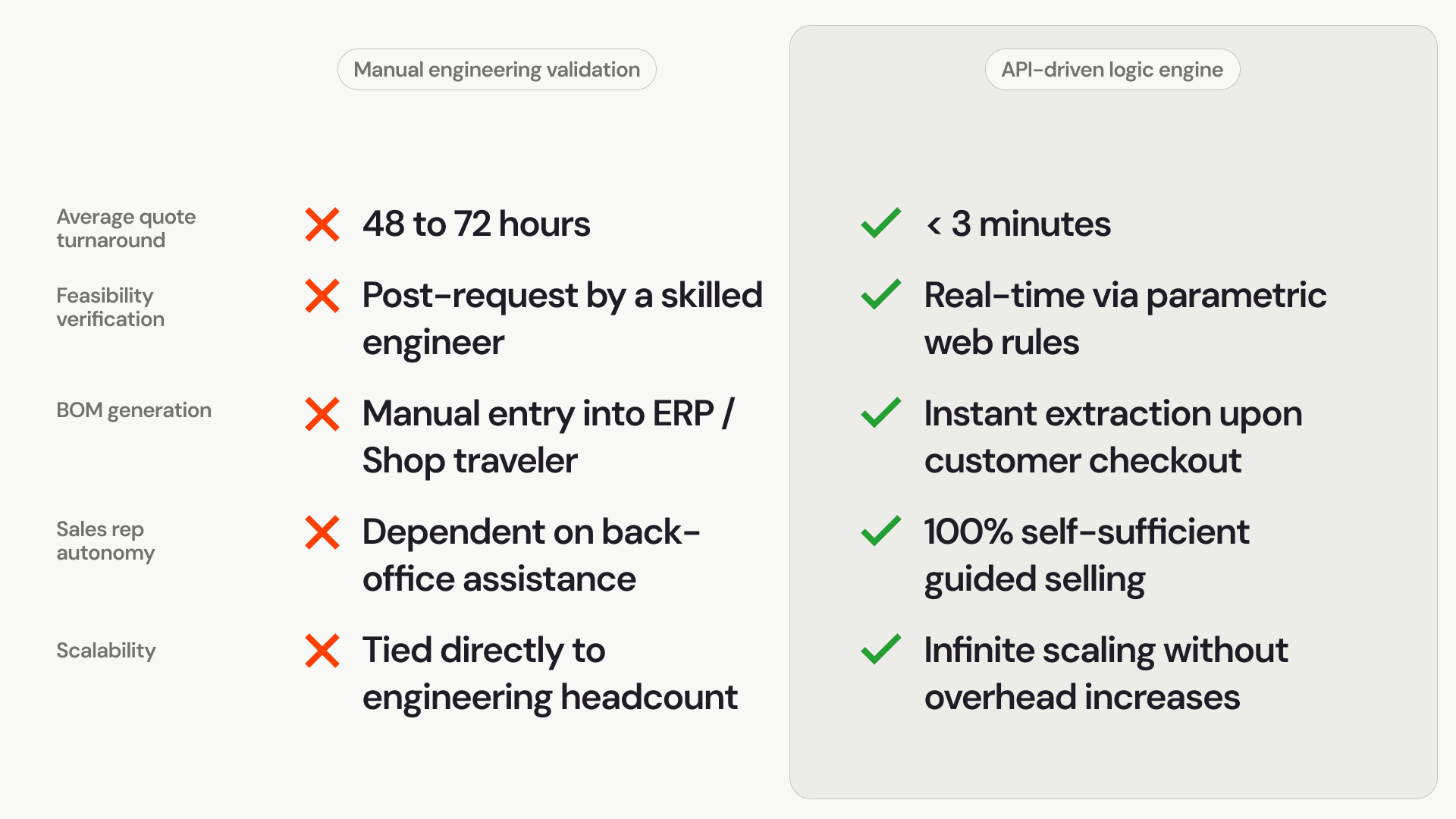
Step-by-step architecture: Automating the pipeline safely
To safely offload quoting from your engineering department without risking order errors, your digital sales channel must be powered by an architectural framework that respects physical constraints.
1. Parametric constraint enforcement
Instead of relying on rigid, pre-packaged SaaS catalog models that break when a custom dimension is requested, a custom configurator utilizes parametric rules. This means every component is mathematically linked. If a buyer adjusts a width dimension on the web interface, the smart logic engine automatically recalculates structural load thresholds, spacing tolerances, and maximum weight allowances instantly within the browser.
2. Live geometric validation
By leveraging light, fast web graphics frameworks (such as optimized WebGL layers), the interface acts as a visual guardrail. If a sales rep attempts to place a component where it physically cannot fit, the system rejects the input instantly. The interface communicates why the configuration is invalid and guides the user toward a buildable alternative. Engineering logic is applied dynamically at the point of sale.
3. Direct sales-to-shop-floor automation
The true bottleneck breaker is what happens after the quote is accepted. Because the logic engine handles the geometric rules, it bypasses manual draft entry entirely. The system instantly exports:
An accurate Bill of Materials (BOM) matched to exact inventory codes.
A clean mBOM (Manufacturing Bill of Materials) indicating exact sub-assemblies.
The raw data parameters required to feed your downstream ERP or automated cutting tools.
Validated web configuration ➔ Automated BOM generation ➔ Direct ERP injection ➔ Shop Floor
Validated web configuration ➔ Automated BOM generation ➔ Direct ERP injection ➔ Shop floor production
Reclaiming engineering hours
Moving to an automated, visual quoting architecture changes the daily realities of a manufacturing plant. Sales reps can sit with a customer, build a complex layout, verify its buildability on a screen, and issue an accurate, margin-protected price quote before the meeting ends.
Engineering departments are instantly freed from the quoting loop. Instead of parsing messy RFQ emails and redrawing standard components, your engineering team can focus entirely on true custom edge cases, continuous product improvement, and scaling factory floor throughput.