Eliminating the RFQ Bottleneck: How to Move Custom Configurations Directly into Your Production Pipeline

The traditional Request-for-Quote (RFQ) process is an operational black box. When a customer or sales rep submits an inquiry for a custom configuration, the data typically enters a slow loop of manual translation — from a messy email string, into a conceptual sales drawing, and eventually into a production-ready blueprint.
Every manual handoff introduces data latency, misinterpretation risks, and idle factory time. Eliminating the RFQ bottleneck means entirely removing human translation between the buyer’s selection on your website and the data driving your factory floor. By converting custom web configurations into instant, structured manufacturing data, you can channel orders directly into your production pipeline.
Why the manual RFQ loop stalls the production floor
In many manufacturing facilities, the engineering department acts as a manual data translator. The problem stems from a major disconnect between how a sales team speaks about a product and how the shop floor actually builds it.
Customer request ➔ Sales spec sheet ➔ Manual data re-entry ➔ Engineering blueprint ➔ Manual BOM draft ➔ Production floor
This broken pipeline creates severe operational drag across three distinct friction points:
Data re-entry errors: Copying dimensions and part numbers from an email or sales form into an ERP or CAD program opens the door to transcription mistakes. A single misplaced digit can lead to scrapped materials on the shop floor.
Version disconnects: If a customer changes their mind mid-RFQ, updating the sales quote, the engineering drawing, and the material requirements list simultaneously without losing sync is highly error-prone.
Inventory blindness: Traditional RFQs are priced based on historical or static data. If a customer configures a part that relies on a backordered component or a material with spiking costs, the issue isn't caught until the order is already scheduled for production.
The technical fix: From web input to production output
To move from a slow RFQ system to a direct production pipeline, your sales interface must capture and store configuration rules as clean, structured operational data. Instead of generating flat images or simple text notes, a custom configuration engine structures the buyer’s choices into an explicit parametric data model.
Data flow comparison: RFQ vs. direct pipeline
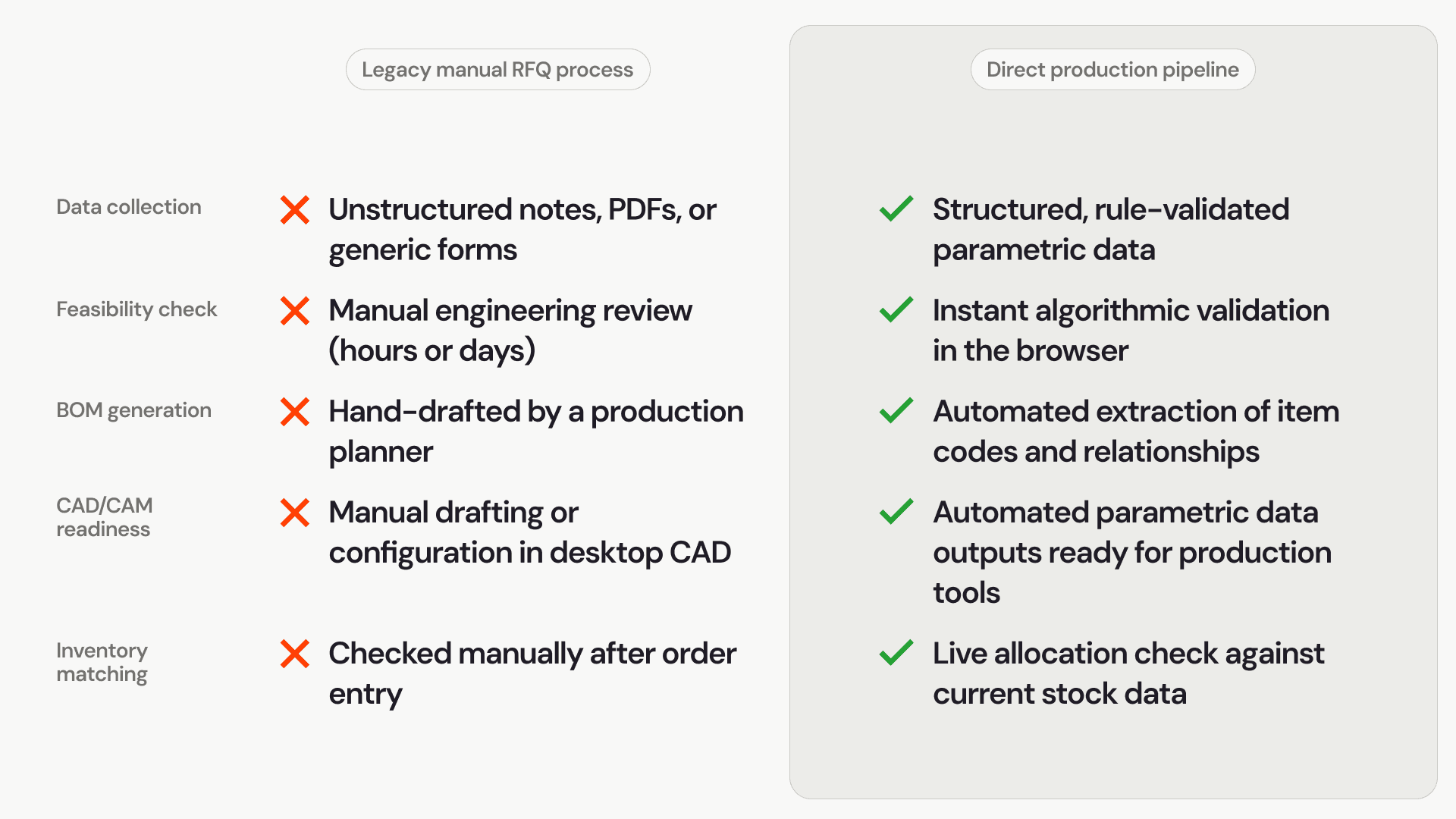
The core stages of direct-to-production architecture
Achieving this seamless transition requires connecting your web-based configuration logic directly to your downstream operational systems.
1. Generating a dynamic Bill of Materials (BOM)
A web configurator shouldn't just look visually accurate; it must be a structural map of the product. When a user modifies a dimension, adds an optional component, or changes a finish, the underlying logic engine dynamically modifies the parent-child relationships of the parts list. The moment the user approves the layout, the system exports a complete sales and manufacturing BOM, explicitly matching your internal component stock codes.
2. Streamlining ERP and shop traveler injection
Instead of forcing your operations team to manually type approved quotes into your ERP or generate physical shop travelers by hand, the configuration engine pushes structured data packets via direct APIs. The system populates the production queue automatically, flagging the precise cut lists, routing instructions, and assembly steps based entirely on the customer’s custom selections.
3. Supplying downstream production rules
Because the configuration parameters are locked in and mathematically validated during the web session, the data output can be structured to assist production automation. The engine provides the exact coordinate sets, bounding boxes, and parametric dimensions needed to feed nesting software or CNC cutting equipment, bypassing the typical drafting delay.
Web UI interaction ➔ Algorithmic validation ➔ Instant structured data output ➔ Automated ERP queue
Accelerating factory throughput
By turning your sales interface into the primary mechanism for order data capture, you convert the traditional, sluggish RFQ into an instantaneous production trigger.
The advantages extend far beyond a faster sales cycle. Your factory floor receives error-free, pre-validated build specifications that match your live inventory, eliminating administrative rework. By wiping out the manual translation layer, you drastically compress lead times, reduce scrap rates, and maximize your plant’s true production capacity.