Democratizing Product Rules in CPQ: Managing Engineering Constraints Without Coding

Manufacturers are facing increasing pressure to deliver highly configurable products while maintaining production accuracy, shorter sales cycles, and operational scalability. As product complexity grows, traditional CPQ systems and configurators often become difficult to maintain because engineering logic remains dependent on developers.
Modern CPQ platforms are addressing this limitation through democratized product rule management — an approach that allows engineering, product, and sales teams to update product constraints and configuration logic without modifying source code.
For manufacturers operating with configurable products, flexible rule management is becoming a critical component of digital infrastructure.
Why traditional rule management creates bottlenecks
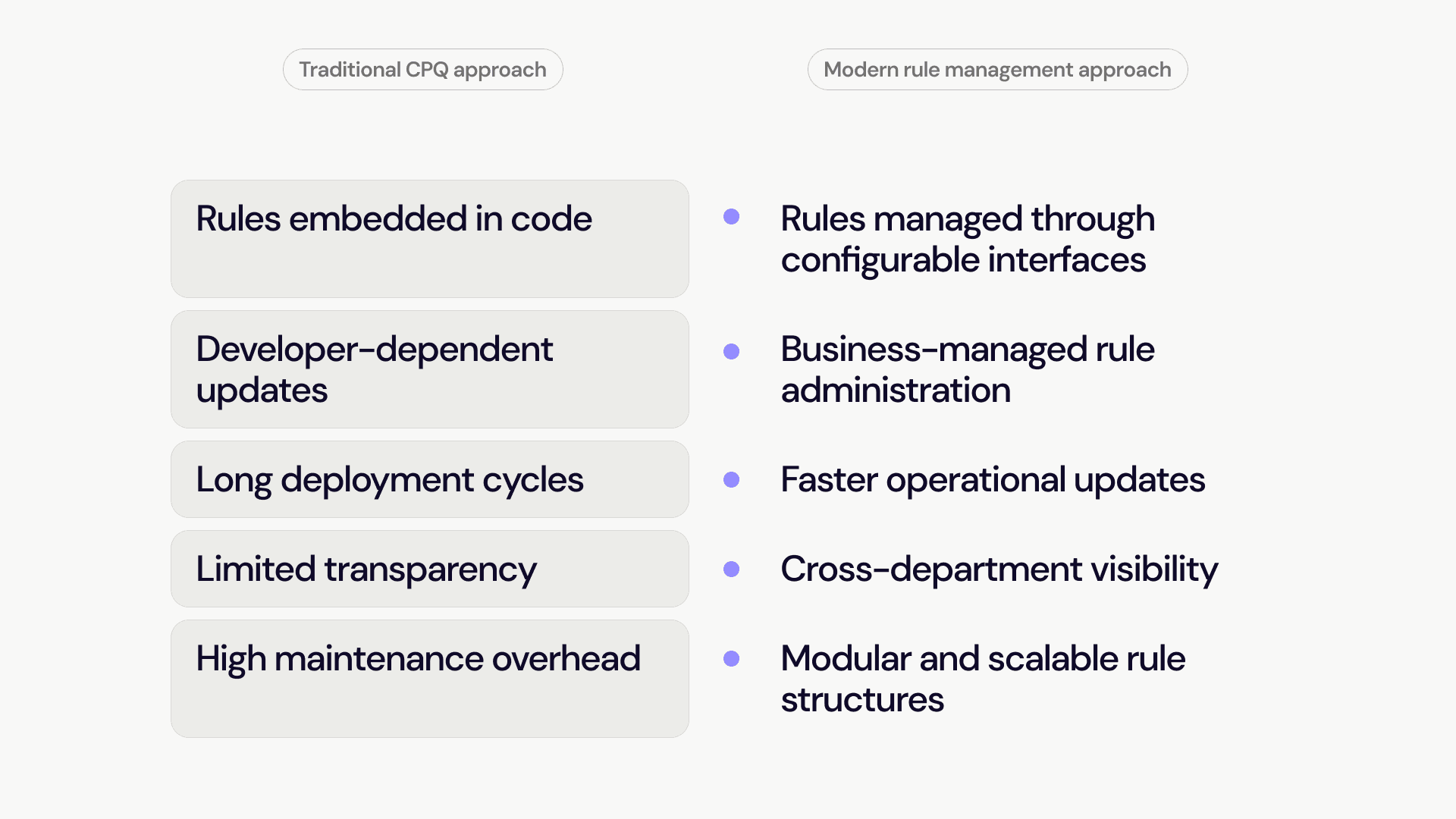
In many legacy CPQ environments, configuration logic is embedded directly into backend development layers. Product compatibility, dimensional limits, manufacturing restrictions, and pricing conditions are often hardcoded during implementation. While functional at the beginning, this architecture becomes increasingly difficult to scale as product structures evolve.
Manufacturers regularly need to adjust:
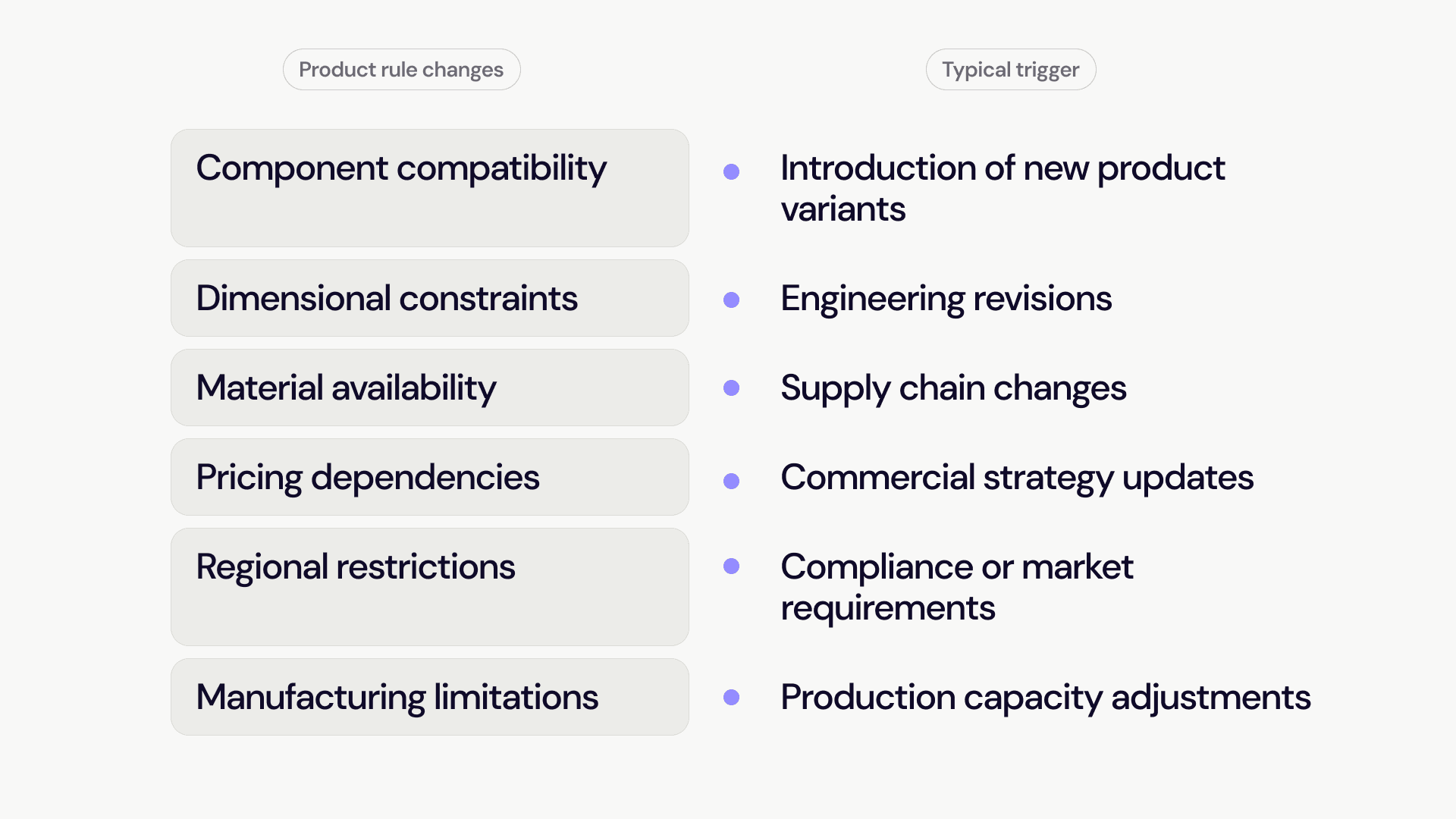
When every modification requires technical implementation, even relatively small product updates can slow down quoting, sales responsiveness, and production coordination.
The shift toward no-code product rule management
Modern CPQ systems increasingly separate engineering logic from application code. Instead of relying on developers to modify constraints manually, companies can manage rules through administrative interfaces and structured rule engines.
The goal is not to eliminate development teams from the process. Technical expertise remains essential for integrations, architecture, performance, and scalability.
The objective is operational flexibility.
Engineering and product teams can update configurable logic directly, while developers focus on platform infrastructure rather than ongoing rule maintenance.
Benefits of democratized product rules
Faster product adaptation
Manufacturers can introduce new configurable options, update compatibility conditions, or adjust production limitations without waiting for development cycles. Faster rule management improves responsiveness across engineering, sales, and manufacturing operations.
Reduced Dependency on Development Teams
Development resources can focus on integrations, infrastructure, and platform optimization instead of repetitive rule modifications. This improves technical scalability while reducing operational bottlenecks.
Improved Cross-Department Collaboration
Engineering logic becomes more transparent when managed through centralized rule systems. Sales teams gain clearer visibility into configuration limitations, while product managers can coordinate updates more efficiently with manufacturing and engineering departments.
Lower Long-Term Maintenance Risk
Hardcoded logic often creates dependency on specific developers or vendors familiar with the original implementation. Configurable rule structures improve maintainability and reduce long-term operational risk.
Core capabilities of modern rule engines
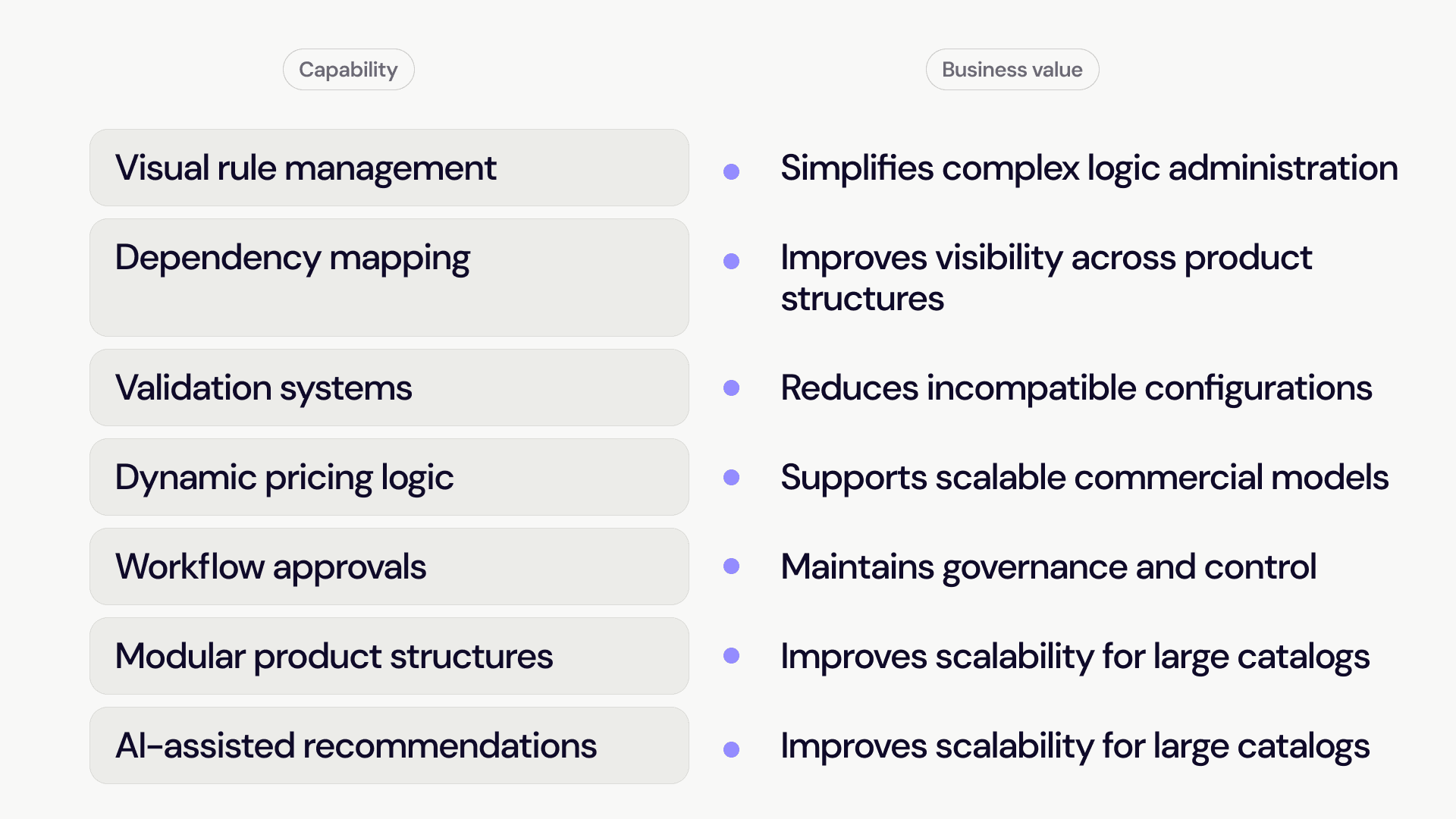
Advanced CPQ rule management systems typically include configurable frameworks designed for non-technical administration.
Key capabilities often include:
AI and the future of product configuration
As configurable products become more complex, AI is beginning to support rule administration inside CPQ ecosystems.
AI-assisted systems can help manufacturers:
identify conflicting configuration rules
detect missing dependencies
analyze failed configurations
optimize large product structures
improve quote accuracy
simplify rule maintenance
AI does not replace engineering expertise. It enhances visibility and accelerates management of increasingly complex product ecosystems.
Industries where flexible rule management delivers the highest value
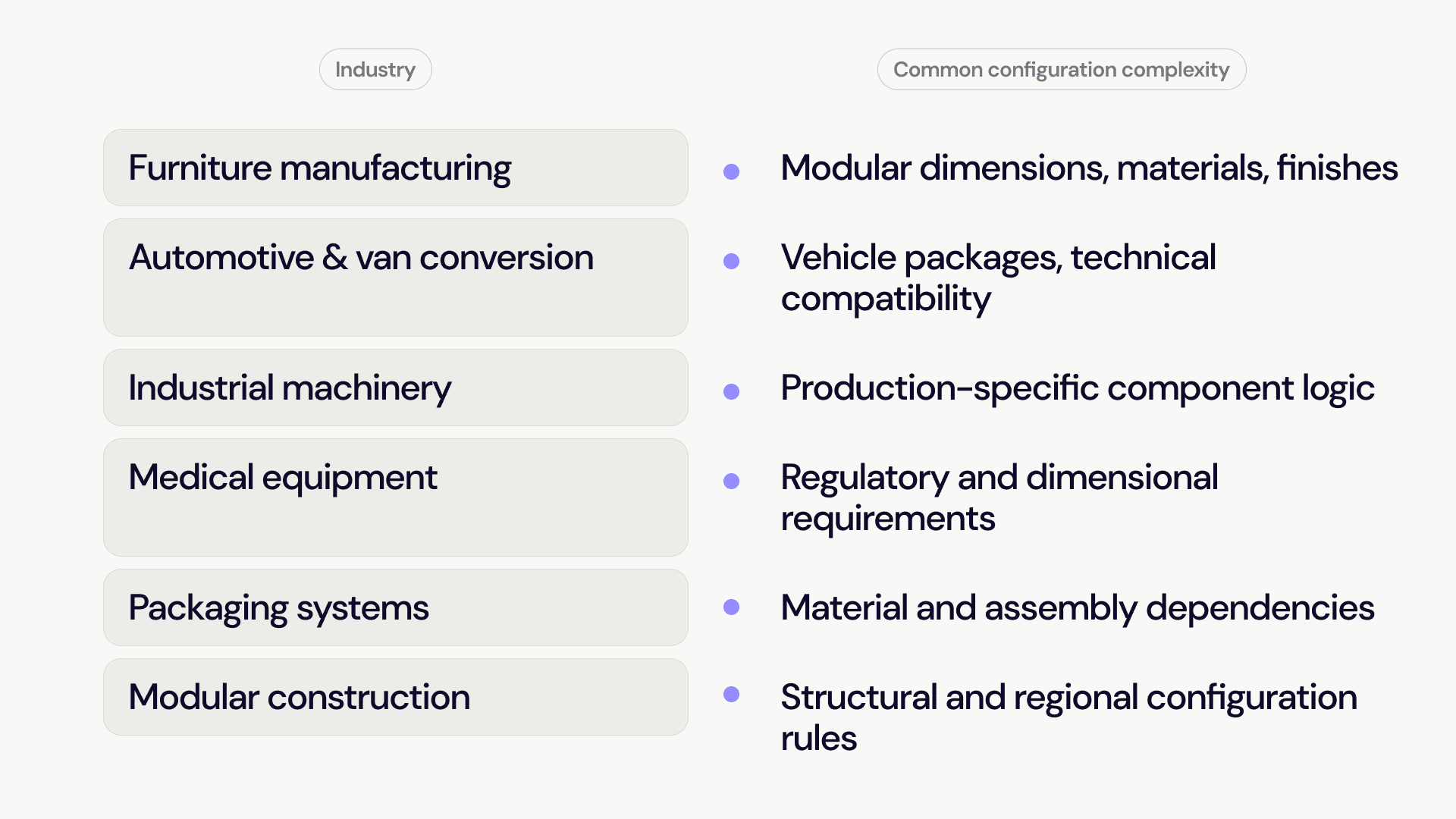
The operational impact of democratized rule management is especially significant in industries with large configurable product structures and complex engineering dependencies.
Examples include:
Conclusion
Modern CPQ systems are evolving beyond quote automation and product visualization. Manufacturers increasingly require platforms capable of supporting continuous product evolution without creating operational dependency on development teams.
Democratized product rule management enables engineering, sales, and product teams to maintain configurable logic through structured, scalable systems designed for operational flexibility.
For manufacturers managing complex configurable products, no-code rule administration is becoming an important factor in scalability, maintenance efficiency, and long-term digital adaptability.