Building Web Configurators That Enforce Parametric Manufacturing Constraints and Tolerances

When selling custom-engineered products online, giving buyers the freedom to personalize dimensions is a massive competitive advantage. B2B buyers expect to input precise length, width, and clearance measurements directly into their web browser.
However, offering complete dimensional freedom introduces a major operational hazard: invalid configurations. Without real-time engineering guardrails, a customer can easily input custom measurements that break the physical laws of manufacturing. They might design an industrial enclosure that is too wide to support its own structural load, or specify material dimensions that violate your machinery's tight tolerances.
If your website accepts these flawed designs, your sales pipeline breaks down. Your engineering team has to spend valuable hours reviewing quotes, calling clients to correct errors, and manually redrafting files.
Eliminating this friction requires real-time parametric enforcement. By embedding active manufacturing constraints and tolerances directly into your web configuration software, you make it impossible for a user to submit a broken design.
The operational cost of unvalidated customer inputs
Allowing unvalidated dimensional data to enter your ordering pipeline creates three distinct bottlenecks for a manufacturing organization:
The engineering review loop: When a custom configuration bypasses validation checks online, it lands directly on an engineer's desk. Instead of focusing on profitable new product development, your top technical minds spend their days caught in a loop of caught errors, phone calls, and manual redesigns.
Material waste and scrap: If an invalid measurement slips past a manual check and hits the production line, it leads to immediate manufacturing failure. Tool paths fail, parts warp during cutting, and expensive raw materials end up as scrap metal.
Delayed lead times: Every manual touchpoint added to verify an order's physical dimensions adds days or weeks to your delivery timeline. In a fast-paced market, slow quote-to-production cycles cause frustrated buyers to move to faster competitors.
Comparison: Manual validation vs. parametric web enforcement
Moving your manufacturing tolerances to the front-end interface shifts your business from a reactive correction workflow to a proactive prevention model:

How to embed manufacturing math into a web interface
Building a web application that respects physical constraints relies on a structured tier of calculation rules. These rules interpret your technical engineering guidelines and present them as interactive, responsive boundaries in the user's browser.
1. Establishing dependent parametric variables
In complex manufacturing, a change to one dimension rarely happens in isolation. For example, if a buyer increases the total length of a structural frame, the software must instantly recalculate the physical load. Behind the scenes, the rules engine automatically determines if the design requires an increased wall thickness for the steel or demands an extra center support brace to prevent bowing. By codifying these relational dependencies directly into the application layer, the user interface shifts dynamically, altering part requirements in real time as the customer scales the model.
2. Applying dynamic slider constraints
Instead of giving buyers an open text box where they can type any number, top-tier configurators use intelligent, dynamic sliders. The boundaries of these sliders shift adaptively based on previous selections. If a user selects a lightweight aluminum base material, the software can automatically lower the maximum allowable length slider to prevent structural bending, visually guiding the user within safe manufacturing limits.
3. Real-time tolerance warning matrices
When a configuration edges close to a manufacturing limit, the interface should provide clear feedback. By connecting the web input fields to a matrix of your machinery's precise tolerances, the software can display helpful tooltips or visual warnings if a selected hole placement sits too close to a material edge, actively explaining the mechanical limitation to the buyer.
Protecting your shop floor from ordering errors
The architectural choices you make on your website directly dictate the efficiency of your factory floor:
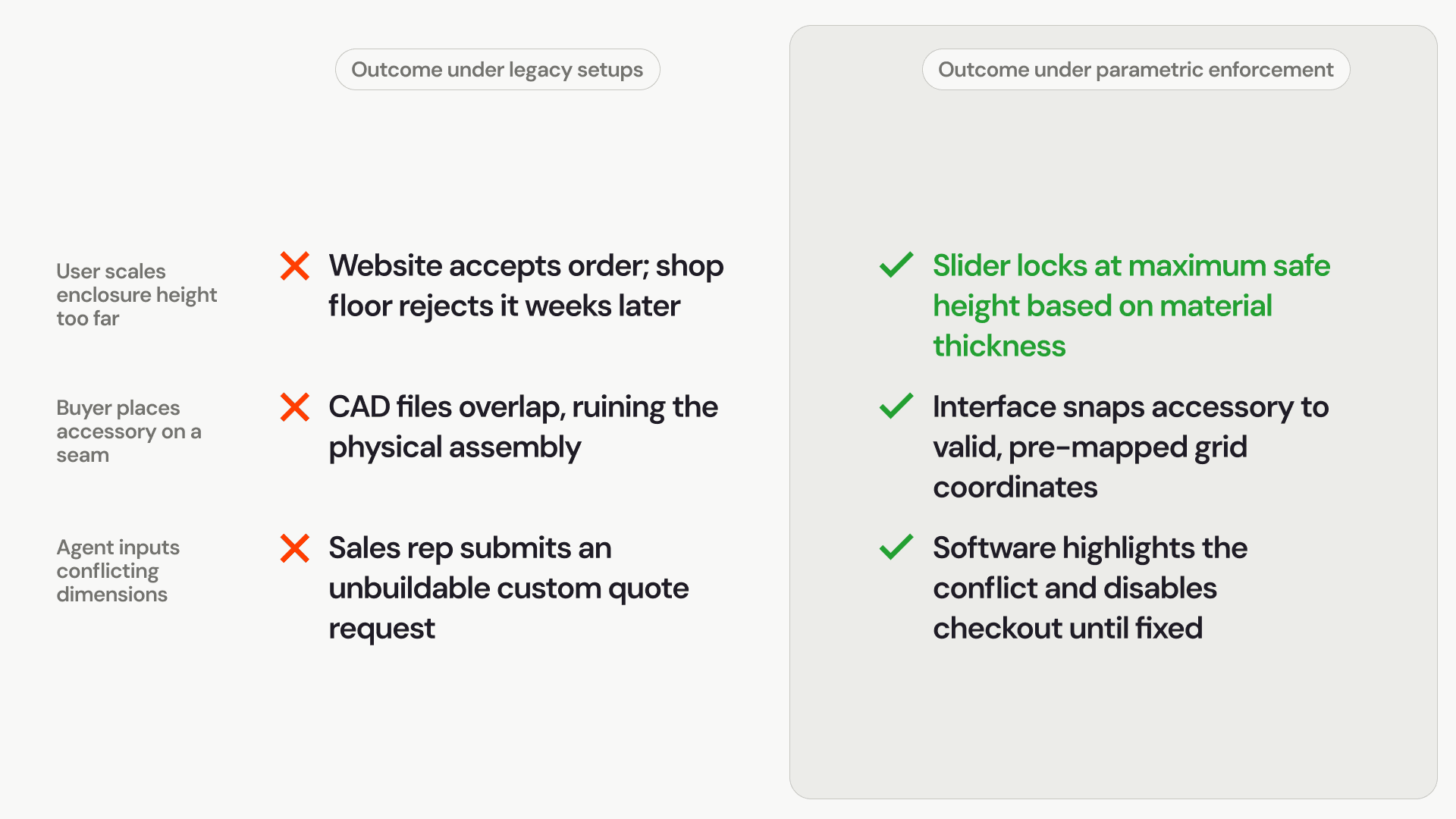
Maximizing throughput with error-proof sales
Forcing your engineering team to act as a human firewall against bad website data limits your operational throughput and slows down your sales team.
Upgrading to a web configurator driven by true parametric manufacturing logic ensures that every single order entering your system is 100% buildable from the very start. By moving your exact tolerance rules and engineering math directly into a responsive, browser-based sales tool, you eliminate costly back-and-forth revisions, slash your quoting lead times, and free your production staff to focus on scaling your output.