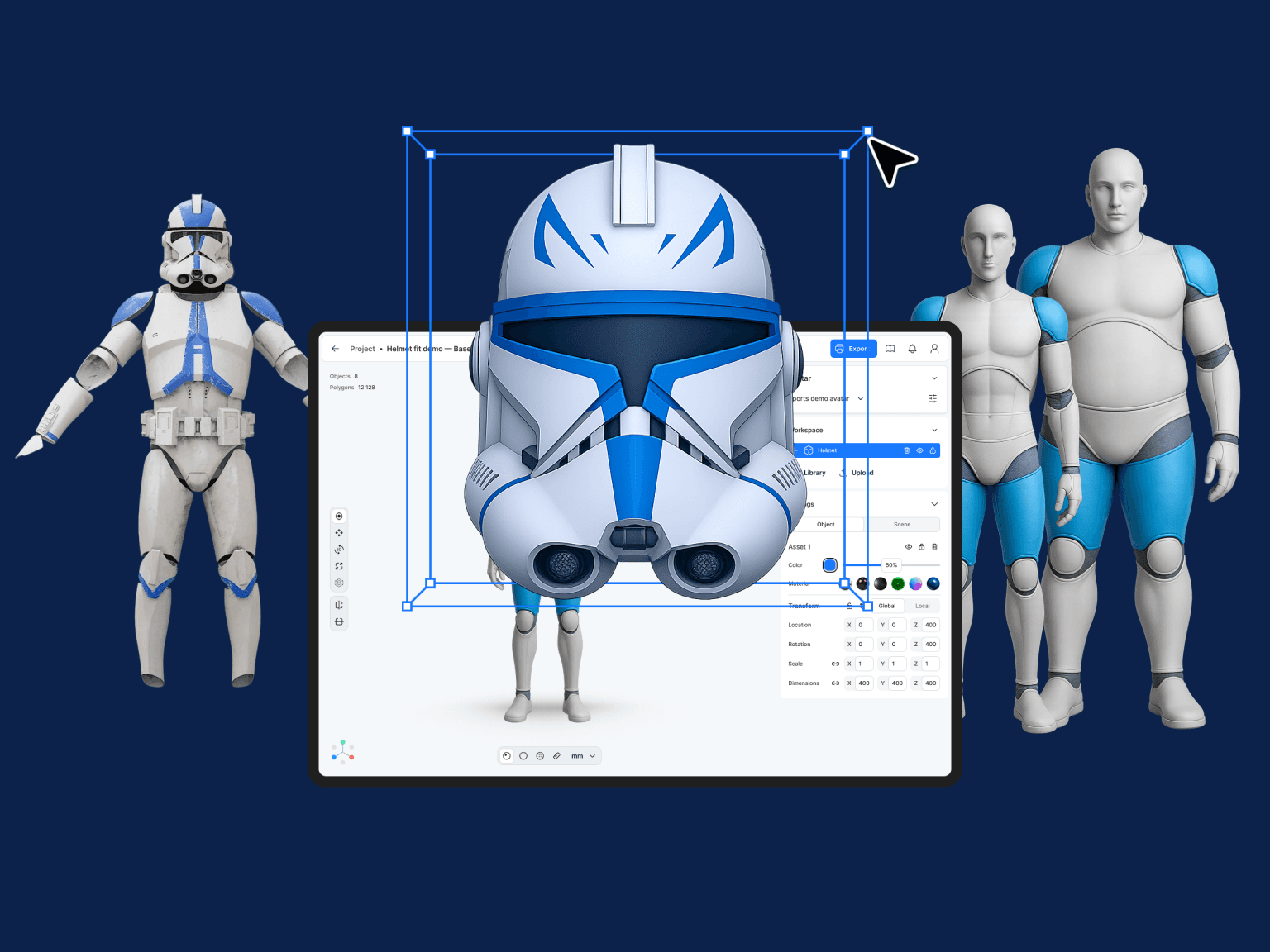
FormFitter, a web-based parametric 3D tool that allows users to customize armor assets to their specific body measurements before 3D printing


USA
High-fidelity cosplay armor STL editor for makers and collectors
B2C cosplay community, 3D printing enthusiasts and makers
3D parametric avatar
Web-based 3D fitting tool
Real-time visual fit adjustment
Print-ready STL export

Petra Palusova
CSO, Digital Tails Group
15 min read
In the modern 3D maker environment, few names carry as much weight as Galactic Armory. Based in the United States, the company has grown into a rooted, community-driven ecosystem with a strong presence across YouTube, Instagram, and Patreon. For a global audience of creators, it has become a go-to source for the digital blueprints needed to bring iconic sci-fi and fantasy armor into the physical world.
The business follows a fast-moving, digital-first B2C model. At its core is a library of high-fidelity 3D assets – STL files that serve as the digital DNA for helmets, gauntlets, and full suits of armor. The offer also includes physical collectibles and finished props, which allows the company to serve both makers and collectors. Some customers prefer to print and assemble the pieces themselves, while others look for a completed product. In both cases, Galactic Armory opens access to high-end cosplay.
Problem: The “trial-and-error” gap
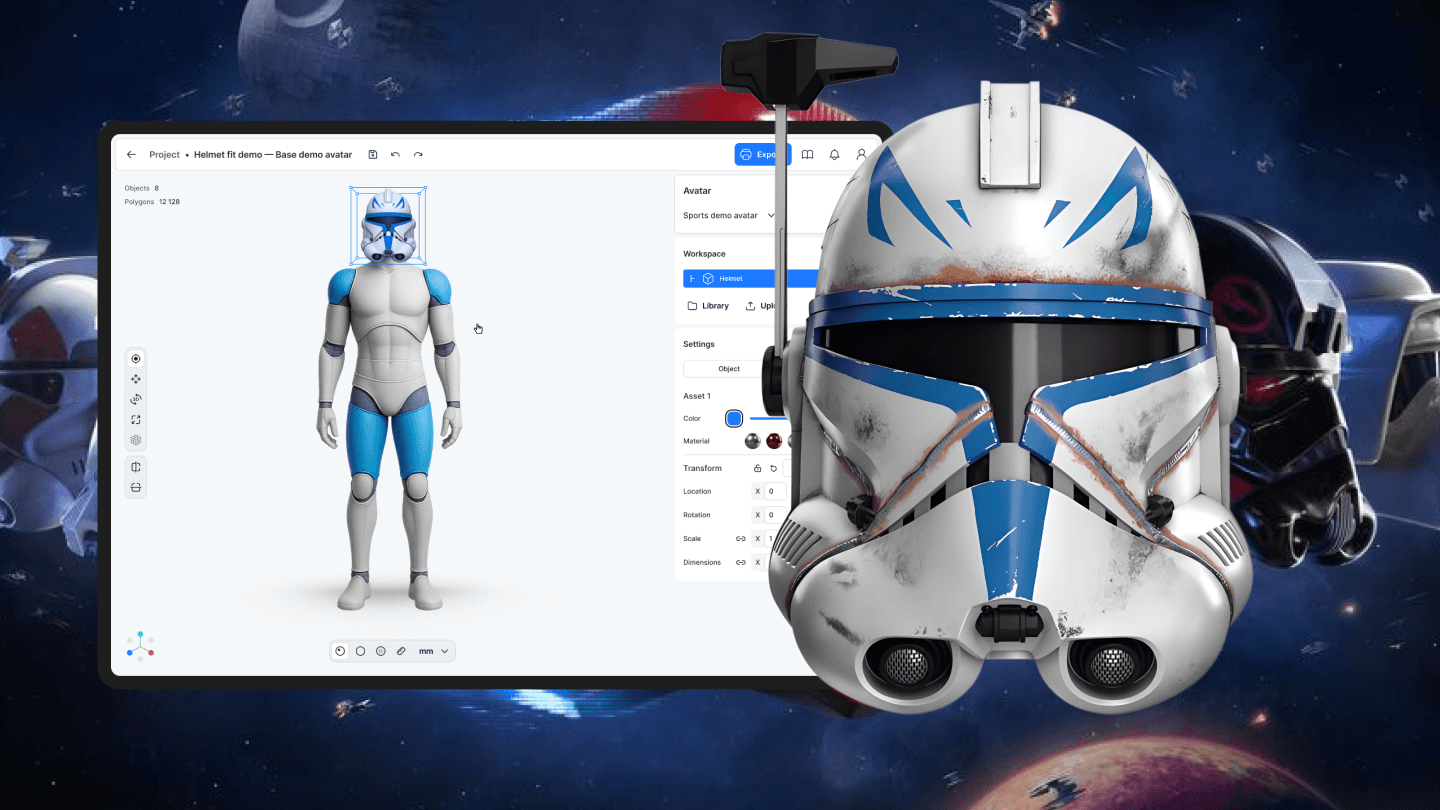
For a long time, the process came with a significant barrier to entry. The challenge went beyond cost and focused on technical skill. A 3D printer alone was not enough – users had to know how to manipulate files, scale models to their own proportions, and work with software that was closer to engineering tools than creative ones, which created a form of gatekeeping. Only the most technically confident or persistent individuals could achieve accurate results, while a large part of the audience stayed on the sidelines, discouraged by a demanding process. Aaron Hughes, CEO of Galactic Armory, recognized this limitation and reached a point where further growth required a simpler path from digital asset to physical fit.
At the same time, there was a deeper issue built into the workflow itself. The idea of a screen-accurate costume met a hard constraint in reality. Every human body is different, while 3D files remain fixed. A digital model can be precise in theory, but it does not adapt to the person who needs to wear it. This mismatch created a persistent trial-and-error gap that shaped the entire experience. The most critical friction point appeared at the very end of the process. A user could spend more than 72 hours on a detailed helmet print, using expensive filament and electricity throughout the process only to find out that the helmet might not pass over the ears, or the chest piece is too tight across the shoulders. At that stage, there is no recovery – time, material, and cost are already lost.
“
Scaling the armor is the hardest part of the entire build. It can take multiple attempts, and each one costs time and material. Right now, people either guess through trial and error or rely on outdated tools.

Aaron Hughes
CEO of Galactic Armory
The adoption of Galactic Armory’s products depended on how far users were willing to go into complex third-party tools, and each new customer had to overcome the same learning curve. Ultimately, the path forward required a different approach: the fit problem had to move from the end of the physical process to the beginning of the digital one.
Solution: FormFitter – a web-based digital tailor
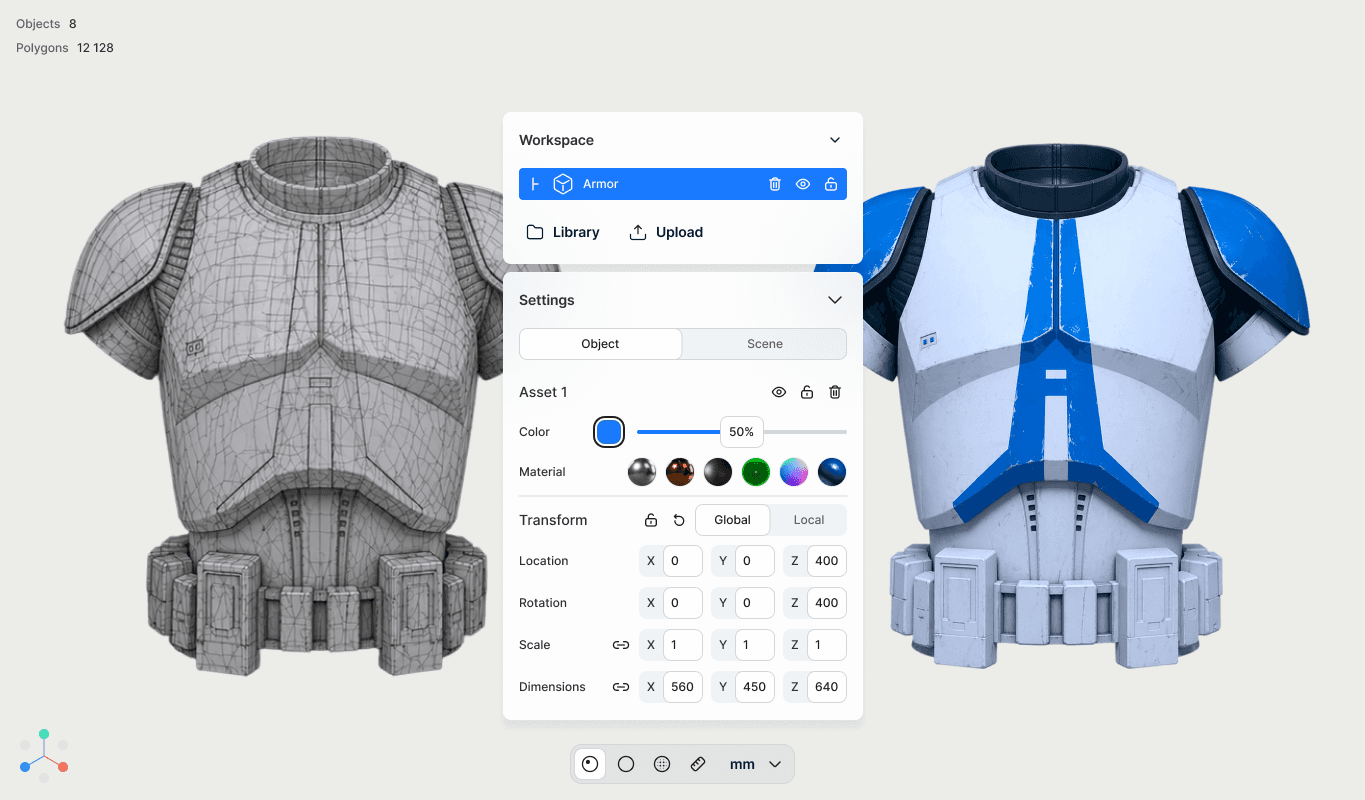
To address the problem, Digital Tails Group developed FormFitter, a custom web-based 3D configuration environment designed to bring the entire fitting process into the browser. The goal was to remove the dependency on complex desktop tools and replace it with a controlled, intuitive system that allows users to move from measurement to print-ready file without leaving a single interface.
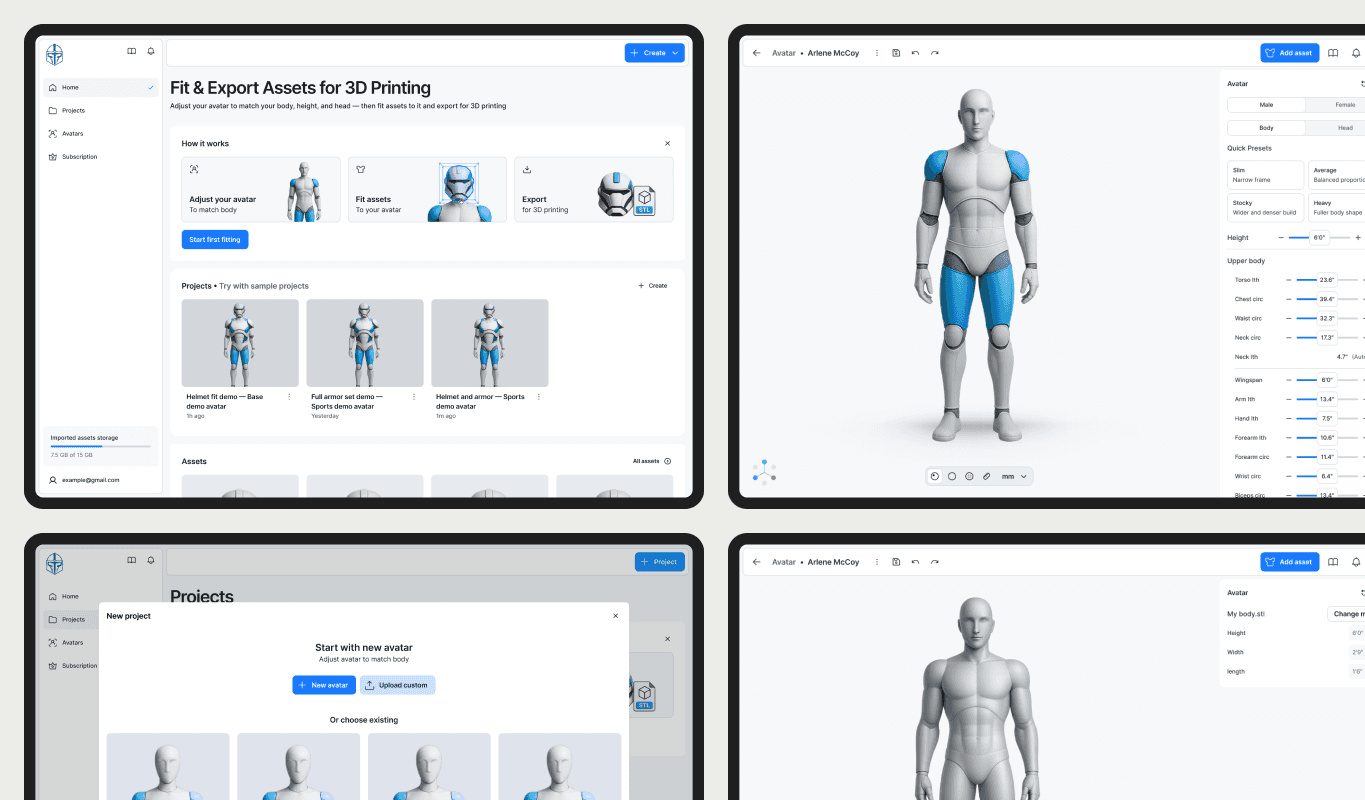
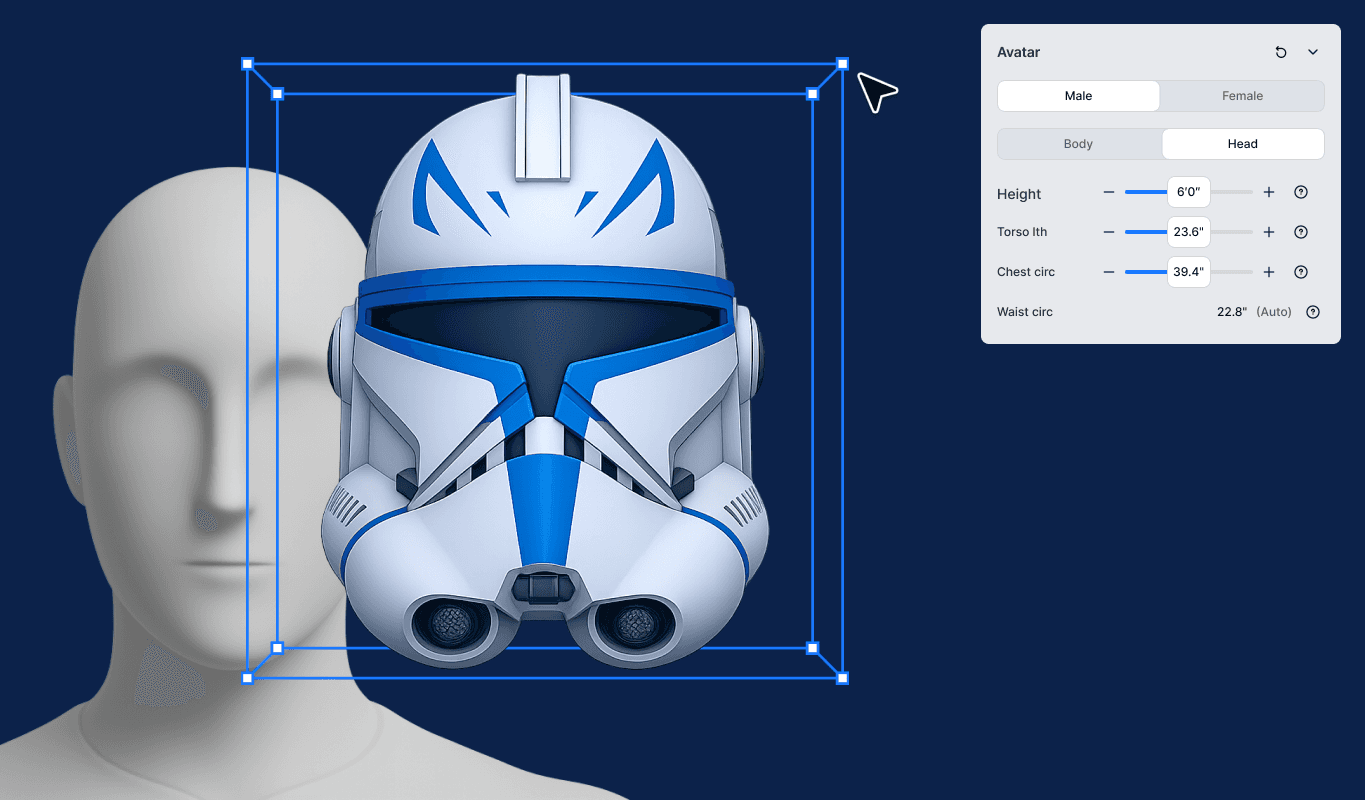
The process begins with a parametric 3D avatar that acts as a digital stand-in for the user. Instead of working with raw geometry, users define their body through a set of structured inputs. Sliders and fields capture real-world measurements such as head width, neck height, torso depth etc. The avatar updates in real time, which creates an accurate baseline for fitting, and establishes a direct connection between physical proportions and digital form. Once the avatar is defined, the system connects to the Galactic Armory asset library. When a user selects a piece of armor, the platform aligns it automatically to the correct anatomical position. The snap-to-body logic removes the need for manual placement and eliminates a common source of error.
“
We replaced complex modeling tools with a 'fitting' mindset. The goal was to make 3D customization feel as intuitive as dressing a character in a video game.

Max Shestakov
Chief Product Officer at Digital Tails Group
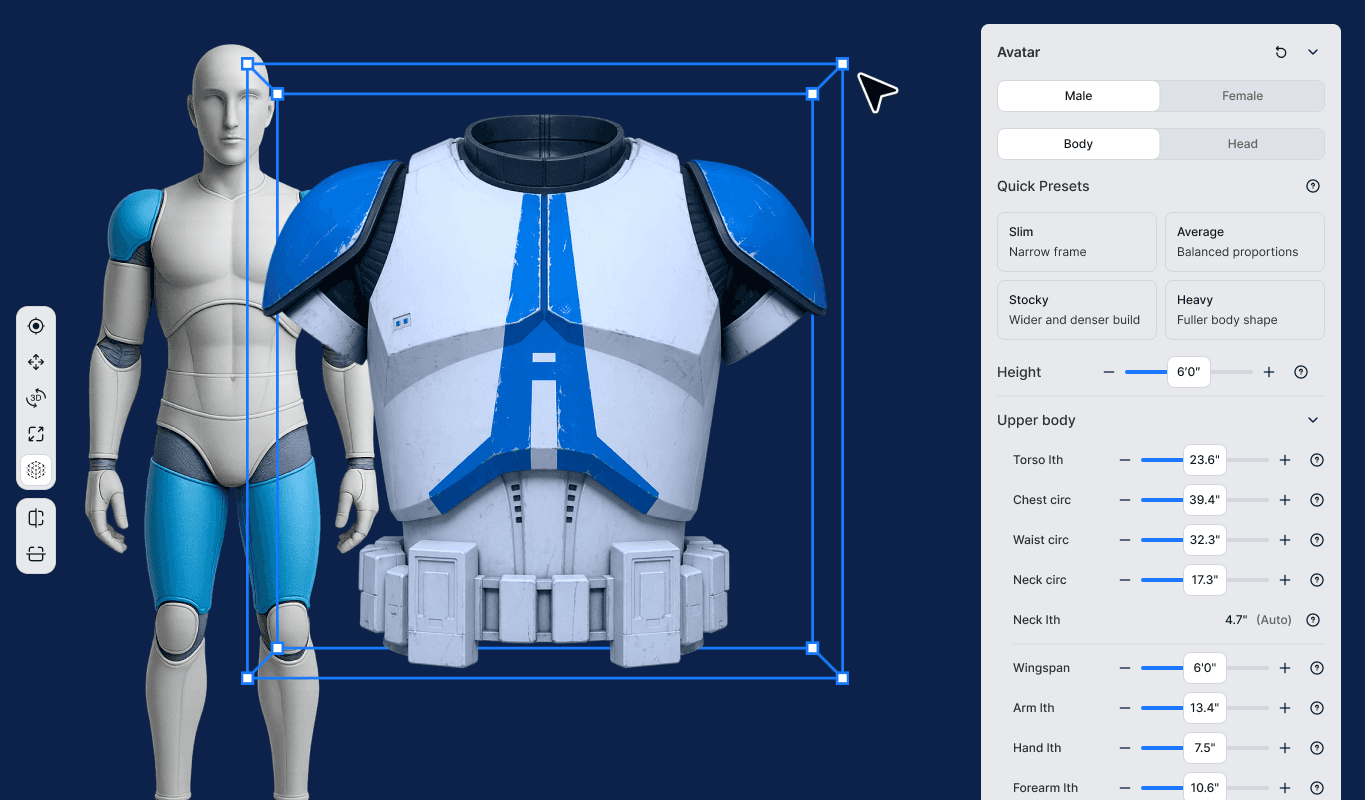
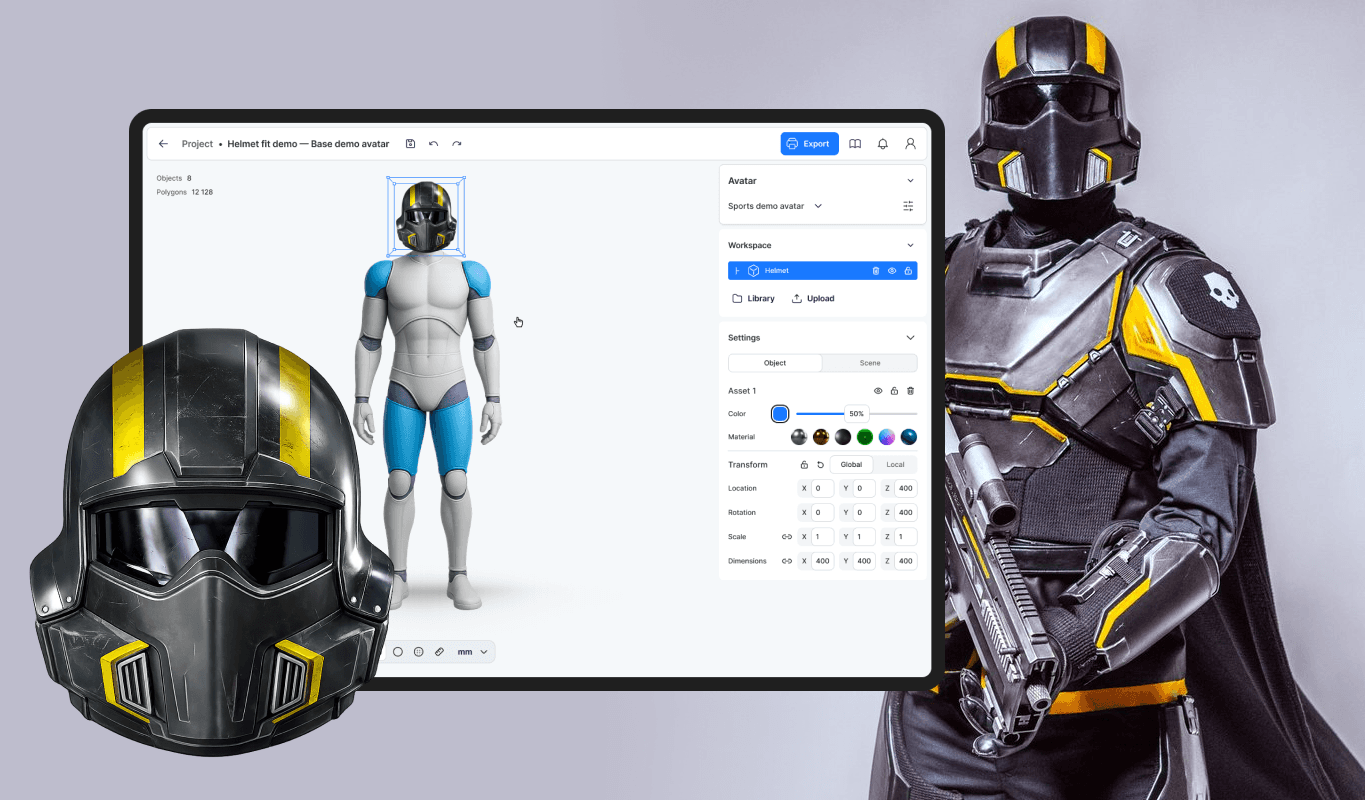
From there, users can refine the fit through direct visual interaction. Adjustments to scale and offset happen in real time and respond immediately on the avatar. If a helmet appears too tight around the temples or too narrow at the jaw, the user can correct it through controls. The process does not require calculations or external tools, and the interface directly translates visual intent into geometric changes. The final step takes place behind the interface. The system calculates required transformations across the X, Y, and Z axes and applies them to the original mesh. Once the user confirms the fit, the platform generates a fully adjusted STL file ready for immediate use in slicing software, and which reflects the exact proportions defined during the session.
FormFitter changes the structure of the entire workflow, with changes appearing across each stage of the user journey:
Business strategy and phased product development
The project follows a multi-stage development that turns FormFitter from into a full ecosystem and a standalone tool. Each phase builds on the previous one, with a shift from acquisition to retention and finally to independence.
Phase 1
Demo
FormFitter is currently launched as a public demo that requires no login or account creation. The goal is instant user value and easy onboarding. The tool functions as a lead magnet and a proof of concept for a broader campaign. It also supports marketing efforts, including the upcoming Kickstarter campaign, by demonstrating that the product already works in practice and reduces perceived risk for potential backers.
Phase 2
The next stage shifts toward ownership of the user relationship and long-term monetization. Galactic Armory currently pays around $10,000 per month in commission fees to third-party platforms such as Patreon. The new platform replaces this dependency with an internal system. Users move into a subscription model where they can create accounts, store body measurements, and save projects. The workflow becomes persistent, and users stay inside a unified ecosystem.
Phase 3
Standalone application
The final stage introduces a standalone application with offline functionality. The goal is to serve advanced users who require stability and independence from browser, supporting uninterrupted work regardless of connectivity and expanding use cases for power users.
Additional challenge
The system must handle heavy 3D workloads in a browser environment. STL files can exceed 1GB, which creates constraints around performance, memory, and loading speed. The platform applies complex geometric transformations in real time while maintaining stability. Cloud storage and processing introduce additional constraints, and each saved profile and project increases storage demand, which requires cost control. The engineering focus stays on balancing performance, scalability, and long-term infrastructure efficiency while maintaining a smooth user experience.
Technical implementation: engineering real-time 3D fitting for the web
Building a professional-grade 3D fitting tool inside a standard web browser required rethinking the traditional 3D workflow. The objective was to preserve manufacturing-level precision while delivering the speed and responsiveness expected from modern web applications. The system had to combine heavy geometric computation with a smooth, interactive user experience.
Our 3D engine focuses on maintaining real-time performance under heavy asset loads. We used advanced optimization techniques to ensure that even detailed armor models remain responsive during interaction, and that the GPU offloading supports continuous manipulation without stuttering or delay.
In the UI/UX layer, we removed technical barriers by reframing the experience around familiarity. Instead of treating the system as a modeling environment, the interface behaves like a character customization screen in a video game. Users adjust fit through visual controls rather than numerical input.
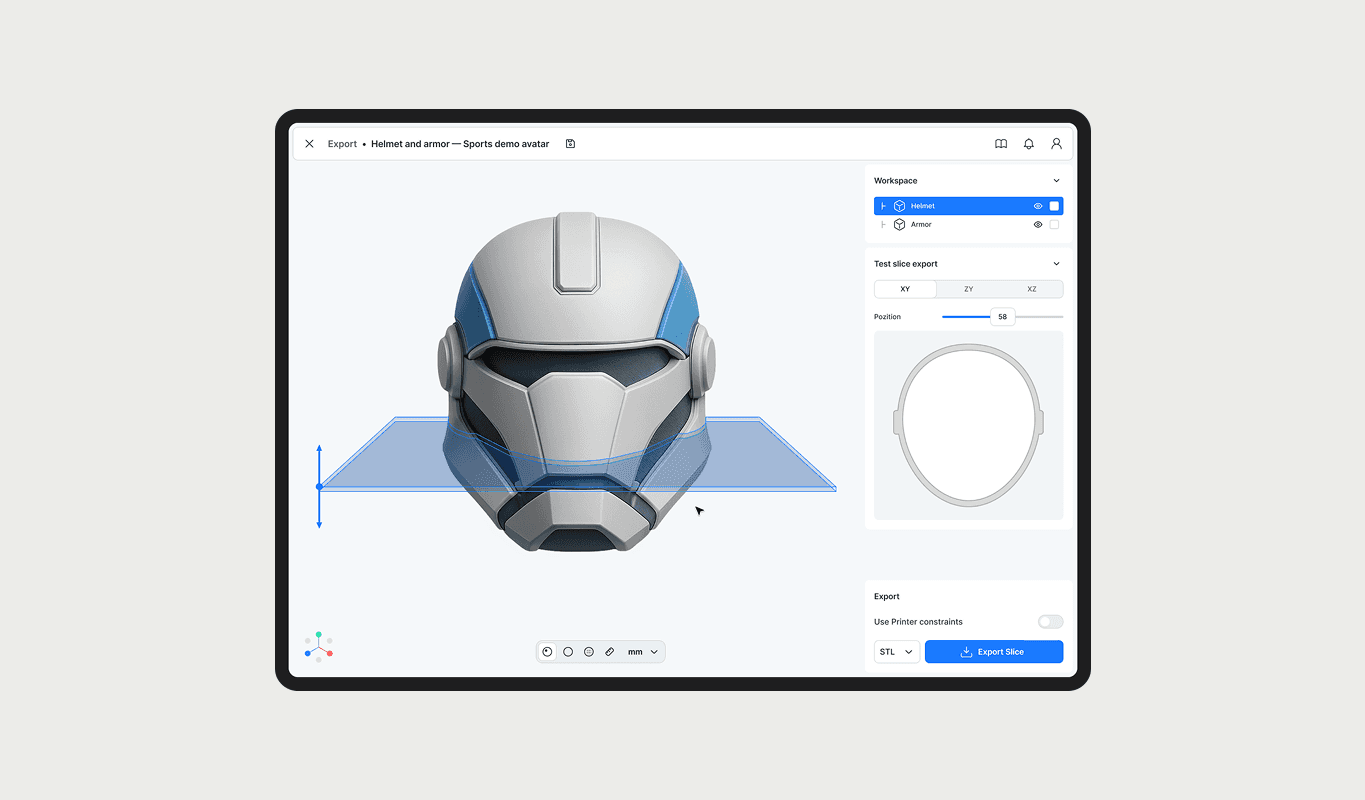
Preparing for the print pipeline, we ensured that every exported file remains structurally valid, and that the system continuously safeguards against non-manifold geometry introduced during scaling or transformation. Before download, the engine performs a final validation step to ensure the mesh is watertight and ready for slicing, which guarantees that the file translates into physical reliability at the point of production.
“
The most challenging part of this application was the avatar. Creating a 3D model that looks great while remaining precise and fully configurable required a deep level of technical refinement.

Victor Safronov
Solutions Architect at Digital Tails Group
Outcome for the client: structural impact and market expansion
For Galactic Armory, the impact of Form Fitter is primarily structural: the workflow that used to depend on user expertise and tolerance for failure is now stabilized at the system level. The result will be a noticeable reduction in abandoned attempts, failed prints, and support friction around sizing and fit. FormFitter also changes the economics of the business. The product becomes accessible to a broader audience without requiring any change in the core content library. Customers who would previously hesitate due to technical complexity now confidently complete the process, which translates into stronger conversion and higher product usability across Galactic Armory’s existing catalog. Dependency on external tools decreases, which gives the company more control over the end-to-end experience.
“
If FormFitter works the way I expect, it has the potential to become the standout scaling software in the space
Aaron Hughes
CEO of Galactic Armory
Operationally, the platform is expected to reduce hidden costs tied to user error and support. Each failed print avoided represents not only saved material on the user side, but also fewer support interactions and less reputational friction around “difficult-to-use” assets. The system will be able to effectively absorb complexity that previously sat with the customer. On a strategic level, Galactic Armory gains a clearer path toward platform independence. The transition away from fragmented tools and external ecosystems strengthens retention and prepares the ground for a subscription-based model with persistent user data and cloud workflows, which positions the company closer to a controlled ecosystem rather than a distributed marketplace presence.
For us at Digital Tails Group, the outcome demonstrates the ability to convert a high-complexity 3D workflow into a consumer-grade digital product without compromising precision. For the client, the result is direct: a larger market, a smoother customer journey, and a product experience that finally matches the scale of their audience.
Next phases

