
A real-time pipeline for physically accurate diamond visualization in interactive 3D configurators

DTG Core Technology
Internal reflection
Multi-bounce light transport
Refraction across facets
Spectral dispersion (“fire”)
Path-length attenuation
Preprocessed facet geometry
Optimized ray–facet intersection model
Unified geometry–shader optical system
Real-time 3D configurator stability
Consistent visual fidelity across variants

Petra Palusova
CSO, Digital Tails Group
15 min read
Rendering a diamond in real-time digital environments is a distinct challenge within computer graphics. Unlike conventional transparent materials, a diamond is defined by the interaction of light within a structured geometry. Its visual appearance comes from a set of optical phenomena: internal reflections, multi-surface refraction, spectral dispersion, and controlled light attenuation. Optical effects do not operate independently. They accumulate across depth and facet boundaries and produce a level of optical complexity that exceeds the assumptions of standard real-time shading models.
In digital commerce and especially luxury product visualization, this problem has direct commercial implications. Jewelry and luxury goods depend heavily on visual credibility. When a digital representation fails to communicate brilliance, depth, and material fidelity, perceived product value declines. Static imagery can partially compensate for this limitation by allowing offline control over lighting and post-processing, though it restricts interaction and scalability. Real-time rendering, by contrast, supports configurability and user engagement, yet traditional pipelines simplify or approximate diamond-specific light transport in ways that reduce realism.
In this case study we introduce a specialized rendering pipeline developed by the Digital Tails Group technical team that was designed to close this gap. Our approach treats the diamond as an integrated optical system in which geometry and light transport are computed in coordination. It’s a combination of structured geometric preprocessing and a physically motivated shader model enabling the simulation of key optical behaviors while maintaining real-time performance constraints.
The problem: Why diamonds break standard rendering
Standard rendering models usually focus on surface appearance. However, diamonds depend on internal light behavior rather than external texture. The challenge is that a standard shader treats a diamond as a generic transparent solid, which strips away its unique optical identity. A “convincing” diamond requires a specialized computational pipeline to simulate specific light physics:
Internal reflections
Light bounces multiple times within the faceted volume
Refraction across facets
Light bends at precise angles as it enters and exits the stone
Dispersion
The stone splits light into spectral colors to create "fire"
Attenuation
Light loses intensity over distance, which provides a sense of depth and density
The use of standard rendering significantly reduces perceived product quality. Without a dedicated optical model, a diamond looks like generic glass or plastic. When the level of visual fidelity fails to communicate the luxury and value of the stone, it directly impacts the brand's ability to showcase high-end products effectively in a digital space.
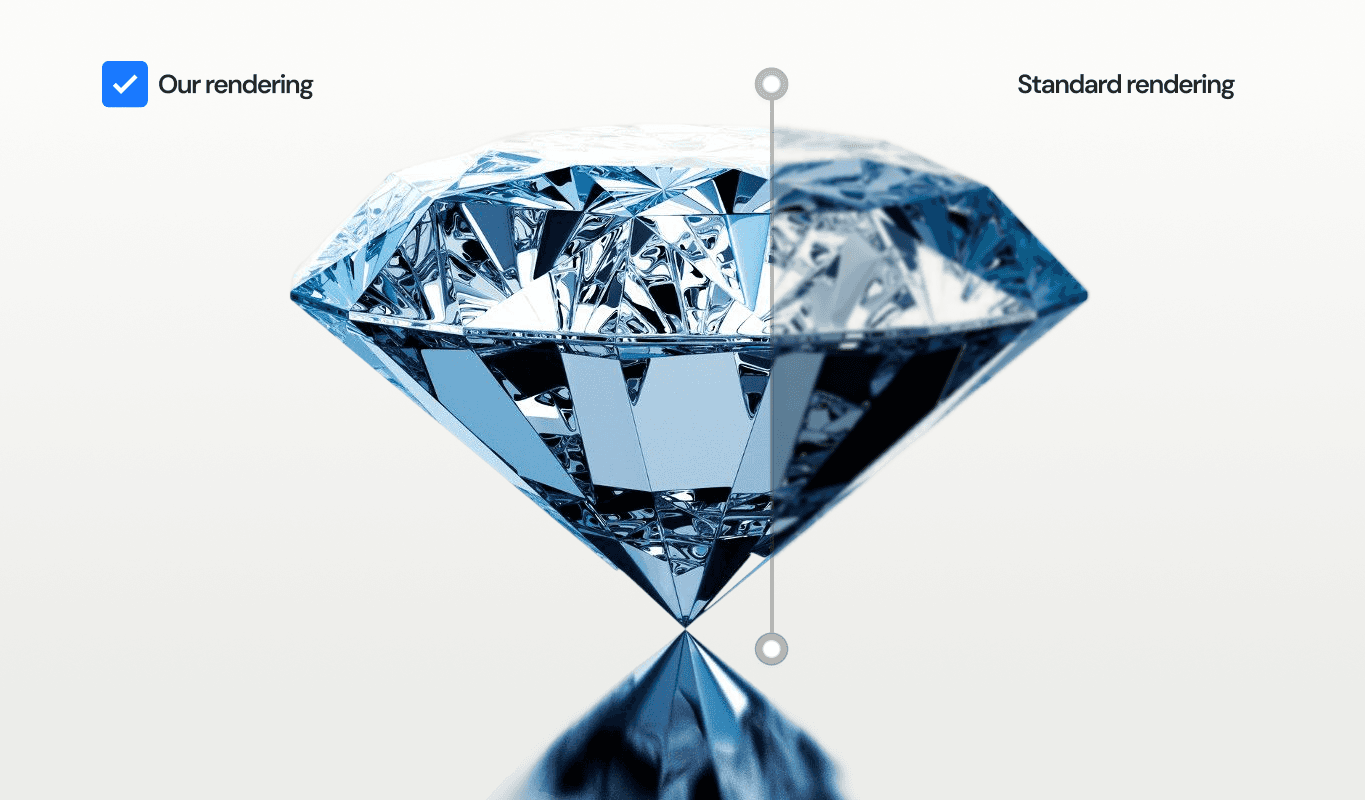
Solution: The Digital Tails Group integrated rendering pipeline
A convincing diamond requires a departure from traditional material-on-mesh workflows. Instead, our solution relies on an integrated rendering pipeline in which the stone’s geometry and the optical model function as a single, unified system. The technical burden therefore shifts away from a simple surface shader and into a specialized computational framework designed for complex internal light transport.
In this pipeline, the diamond’s geometry serves a dual purpose. It functions as a visible hull and as a structured data description of the faceting. The system derives a dedicated computational representation from the raw polygonal form during a foundational preprocessing stage. This step is essential because the renderer must compute internal ray intersections with facets at high speed. Direct evaluation against raw polygonal data increases computational cost beyond what interactive performance can sustain. As a result, geometry and shader operate as a single mechanism rather than separate concerns.

The pipeline minimizes reliance on static texture-driven appearance in favor of dynamic optical simulation. When a viewing ray hits the stone, the system initiates a multi-layered execution path that uses bounded iterative propagation and controlled approximation layers to remain within real-time GPU budgets.:
Data-driven intersections
The shader uses the preprocessed geometric descriptors to estimate the propagation path of light through the internal structure.
Iterative internal propagation
After the initial refraction, the shader determines which facet the ray will interact with next, how its direction changes, and how much energy exits the stone versus how much continues through further reflections.
Multi-channel evaluation
The renderer evaluates light separately across color channels. Because red, green, and blue components do not follow identical paths, the system produces the controlled spectral separation known as dispersion.
Volumetric absorption
The pipeline tracks the distance light travels inside the stone to apply attenuation. This introduces a sense of physical density and depth that uniform transparency cannot replicate.
The result of the architecture is a controlled simulation of diamond-specific light behavior that remains within a strict performance budget. Geometric data design and physically motivated logic work in coupling to reproduce sharp flashes and deep internal highlights in real time. The integrated approach establishes the stone as a distinct optical material with a rich, material-dependent response to light.
"
The goal was to treat the diamond not as a surface object, but as an optical system governed by internal light behavior. Real-time rendering only works when geometry and light transport operate as a single computational process rather than separate layers.

Sergei Svistunov
CTO at Digital Tails Group
Geometry preprocessing as foundation
The efficiency of the diamond pipeline depends entirely on the initial geometry preprocessing stage. In this phase, the system treats the source mesh as a database of faceting data rather than a visual surface. Standard mesh formats are often too heavy or unorganized for the thousands of rapid-fire calculations required for internal light transport. The raw polygonal hull is transformed into a specialized internal representation, which establishes the necessary framework for complex optical simulation.
The preprocessing engine analyzes the stone's geometry to derive a dedicated computational model. This model serves as a high-speed reference for the shader during execution.

Finding where a ray of light hits a facet inside a volume is one of the most computationally expensive tasks in rendering. If the shader attempts to test every ray against every raw polygon in real time, the frame rate will collapse. Preprocessing solves this by:
Spatial optimization
The system organizes facet data so the shader only tests relevant surfaces
Intersection stability
The refined representation prevents "light leaks" or artifacts where rays might miss a facet edge
Reduced overhead
By stripping away unnecessary mesh metadata, the shader focuses exclusively on the math of the light path
Internal light simulation - the shader logic
The core of the rendering solution resides in the shader logic, which moves beyond color mapping to execute a dynamic simulation for every pixel. Unlike standard shaders that stop at the surface, this system treats the stone as a navigable 3D volume. The shader must calculate the trajectory of light with extreme precision to ensure that the resulting brilliance feels reactive and physically grounded.
The shader treats each pixel as an individual observer. It initiates a complex sequence of calculations to determine how much light reaches that specific point on the screen after traveling through the diamond’s internal structure.

Phase 1 - Ray construction
Per-pixel view ray generation
The shader calculates a unique viewing ray for every pixel based on the camera position and the stone’s world-space coordinates
Phase 2 - Initial refraction
Snell’s law implementation
At the point of entry, the system determines the initial bend of the ray based on the diamond's high refractive index
Phase 3 - Iterative propagation
Iterative ray-tracing
The shader enters a loop, iteratively tracking the ray as it moves from facet to facet using the preprocessed geometric data
Phase 4 - Energy distribution
Fresnel and conservation logic
At every intersection, the system calculates how much energy exits the stone (refraction) versus how much stays inside (reflection)
Interaction with facets: The math of brilliance

"
We built the shader as a simulation layer rather than a visual effect layer, where pixels behave like a light path inside a physical object. The challenge was to stabilize multi-bounce internal reflection under real-time performance constraints.
Sergei Svistunov
CTO at Digital Tails Group
Visual result: Highlights and internal depth
This iterative approach produces two defining visual characteristics:
Sharp highlights: By tracking light through multiple reflections, the shader produces high-frequency "flashes" or sparkles. These are not textures, but the result of concentrated light paths exiting the stone.
Internal depth: The combination of internal propagation and energy loss (attenuation) creates a sense of volume. The viewer perceives light as coming from within the stone, which differentiates the material from the flat, shallow look of generic glass.
Key outcome: Scintillation and fire
The final result is a stone that feels "alive." As the viewer or the light source moves, the internal ray paths update at the speed of the GPU. This produces a dynamic optical response where highlights appear and disappear with the precision of a real diamond. This ensures that the digital representation maintains the high-end visual fidelity required for luxury retail environments.
Optical accuracy layers
To achieve physical realism, the shader applies three distinct layers of optical logic. These layers ensure the stone reacts to light with the same complexity as a natural gemstone.
Dispersion
The system achieves "fire" by treating light as a spectrum rather than a single color. The renderer calculates light paths separately for red, green, and blue wavelengths. Because each color channel refracts at a slightly different angle, the light splits as it traverses the facets. Each channel produces the spectral color effects and rainbow-colored flashes characteristic of high-quality diamonds.
Absorption
Light loses energy as it travels through any medium, and the shader simulates this through path-length-based attenuation. The system tracks the total distance a ray travels inside the volume; the longer the path, the more the light contribution diminishes. This provides a critical sense of depth and density, revealing the internal structure and preventing the stone from looking like a hollow shell.
Fresnel balance
The distribution of energy between the exterior and interior depends entirely on the observer's perspective. The system uses Fresnel equations to manage the relation between surface reflection and internal refraction. This viewing-angle dependency ensures that at grazing angles, the surface becomes more mirror-like, while at direct angles, the viewer sees deeper into the stone. This balance allows the diamond to maintain sharp edge definition while preserving its signature internal brilliance.
Commercial use and business value
The commercial value of a diamond rendering pipeline reaches beyond its technical structure. In luxury retail, the gap between simplified digital models and physically grounded approximations of gemstones directly shapes purchase confidence. When that gap narrows, perceived value rises, trust strengthens, and the product holds a clearer premium position. Brilliance, fire, and depth appear as defining qualities rather than approximations.
This shift also changes how jewelry is presented and understood. A diamond no longer depends on static image sets as the model allows rotation, close inspection, and changes in lighting conditions in real time. The experience becomes more immediate and controlled, with the viewer guiding the interaction instead of selecting from predefined views. The system also supports scale across entire inventories. It applies the same rendering logic to both entry-level pieces and high jewelry, while preserving visual fidelity. Each asset retains its specific optical character, even within a consistent framework.
Purchase confidence
Perceived value
Premium positioning
Physical accuracy
Scalable consistency
Real-time interaction
Application in 3D configurators
The strongest value of the system emerges in real-time configurator environments. Jewelry configurators depend on instant visual feedback to support high-consideration purchasing decisions, where the changes in stone, setting, or material must remain visually coherent and credible. Within this context, the pipeline enables:
Real-time stone replacement
Seamless visual continuity
Accurate light behavior across variants
Stable optical behavior during customization
Consistent reflections and dispersion
Physically grounded appearance
Trust-driven configuration
Reduced purchase uncertainty
Higher conversion potential
Business outcome
The result is a closer alignment between digital presentation and physical reality. The visual output carries the same credibility as the object itself, which shifts how value comes across.

The product is understood through direct observation, and that clarity reduces hesitation, supports faster decisions, and sustains a premium perception. At a business level, this leads to stronger conversion rates, shorter sales cycles, and fewer drop-offs driven by uncertainty. The interaction becomes more stable and predictable, with each step reinforcing confidence in the selection.
Over time, the digital environment functions as a dependable sales channel. It enables scale while maintaining visual precision and preserves brand value as the business grows.
Contact us
We are here to help
Interested in using this technology in your luxury business?